
2006 AMC 10A Problems
25 problems · 75 minutes
Scroll down and press Start to try the exam! Or, go to the printable PDF, answer key, or professional solutions curated by LIVE by Po-Shen Loh.
Or jump straight to a single problem with its solution: 1 · 2 · 3 · 4 · 5 · 6 · 7 · 8 · 9 · 10 · 11 · 12 · 13 · 14 · 15 · 16 · 17 · 18 · 19 · 20 · 21 · 22 · 23 · 24 · 25
All problems are used with official legal permission of the Mathematical Association of America (MAA).
Want to learn professionally through interactive video classes?
Learn LIVETimed
1:15:00
1.
Sandwiches at Joe’s Fast Food cost each and sodas cost each. How many dollars will it cost to purchase sandwiches and sodas?
Answer: A
Small hint:
Find the sandwich total and the soda total separately
Big hint:
Compute
Solution:
Five sandwiches cost dollars and eight sodas cost dollars. Together they cost dollars.
Thus, the correct answer is A.
2.
Define What is
Answer: C
Small hint:
First evaluate the inner
Big hint:
then apply the operation again
Solution:
The inner operation gives Then
Thus, the correct answer is C.
3.
The ratio of Mary’s age to Alice’s age is Alice is years old. How many years old is Mary?
Answer: B
Small hint:
Mary’s age is of Alice’s age
Big hint:
Compute
Solution:
Since the ratio is and Alice is Mary is years old.
Thus, the correct answer is B.
4.
A digital watch displays hours and minutes with am and pm. What is the largest possible sum of the digits in the display?
Answer: E
Small hint:
The display uses a -hour clock, so the hour is through
Big hint:
Maximize the minutes’ digit sum and the hour’s digit sum separately
Solution:
The minutes run from to so the largest digit sum for the minutes is at minutes.
For the hour, the single digit beats from The largest total is occurring at
Thus, the correct answer is E.
5.
Doug and Dave shared a pizza with equally-sized slices. Doug wanted a plain pizza, but Dave wanted anchovies on half of the pizza. The cost of a plain pizza was and there was an additional cost of for putting anchovies on one half. Dave ate all the slices of anchovy pizza and one plain slice. Doug ate the remainder. Each then paid for what he had eaten. How many more dollars did Dave pay than Doug?
Small hint:
A plain pizza costs for slices, so each slice is
Big hint:
Dave also pays the full for the anchovies on top of his five slices
Solution:
Each of the slices costs Dave ate slices and also pays the extra for the anchovies, for a total of dollars.
Doug ate slices, paying dollars. So Dave paid dollars more.
Thus, the correct answer is D.
6.
What non-zero real value for satisfies
Answer: B
Small hint:
Take the seventh root of both sides
Big hint:
then divide by
Solution:
Taking the seventh root of both sides gives so Since divide by to get hence
Thus, the correct answer is B.
7.
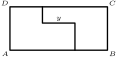
The rectangle is cut into two congruent hexagons, as shown, in such a way that the two hexagons can be repositioned without overlap to form a square. What is
Answer: A
Small hint:
The two hexagons form a square with the same area as the rectangle
Big hint:
The rectangle has area so the square has side
Solution:
The rectangle’s area is so the square formed has side
Let and be the upper and lower endpoints of the stair-step cut. For the two congruent pieces to fit into a square, the three horizontal segments the middle segment of length and must be equal. Together they span the rectangle’s width, so gives and Indeed, the resulting square has side agreeing with the area calculation.
Thus, the correct answer is A.
8.
A parabola with equation passes through the points and What is
Answer: E
Small hint:
The two points have the same -value, so they are symmetric about the vertex
Big hint:
The axis of symmetry is giving
Solution:
Substituting the points gives and Subtracting yields so
Then
Thus, the correct answer is E.
9.
How many sets of two or more consecutive positive integers have a sum of
Answer: C
Small hint:
The sum of consecutive integers is times the middle value
Big hint:
Check
Solution:
The sum of consecutive integers equals times their median. For a sum of : gives gives and gives
No set of works (their sum is even), and or more consecutive positive integers already exceed There are such sets.
Thus, the correct answer is C.
10.
For how many real values of is an integer?
Answer: E
Small hint:
Let and bound
Big hint:
is an integer with
Solution:
Let Since we need so giving values.
Each yields and since is positive and strictly decreasing, the resulting values are distinct.
Thus, the correct answer is E.
11.
Which of the following describes the graph of the equation
the empty set
one point
two lines
a circle
the entire plane
Answer: C
Small hint:
Expand and simplify
Big hint:
The equation reduces to
Solution:
Expanding, which reduces to i.e.
This holds exactly when or the two coordinate axes, so the graph is two lines.
Thus, the correct answer is C.
12.
Rolly wishes to secure his dog with an -foot rope to a square shed that is feet on each side. His preliminary drawings are shown.
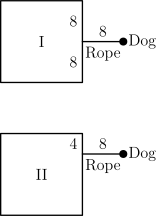
Which of these arrangements gives the dog the greater area to roam, and by how many square feet?
by
by
by
by
by
Answer: C
Small hint:
In each case the dog sweeps a half-disk of radius on the open side
Big hint:
In arrangement II the rope also wraps around the near corner
Solution:
In arrangement I the dog is tied at the middle of a side and sweeps a half-disk of radius : area The rope reaches exactly to the corners, so nothing wraps.
In arrangement II the dog is tied feet from a corner. It sweeps the same half-disk, and after the rope reaches the corner, feet remain to sweep a quarter-disk of radius :
So II gives exceeding I by
Thus, the correct answer is C.
13.
A player pays to play a game. A die is rolled. If the number on the die is odd, the game is lost. If the number on the die is even, the die is rolled again. In this case the player wins if the second number matches the first and loses otherwise. How much should the player win if the game is fair? (In a fair game the probability of winning times the amount won is what the player should pay.)
Answer: D
Small hint:
Find the probability of winning: an even roll, then a matching roll
Big hint:
The win probability is set (probability)(prize) equal to
Solution:
The player wins only if the first roll is even (probability ) and the second roll matches it (probability ), so the win probability is
For a fair game, so
Thus, the correct answer is D.
14.
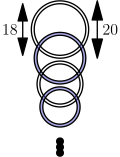
A number of linked rings, each cm thick, are hanging on a peg. The top ring has an outside diameter of cm. The outside diameter of each of the other rings is cm less than that of the ring above it. The bottom ring has an outside diameter of cm. What is the distance, in cm, from the top of the top ring to the bottom of the bottom ring?
Answer: B
Small hint:
The exposed part of each lower ring is its outside diameter minus the cm of overlap with the ring above
Big hint:
Add to
Solution:
The top ring contributes its full outside diameter, cm. Because the rings are cm thick, each ring hangs cm below the top of the ring above it, so each lower ring adds its outside diameter minus
The outside diameters run so the added distances are The total is
Thus, the correct answer is B.
15.
Odell and Kershaw run for minutes on a circular track. Odell runs clockwise at m/min and uses the inner lane with a radius of meters. Kershaw runs counterclockwise at m/min and uses the outer lane with a radius of meters, starting on the same radial line as Odell. How many times after the start do they pass each other?
Answer: D
Small hint:
Compute each runner’s time for one lap; they turn out equal
Big hint:
Running in opposite directions, they meet twice per lap; count how many laps fit in minutes
Solution:
Odell’s lap is m at m/min, taking min. Kershaw’s lap is m at m/min, also min.
Their periods are equal. Running in opposite directions, they meet at times for Requiring gives so they pass times.
Thus, the correct answer is D.
16.
A circle of radius is tangent to a circle of radius The sides of are tangent to the circles as shown, and the sides and are congruent. What is the area of

Answer: D
Small hint:
Let and be the centers; the right triangles cut off along are similar
Big hint:
The centers lie and from and the base is below
Solution:
Let be the centers of the small and large circles, and let be the point where the small circle touches The right triangles cut off along are similar, so giving and
The tangent length is Let be the midpoint of ; then
Since we get Thus and the area is
Thus, the correct answer is D.
17.
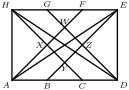
In rectangle points and trisect and points and trisect In addition, What is the area of quadrilateral shown in the figure?
Answer: A
Small hint:
Assign coordinates using and
Big hint:
is a square; find its diagonals
Solution:
Set so and
The drawn segments meet at and These form a square whose perpendicular diagonals and each have length
Its area is
Thus, the correct answer is A.
18.
A license plate in a certain state consists of digits, not necessarily distinct, and letters, also not necessarily distinct. These six characters may appear in any order, except that the two letters must appear next to each other. How many distinct license plates are possible?
Answer: C
Small hint:
Glue the two letters into a single block that moves as a unit
Big hint:
Count digit choices, letter choices, and positions for the block
Solution:
Since the two letters must be adjacent, treat them as one block. A plate is then digits plus this block— objects—and the block can occupy positions.
There are choices for the digits and for the two letters, so the total is
Thus, the correct answer is C.
19.
How many non-similar triangles have angles whose degree measures are distinct positive integers in arithmetic progression?
Answer: C
Small hint:
If the angles are in arithmetic progression, the middle angle is
Big hint:
The common difference satisfies
Solution:
Let the angles be Their sum is so
The measures are distinct positive integers, so and forces Thus giving non-similar triangles.
Thus, the correct answer is C.
20.
Six distinct positive integers are randomly chosen between and inclusive. What is the probability that some pair of these integers has a difference that is a multiple of
Answer: E
Small hint:
Consider the remainders when the integers are divided by
Big hint:
There are only possible remainders for integers
Solution:
Group the integers by their remainder modulo There are only possible remainders but integers, so by the Pigeonhole Principle two share a remainder.
Their difference is then a multiple of This always happens, so the probability is
Thus, the correct answer is E.
21.
How many four-digit positive integers have at least one digit that is a or a
Answer: E
Small hint:
Count the complement: four-digit numbers with no and no
Big hint:
The leading digit has choices; each other digit has
Solution:
There are four-digit integers. For those avoiding and the leading digit is one of ( choices) and each remaining digit is one of ( choices):
So have at least one or
Thus, the correct answer is E.
22.
Two farmers agree that pigs are worth and that goats are worth When one farmer owes the other money, he pays the debt in pigs or goats, with “change” received in the form of goats or pigs as necessary. (For example, a debt could be paid with two pigs, with one goat received in change.) What is the amount of the smallest positive debt that can be resolved in this way?
Answer: C
Small hint:
A resolvable debt is for integers (possibly negative)
Big hint:
This equals and
Solution:
A resolvable debt is for integers where a negative value means change received. Since and the value can be any integer, so is any multiple of
The smallest positive one is achieved by (give goats, receive pigs).
Thus, the correct answer is C.
23.
Circles with centers and have radii and respectively. A common internal tangent touches the circles at and as shown. Lines and intersect at and What is
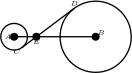
Answer: B
Small hint:
Radii and are perpendicular to the tangent
Big hint:
; first find
Solution:
Since we have
Because so
Then
Thus, the correct answer is B.
24.
Centers of adjacent faces of a unit cube are joined to form a regular octahedron. What is the volume of this octahedron?
Answer: B
Small hint:
The octahedron is two square pyramids glued at their bases
Big hint:
Adjacent face-centers are apart; find the base area and height
Solution:
The six face centers form a regular octahedron, viewed as two congruent square pyramids sharing a base. Adjacent face centers are apart, so the square base has area
Each pyramid has height so its volume is The octahedron has volume
Thus, the correct answer is B.
25.
A bug starts at one vertex of a cube and moves along the edges of the cube according to the following rule. At each vertex the bug will choose to travel along one of the three edges emanating from that vertex. Each edge has equal probability of being chosen, and all choices are independent. What is the probability that after seven moves the bug will have visited every vertex exactly once?
Answer: C
Small hint:
The bug must trace a path visiting all vertices, i.e. moves with no repeated vertices
Big hint:
Count such paths from the start; there are equally likely walks
Solution:
After moves there are equally likely walks. A successful walk visits every vertex exactly once.
Label the cube’s vertices by binary triples, with adjacent vertices differing in one coordinate. There are choices for the first move and for the second move if the bug is not to return to its starting point. By symmetry, fix these first moves as
The successful continuations are exactly and Thus each allowed pair of first moves has successful continuations, giving successful walks.
The probability is
Thus, the correct answer is C.