
2008 AMC 10B Problems
25 problems · 75 minutes
Scroll down and press Start to try the exam! Or, go to the printable PDF, answer key, or professional solutions curated by LIVE by Po-Shen Loh.
Or jump straight to a single problem with its solution: 1 · 2 · 3 · 4 · 5 · 6 · 7 · 8 · 9 · 10 · 11 · 12 · 13 · 14 · 15 · 16 · 17 · 18 · 19 · 20 · 21 · 22 · 23 · 24 · 25
All problems are used with official legal permission of the Mathematical Association of America (MAA).
Want to learn professionally through interactive video classes?
Learn LIVETimed
1:15:00
1.
A basketball player made baskets during a game. Each basket was worth either or points. How many different numbers could represent the total points scored by the player?
Answer: E
Small hint:
If baskets are worth points, the total is
Big hint:
As runs from to , the total increases by each time
Solution:
If of the baskets are worth points and the rest worth the total is
As ranges over the total takes every integer value from to giving possibilities.
Thus, the correct answer is E.
2.
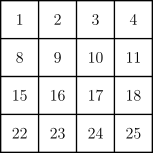
A block of calendar dates is shown. The order of the numbers in the second row is to be reversed. Then the order of the numbers in the fourth row is to be reversed. Finally, the numbers on each diagonal are to be added. What will be the positive difference between the two diagonal sums?
Answer: B
Small hint:
After reversing rows and write out the new grid
Big hint:
The main diagonal reads and the other reads
Solution:
After reversing the second row to and the fourth row to the two diagonals are and
Their sums are and so the positive difference is
Thus, the correct answer is B.
3.
4.
A semipro baseball league has teams with players each. League rules state that a player must be paid at least and that the total of all players’ salaries for each team cannot exceed What is the maximum possible salary, in dollars, for a single player?
Answer: C
Small hint:
To maximize one salary, pay everyone else as little as allowed
Big hint:
The other players each earn
Solution:
One player’s salary is largest when the other players each earn the minimum
That leaves for the single player.
Thus, the correct answer is C.
5.
For real numbers and define What is
Answer: A
Small hint:
Compare and
Big hint:
Once you know the two inputs agree, apply the definition of
Solution:
Since the two inputs are identical.
Therefore
Thus, the correct answer is A.
6.
Points and lie on The length of is times the length of and the length of is times the length of The length of is what fraction of the length of
Answer: C
Small hint:
From and find as a fraction of
Big hint:
Similarly and
Solution:
Since and we get so
Since and we get so
Then
Thus, the correct answer is C.
7.
An equilateral triangle of side length is completely filled in by non-overlapping equilateral triangles of side length How many small triangles are required?
Answer: C
Small hint:
Area scales with the square of the side length
Big hint:
The big triangle has times the area of a small one
Solution:
The large triangle has side length times that of a small triangle, so its area is times as large.
Since the small triangles tile it without overlap, exactly of them are required.
Thus, the correct answer is C.
8.
A class collects to buy flowers for a classmate who is in the hospital. Roses cost each, and carnations cost each. No other flowers are to be used. How many different bouquets could be purchased for exactly
Answer: C
Small hint:
Let be the number of roses; then
Big hint:
Since is even and is even, must be even, and
Solution:
If roses and carnations are bought, then Because and are even, must be even, so is even.
Also so The even values each give a valid which is bouquets.
Thus, the correct answer is C.
9.
A quadratic equation has two real solutions. What is the average of the solutions?
Answer: A
Small hint:
For the sum of the roots is
Big hint:
The average is half the sum of the roots
Solution:
By Vieta’s formulas, the sum of the roots of is
The average is half of this, namely
Thus, the correct answer is A.
10.
Points and are on a circle of radius and Point is the midpoint of the minor arc What is the length of the line segment
Answer: A
Small hint:
The line from the center through perpendicularly bisects chord
Big hint:
Find the center-to-chord distance, subtract from to reach then use the right triangle with leg
Solution:
Let be the center and the midpoint of Then with so
Since is the midpoint of the minor arc, are collinear and
Then
Thus, the correct answer is A.
11.
Suppose that is a sequence of real numbers satisfying and that and What is
Answer: B
Small hint:
Write and in terms of and
Big hint:
and so
Solution:
Using the recurrence, and
Setting gives so
Thus, the correct answer is B.
12.
Postman Pete has a pedometer to count his steps. The pedometer records up to steps, then flips over to on the next step. Pete plans to determine his mileage for a year. On January Pete sets the pedometer to During the year, the pedometer flips from to forty-four times. On December the pedometer reads Pete takes steps per mile. Which of the following is closest to the number of miles Pete walked during the year?
Answer: A
Small hint:
Each flip represents steps
Big hint:
Total steps are then divide by
Solution:
Each flip counts steps, so Pete took steps.
Dividing by gives about miles, which is closest to
Thus, the correct answer is A.
13.
For each positive integer the mean of the first terms of a sequence is What is the th term of the sequence?
Answer: B
Small hint:
The sum of the first terms is
Big hint:
The th term is
Solution:
Since the mean of the first terms is their sum is
The th term is so the th term is
Thus, the correct answer is B.
14.
Triangle has and in the first quadrant. In addition, and Suppose that is rotated counterclockwise about What are the coordinates of the image of
Answer: B
Small hint:
Find first: since the right angle is at
Big hint:
A counterclockwise rotation sends to
Solution:
Because segment is vertical, so
A counterclockwise rotation about the origin sends to so the image of is
Thus, the correct answer is B.
15.
How many right triangles have integer leg lengths and and a hypotenuse of length where
Answer: A
Small hint:
Set and simplify
Big hint:
This gives so is an odd perfect square with
Solution:
From we get so is odd and is an odd perfect square.
Since we need and for The odd squares give which is triangles.
Thus, the correct answer is A.
16.
Two fair coins are to be tossed once. For each head that results, one fair die is to be rolled. What is the probability that the sum of the die rolls is odd? (Note that if no die is rolled, the sum is )
Answer: A
Small hint:
If at least one die is rolled, the sum is odd exactly half the time
Big hint:
Subtract the probability of rolling no dice (both coins tails), then take half of the rest
Solution:
Whenever at least one die is rolled, by symmetry the sum is odd with probability
No die is rolled only when both coins are tails, with probability that sum is even. So the answer is
Thus, the correct answer is A.
17.
A poll shows that of all voters approve of the mayor’s work. On three separate occasions a pollster selects a voter at random. What is the probability that on exactly one of these three occasions the voter approves of the mayor’s work?
Answer: B
Small hint:
Exactly one approval can happen in ordered ways
Big hint:
Each such arrangement has probability
Solution:
Exactly one approval among three occasions arises in ways, each with probability
The total is
Thus, the correct answer is B.
18.
Bricklayer Brenda would take hours to build a chimney alone, and bricklayer Brandon would take hours to build it alone. When they work together, they talk a lot, and their combined output is decreased by bricks per hour. Working together, they build the chimney in hours. How many bricks are in the chimney?
Answer: B
Small hint:
Let be the number of bricks; their solo rates are and
Big hint:
Together they lay bricks per hour for hours to total
Solution:
Let be the number of bricks. Brenda lays per hour and Brandon so together they lay per hour.
Over hours this equals Solving, which gives
Thus, the correct answer is B.
19.
A cylindrical tank with radius feet and height feet is lying on its side. The tank is filled with water to a depth of feet. What is the volume of the water, in cubic feet?
Small hint:
The water cross-section is a circular segment cut by a chord feet below the center
Big hint:
Its area is a sector minus a triangle; multiply by the length
Solution:
The submerged cross-section is a circular segment. The chord is feet below the center, and so the half-angle is and the central angle is
The sector area is and the triangle formed by the two radii has area The segment area is
Multiplying by the length gives
Thus, the correct answer is E.
20.
The faces of a cubical die are marked with the numbers and The faces of a second cubical die are marked with the numbers and Both dice are thrown. What is the probability that the sum of the two top numbers will be or
Answer: B
Small hint:
There are equally likely outcomes; count those summing to or
Big hint:
Remember each and each on the first die appears on two faces
Solution:
Of the equally likely outcomes, the pairs giving sum are which is outcomes.
Sum comes from which is and sum from which is
The probability is
Thus, the correct answer is B.
21.
Ten chairs are evenly spaced around a round table and numbered clockwise from through Five married couples are to sit in the chairs with men and women alternating, and no one is to sit either next to or directly across from his or her spouse. How many seating arrangements are possible?
Answer: C
Small hint:
Seat the women first; count their arrangements in the alternating seats
Big hint:
For a fixed seating of the women, count how many ways the men can avoid their spouses
Solution:
Seat the women first. The first woman may take any of the chairs, and since seats alternate, the remaining women fill their four seats in ways, giving arrangements.
Fix a woman in chair Her spouse must sit in chair or chair each choice then forces the placement of every other man consistently. So each seating of the women yields exactly valid seatings of the men.
The total is
Thus, the correct answer is C.
22.
Three red beads, two white beads, and one blue bead are placed in a line in random order. What is the probability that no two neighboring beads are the same color?
Answer: C
Small hint:
There are distinguishable orderings
Big hint:
First place the three red beads so no two are adjacent, then fit the white and blue beads
Solution:
There are distinguishable orderings. The three reds must occupy non-adjacent positions, and the possible red placements are and
For and the remaining seats are mutually non-adjacent, so the blue bead can go in any of the giving For and two remaining seats are adjacent, so the blue must separate the whites, giving
That is valid orderings, so the probability is
Thus, the correct answer is C.
23.
A rectangular floor measures feet by feet, where and are positive integers with An artist paints a rectangle on the floor with the sides of the rectangle parallel to the sides of the floor. The unpainted part of the floor forms a border of width foot around the painted rectangle and occupies half the area of the entire floor. How many possibilities are there for the ordered pair
Answer: B
Small hint:
The painted rectangle measures by and its area is half of
Big hint:
From rearrange to
Solution:
The painted rectangle is and it is half the floor, so
Expanding gives and adding yields
With the factorizations give and So there are possibilities.
Thus, the correct answer is B.
24.
Quadrilateral has and What is the degree measure of
Answer: C
Small hint:
Build an equilateral triangle on the same side of as
Big hint:
Show and are isosceles, then prove lies on
Solution:
Let be the point with equilateral, on the same side of as Then and
Since and triangles and are isosceles, giving and
Then so lies on and
Thus, the correct answer is C.
25.
Michael walks at the rate of feet per second on a long straight path. Trash pails are located every feet along the path. A garbage truck travels at feet per second in the same direction as Michael and stops for seconds at each pail. As Michael passes a pail, he notices the truck ahead of him just leaving the next pail. How many times will Michael and the truck meet?
Answer: B
Small hint:
Number the pails so Michael starts at pail and the truck at pail track arrival times
Big hint:
Michael reaches pail at seconds; the truck leaves pail at seconds
Solution:
Number the pails so Michael is at pail and the truck at pail Michael reaches pail at seconds. The truck leaves pail at seconds and arrives there at seconds.
Michael and the truck are together at pail when which simplifies to
At pail they meet as the truck departs, at pails and Michael passes it, and at pail they meet as the truck arrives. Between pails and the truck must overtake Michael once more, so in total they meet times.
Thus, the correct answer is B.