
1963 AMC 12 Solutions
Scroll down to view professionally curated solutions from LIVE by Po-Shen Loh, print PDF solutions, view answer key, or take the full timed exam.
All problems are used with official legal permission of the Mathematical Association of America (MAA).
1.
Which one of the following points is not on the graph of
Small hint:
Check the domain before substituting coordinates
Big hint:
The denominator vanishes at one of the listed -coordinates
Solution:
The expression is undefined when Therefore no point whose first coordinate is can lie on its graph.
Thus, the correct answer is D.
2.
Let Find when and
Small hint:
First compute the exponent
Big hint:
Evaluate the power before subtracting it from
Solution:
Here so
Therefore, the correct answer is A.
3.
If the reciprocal of is then equals:
none of these
Small hint:
Translate “the reciprocal of ” into an equation
Big hint:
Multiplying by leads to a difference of squares
Solution:
The equation is Hence so Neither value is listed.
Thus, the correct answer is E.
4.
For what value(s) of does the pair of equations and have two identical solutions?
Small hint:
Set the two expressions for equal
Big hint:
A repeated intersection makes the resulting quadratic’s discriminant zero
Solution:
Intersections satisfy Two identical solutions require giving
Therefore, the correct answer is D.
5.
If and are real numbers and then:
Small hint:
A real logarithm requires a positive argument
Big hint:
Compare with
Solution:
The logarithm is real only for Since base is greater than implies
Thus, the correct answer is E.
6.
Triangle is right-angled at On there is a point for which and The magnitude of angle in degrees, is:
Small hint:
A midpoint of a right triangle’s hypotenuse is equidistant from all three vertices
Big hint:
Use
Solution:
Since is the midpoint of hypotenuse Given triangle is equilateral. Thus
Therefore, the correct answer is B.
7.
Given the four equations:
The pair representing perpendicular lines is:
and
and
and
and
and
Small hint:
Rewrite each equation in slope-intercept form
Big hint:
Perpendicular nonvertical lines have slopes whose product is
Solution:
Line has slope and line has slope Their product is so these two lines are perpendicular.
Thus, the correct answer is A.
8.
The smallest positive integer for which where is an integer, is:
Small hint:
Factor into primes
Big hint:
Raise every prime exponent to the next multiple of
Solution:
Since the least multiplier making every exponent divisible by is
Thus, the correct answer is D.
9.
In the expansion of the coefficient of is:
Small hint:
The term choosing the second summand times has exponent
Big hint:
Set that exponent equal to before finding the binomial coefficient and sign
Solution:
The term using exactly times has exponent Setting this to gives Its coefficient is
Therefore, the correct answer is C.
10.
Point is taken interior to a square with side-length and such that it is equally distant from two consecutive vertices and from the side opposite these vertices. If represents the common distance, then equals:
Small hint:
The equal distances to two consecutive vertices put on their perpendicular bisector
Big hint:
If the distance to the opposite side is use a right triangle with legs and
Solution:
Place the opposite side at height and the two vertices at height Then Equality of the vertex distance and gives so and
Thus, the correct answer is B.
11.
The arithmetic mean of a set of numbers is If two numbers of the set, namely and are discarded, the arithmetic mean of the remaining set of numbers is:
Small hint:
Recover the original sum from the mean
Big hint:
Subtract and divide by
Solution:
The original sum is After removing the remaining sum is so the new mean is
Thus, the correct answer is B.
12.
Three vertices of parallelogram are with and diagonally opposite. The sum of the coordinates of vertex is:
Small hint:
The diagonals of a parallelogram bisect each other
Big hint:
Use the vector relation
Solution:
Since The coordinate sum is
Therefore, the correct answer is E.
13.
If the number of integers which can possibly be negative is, at most:
Small hint:
A reduced denominator on the left can contain only while one on the right can contain only
Big hint:
Conclude both sides must be integers, then examine when a sum of two negative powers can be integral
Solution:
In lowest terms, the left side can have only a power of in its denominator, while the right side can have only a power of Equality therefore forces both sides to be integers. If either or were negative, would retain a factor in its denominator. Thus
Likewise, negative or can give an integer only in the exceptional case whose sum is But Hence as well, so none can be negative.
Thus, the correct answer is E.
14.
Given the equations and If, when the roots of the equations are suitably listed, each root of the second equation is more than the corresponding root of the first equation, then equals:
none of these
Small hint:
Compare the sums of the two pairs of roots
Big hint:
Adding to each root increases their sum by
Solution:
The first pair of roots has sum while the second has sum Since both roots increase by so
Therefore, the correct answer is A.
15.
A circle is inscribed in an equilateral triangle, and a square is inscribed in the circle. The ratio of the area of the triangle to the area of the square is:
Small hint:
Express both areas using the circle’s radius
Big hint:
The triangle’s side is and the square’s diagonal is
Solution:
If the circle has radius the equilateral triangle has side and area The square has side and area The ratio is
Thus, the correct answer is C.
16.
Three numbers none zero, form an arithmetic progression. Increasing by or increasing by results in a geometric progression. Then equals:
Small hint:
Translate the three progression conditions into equations involving and
Big hint:
Compare first
Solution:
The conditions give Comparing the last two yields Thus and Since so
Therefore, the correct answer is C.
17.
The expression
real, has the value for:
all but two real values of
only two real values of
all real values of
only one real value of
no real values of
Small hint:
Combine the two fractions in the numerator and denominator separately
Big hint:
Keep track of the excluded values
Solution:
For the numerator simplifies to and the denominator to its negative. Their quotient is therefore The two values and are undefined.
Thus, the correct answer is A.
18.
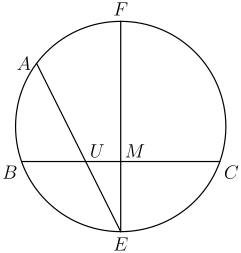
Chord is the perpendicular bisector of chord intersecting it in Between and point is taken, and extended meets the circle in Then, for any selection of as described, triangle is similar to triangle:
Small hint:
Because the perpendicular bisector of a chord passes through the center, is a diameter
Big hint:
Compare the right angles and the shared angle at
Solution:
Since is a diameter, Also so Because are collinear, the two triangles share the same acute angle at Hence
Therefore, the correct answer is A.
19.
In counting colored balls, some red and some black, it was found that of the first counted were red. Thereafter, out of every counted were red. If, in all, or more of the balls counted were red, the maximum value of is:
Small hint:
Write the number of red balls as
Big hint:
Require that quantity to be at least
Solution:
The condition is Simplifying gives so The maximum is
Thus, the correct answer is B.
20.
Two men at points and miles apart, set out at the same time to walk towards each other. The man at walks uniformly at miles per hour; the man at walks at miles per hour for the first hour, at miles per hour for the second hour, and so on, in arithmetic progression. If the men meet miles nearer than in an integral number of hours, then is:
Small hint:
Let the integral meeting time be hours and sum the second man’s hourly distances
Big hint:
Their combined distance equation simplifies to
Solution:
In hours the first man walks The second walks an arithmetic-series total Their distances sum to giving whose positive root is They walk and miles, so the meeting point is miles nearer than
Thus, the correct answer is D.
21.
The expression has:
no linear factor with integer coefficients and integer
exponents
the factor
the factor
the factor
the factor
Small hint:
Group as a single expression
Big hint:
Rewrite the polynomial as
Solution:
Let The two groups factor as Thus the whole expression is and one factor is
Therefore, the correct answer is E.
22.
Acute-angled triangle is inscribed in a circle with center at and A point is taken in minor arc such that is perpendicular to Then the ratio of the magnitudes of angles and is:
Small hint:
Find minor arc then use to locate at its midpoint
Big hint:
Compute the central angle and the inscribed angle
Solution:
Minor arc has measure Since bisects that arc, so Isosceles triangle gives while Their ratio is
Thus, the correct answer is D.
23.
gives as many cents as has and as many cents as has. Similarly, then gives and as many cents as each then has. , similarly, then gives and as many cents as each then has. If each finally has cents, with how many cents does start?
Small hint:
Work backward from the final holdings
Big hint:
Immediately before someone gives, each recipient must have half of the amount held just after that gift
Solution:
Reverse the transactions. Before gives, the holdings are Before gives, they are Before gives, and must have had and while had
Therefore, the correct answer is B.
24.
Consider equations of the form How many such equations have real roots and have coefficients and selected from the set of integers
Small hint:
Real roots require
Big hint:
For each count the allowed values of
Solution:
For equal to and the condition permits respectively and values of in the given set. Their sum is
Thus, the correct answer is B.
25.
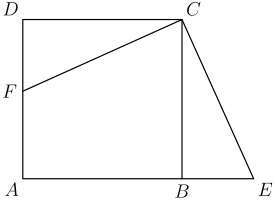
Point is taken in side of square At a perpendicular is drawn to meeting extended at The area of is square inches and the area of triangle is square inches. Then the number of inches in is:
Small hint:
Show that right triangles and are congruent
Big hint:
Then so use the area of right triangle
Solution:
The complementary acute angles and the equal square sides give hence Since so The square side is and right triangle gives
Therefore, the correct answer is A.
26.
Form I. Consider the statements
where are propositions. How many of these imply the truth of
Form II. Consider the statements and are true and is false, is true and and are false, is true and and are false, and are true and is false. How many of these imply the truth of the statement “ is implied by the statement that implies ”?
Small hint:
An implication is false only when its antecedent is true and its consequent is false
Big hint:
Evaluate first in each of the four assignments
Solution:
In cases and is false, so the outer implication is true. In cases and is true, but is also true, so the outer implication is again true. All four statements imply it.
Thus, the correct answer is E.
27.
Six straight lines are drawn in a plane with no two parallel and no three concurrent. The number of regions into which they divide the plane is:
Small hint:
The th line is cut into pieces by the previous lines
Big hint:
Start with one region and add
Solution:
Successive lines create new regions. Thus the total is
Therefore, the correct answer is C.
28.
Given the equation with real roots. The value of for which the product of the roots of the equation is a maximum is:
Small hint:
The product of the roots is
Big hint:
Use the discriminant condition to find the largest allowed
Solution:
Real roots require so The root product is which increases with It is therefore largest at
Thus, the correct answer is D.
29.
A particle projected vertically upward reaches, at the end of seconds, an elevation of feet where The highest elevation is:
Small hint:
The height is a downward-opening quadratic
Big hint:
Find its vertex time using
Solution:
The vertex occurs at Then
Thus, the correct answer is C.
30.
Let
Form a new function by replacing each in by
and simplify. The simplified expression is equal to:
Small hint:
Call the substituted fraction and simplify
Big hint:
Its numerator and denominator factor as cubes
Solution:
For Therefore so
Thus, the correct answer is C.
31.
The number of solutions in positive integers of is:
Small hint:
Solve for
Big hint:
Positive integral requires to be an odd positive integer below
Solution:
We need odd so that is even, and positivity gives The odd values and number
Therefore, the correct answer is D.
32.
The dimensions of a rectangle are and It is required to obtain a rectangle with dimensions and so that its perimeter is one-third that of and its area is one-third that of The number of such (different) rectangles is:
infinitely many
Small hint:
Translate the conditions into and
Big hint:
Divide the sum equation by the product equation and compare reciprocals using and
Solution:
The conditions give and Dividing yields But and make the left side greater than while makes the right side less than This is impossible.
Thus, the correct answer is A.
33.
Given the line and a line parallel to the given line and units from it. A possible equation for is:
Small hint:
Write parallel lines as
Big hint:
The distance equals the absolute difference of constants divided by
Solution:
The given line is A parallel line is so the distance is Setting this equal to gives hence or Choice A is possible.
Thus, the correct answer is A.
34.
In triangle side side and side Let be the largest number such that the magnitude, in degrees, of the angle opposite side exceeds Then equals:
Small hint:
Use the law of cosines for the angle opposite
Big hint:
Compare with the limiting case
Solution:
The law of cosines gives Since so Values can approach as approaches from above, so the largest guaranteed bound is
Therefore, the correct answer is B.
35.
The lengths of the sides of a triangle are integers, and its area is also an integer. One side is and the perimeter is The shortest side is:
Small hint:
Write the other sides as and , with semiperimeter
Big hint:
Heron’s formula makes the squared area
Solution:
Let the other sides be and with The semiperimeter is so Heron’s formula gives The triangle inequalities give Checking these integers, the expression is not a square for while at it is Thus the shortest side is
Therefore, the correct answer is B.
36.
A person starting with cents and making bets, wins three times and loses three times, the wins and losses occurring in random order. The chance for a win is equal to the chance for a loss. If each wager is for half the money remaining at the time of the bet, then the final result is:
a loss of ¢
a gain of ¢
a loss of ¢
neither a gain nor a loss
a gain or a loss depending upon the order in which the wins and
losses occur
Small hint:
A win multiplies the current amount by , while a loss multiplies it by
Big hint:
Multiplication makes the order irrelevant
Solution:
After three wins and three losses, the amount, in cents, is The loss is cents, regardless of order.
Thus, the correct answer is C.
37.
Given points on a straight line, in the order stated (not necessarily evenly spaced). Let be an arbitrarily selected point on the line and let be the sum of the undirected lengths
Then is smallest if and only if the point is:
midway between and
midway between and
midway between and
at
at
Small hint:
Pair the distances to , then , then
Big hint:
Each paired sum is minimized throughout its intervening segment; the unpaired middle point selects one location
Solution:
For any pair the sum is minimized when lies between them. The three such intervals all contain The remaining term is uniquely minimized at
Thus, the correct answer is D.
38.
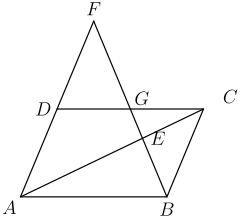
Point is taken on the extension of side of parallelogram intersects diagonal at and side at If and then equals:
Small hint:
Parameterize points on by their fraction of the distance from to
Big hint:
If in affine coordinates based at the parameters of and are and
Solution:
Use affine coordinates and A point on is Intersecting gives while intersecting gives Therefore so and Thus making and
Therefore, the correct answer is E.
39.
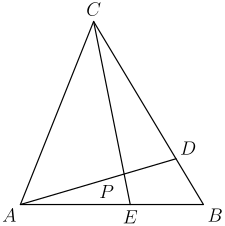
In triangle lines and are drawn so that and
Let where is the intersection point of and Then equals:
Small hint:
Assign endpoint masses inversely proportional to the given side ratios
Big hint:
Choose masses and , then find the mass at
Solution:
The ratio is represented by masses and The ratio then gives Point has mass so along cevian
Thus, the correct answer is D.
40.
If is a number satisfying the equation then is between:
and
and
and
and
and
Small hint:
Set and
Big hint:
Use both and to find
Solution:
Let and Then and so Comparing with gives Hence Cubing gives and either way between and
Therefore, the correct answer is C.