
1979 AMC 12 Problem 28
Attempt Problem 28 of the 1979 AMC 12 below, then check your answer against the professionally curated solution from LIVE by Po-Shen Loh. You can also try the full timed exam, view all 1979 AMC 12 solutions, or check the answer key.
All problems are used with official legal permission of the Mathematical Association of America (MAA).
28.
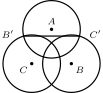
Circles with centers and each have radius where The distance between each pair of centers is If is the point of intersection of circle and circle which is outside circle and if is the point of intersection of circle and circle which is outside circle then length equals
none of these
Answer: D
Small hint:
Introduce the analogous point outside circle ; symmetry makes equilateral
Big hint:
Use the common centroid and the altitude of an isosceles triangle with sides and
Solution:
Let be the analogous outer intersection of the circles centered at and Then and are concentric equilateral triangles. If is their common centroid and is the midpoint of then Similarity gives Hence
Therefore, the correct answer is D.
Problem 28 in other years
- 1950 AMC 12
- 1951 AMC 12
- 1952 AMC 12
- 1953 AMC 12
- 1954 AMC 12
- 1955 AMC 12
- 1956 AMC 12
- 1957 AMC 12
- 1958 AMC 12
- 1959 AMC 12
- 1960 AMC 12
- 1961 AMC 12
- 1962 AMC 12
- 1963 AMC 12
- 1964 AMC 12
- 1965 AMC 12
- 1966 AMC 12
- 1967 AMC 12
- 1968 AMC 12
- 1969 AMC 12
- 1970 AMC 12
- 1971 AMC 12
- 1972 AMC 12
- 1973 AMC 12
- 1974 AMC 12
- 1975 AMC 12
- 1976 AMC 12
- 1977 AMC 12
- 1978 AMC 12
- 1980 AMC 12
- 1981 AMC 12
- 1982 AMC 12
- 1983 AMC 12
- 1984 AMC 12
- 1985 AMC 12
- 1986 AMC 12
- 1987 AMC 12
- 1988 AMC 12
- 1989 AMC 12
- 1990 AMC 12
- 1991 AMC 12
- 1992 AMC 12
- 1993 AMC 12
- 1994 AMC 12
- 1995 AMC 12
- 1996 AMC 12
- 1997 AMC 12
- 1998 AMC 12
- 1999 AMC 12