
1984 AMC 12 Solutions
Scroll down to view professionally curated solutions from LIVE by Po-Shen Loh, print PDF solutions, view answer key, or take the full timed exam.
All problems are used with official legal permission of the Mathematical Association of America (MAA).
1.
equals
Small hint:
Factor the denominator as a difference of squares
Big hint:
Use and
Solution:
Factoring the denominator gives Thus the given quotient is Therefore, the correct answer is C.
2.
If and are not then equals
Small hint:
Write the numerator and denominator as single fractions
Big hint:
Both parts contain the common factor
Solution:
We have and The hypotheses make the needed quantities nonzero, so their quotient is Therefore, the correct answer is B.
3.
Let be the smallest nonprime integer greater than with no prime factor less than Then
Small hint:
The smallest permitted prime factor is
Big hint:
To make the smallest composite, use the two smallest permitted prime factors
Solution:
Every prime factor of is at least The smallest composite with that property is which lies in
Therefore, the correct answer is C.
4.
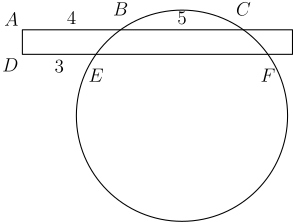
A rectangle intersects a circle as shown: and Then equals
Small hint:
The perpendicular bisectors of the two parallel chords pass through the same center
Big hint:
Therefore the midpoints of and have the same horizontal position
Solution:
The line through the circle’s center perpendicular to the parallel chords and bisects both. Measured from the rectangle’s left side, the midpoint of is while the midpoint of is Thus giving
Therefore, the correct answer is B.
5.
The largest integer for which is
Small hint:
Take the positive one-hundredth root of both sides
Big hint:
Compare with
Solution:
Taking positive one-hundredth roots gives Since but the largest possible integer is
Therefore, the correct answer is D.
6.
In a certain school, there are three times as many boys as girls and nine times as many girls as teachers. Using the letters to represent the number of boys, girls and teachers, respectively, then the total number of boys, girls and teachers can be represented by the expression
Small hint:
Express both and in terms of
Big hint:
The given ratios imply and
Solution:
Because and we have and Hence Therefore, the correct answer is B.
7.
When Dave walks to school, he averages steps per minute, each of his steps cm long. It takes him minutes to get to school. His brother, Jack, going to the same school by the same route, averages steps per minute, but his steps are only cm long. How long does it take Jack to get to school?
min.
min.
min.
min.
min.
Small hint:
Find the route’s length from Dave’s step rate, step length, and time
Big hint:
Jack covers centimeters each minute
Solution:
The route is centimeters long. Jack covers centimeters per minute, so his time is minutes. Therefore, the correct answer is C.
8.
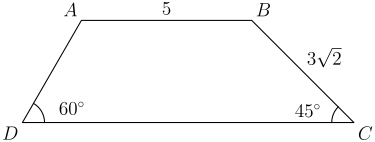
Figure is a trapezoid with and The length of is
Small hint:
Drop perpendiculars from and to
Big hint:
The right-hand triangle is -- and the left-hand triangle is --
Solution:
Drop perpendiculars from and to Since and the angle at is both the height and the right horizontal offset are The left -- triangle has height so its horizontal offset is Therefore The correct answer is D.
9.
The number of digits in (when written in the usual base form) is
Small hint:
Rewrite the power of as a power of
Big hint:
Pair factors of with the factors of
Solution:
We have This is followed by zeros, so it has digits. Therefore, the correct answer is D.
10.
Four complex numbers lie at the vertices of a square in the complex plane. Three of the numbers are and The fourth number is
Small hint:
Two of the listed vertices are opposites
Big hint:
Their midpoint is the square’s center, so reflect the remaining given vertex through that point
Solution:
The points and are opposite vertices, so their midpoint is the center of the square. The fourth vertex is therefore the reflection of through the origin, namely
Therefore, the correct answer is B.
11.
A calculator has a key which replaces the displayed entry with its square, and another key which replaces the displayed entry with its reciprocal. Let be the final result if one starts with an entry and alternately squares and reciprocates times each. Assuming the calculator is completely accurate (e.g., no roundoff or overflow), then equals
Small hint:
Track only the exponent of
Big hint:
One squaring-reciprocating pair multiplies the exponent by
Solution:
Write the displayed value as Squaring changes to and then reciprocating changes it to Starting from after such pairs the exponent is Thus
Therefore, the correct answer is A.
12.
If the sequence is defined by then equals
Small hint:
Add all increments from through
Big hint:
Use
Solution:
Telescoping the recurrence gives Therefore, the correct answer is B.
13.
equals
Small hint:
Group the first two radicals in the denominator
Big hint:
Multiply by
Solution:
Observe that Hence the quotient is
Therefore, the correct answer is A.
14.
The product of all real roots of the equation is
none of these
Small hint:
Take the base- logarithm of both sides
Big hint:
Let and solve the resulting equation in
Solution:
The logarithm requires Taking base- logarithms gives Thus so the two roots are and whose product is
Therefore, the correct answer is A.
15.
If then one value for is
Small hint:
Move all terms to one side and recognize a cosine addition identity
Big hint:
Use
Solution:
The equation is equivalent to Therefore Taking gives the listed value.
Therefore, the correct answer is A.
16.
The function satisfies for all real numbers If the equation has exactly four distinct real roots, then the sum of these roots is
Small hint:
The equation makes the graph symmetric about
Big hint:
Pair each root with its reflected root
Solution:
The relation shows that every root is paired with Four distinct roots therefore form two such pairs, and each pair has sum The sum of all four roots is
Therefore, the correct answer is E.
17.
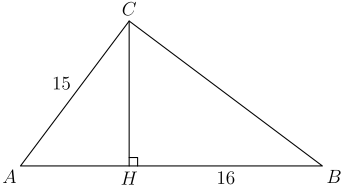
A right triangle with hypotenuse has side Altitude divides into segments and with The area of is
Small hint:
Use the right-triangle projection relation
Big hint:
After finding use
Solution:
Let Similarity in the right triangle gives so Hence Also so The area is
Therefore, the correct answer is C.
18.
A point is to be chosen in the coordinate plane so that it is equally distant from the -axis, the -axis, and the line Then is
not uniquely determined
Small hint:
Equal distance from the two axes forces
Big hint:
Check both lines and
Solution:
Equal distance from the axes gives or On the distance to the line is so both and satisfy all three distance conditions. Their -coordinates differ, so is not uniquely determined.
Therefore, the correct answer is E.
19.
A box contains balls, numbered If balls are drawn simultaneously at random, what is the probability that the sum of the numbers on the balls drawn is odd?
Small hint:
There are odd-numbered balls and even-numbered balls
Big hint:
Count selections containing or odd balls
Solution:
An odd sum requires an odd number of the six selected balls to be odd. There are odd and even balls, so the favorable count is Of the selections, the desired probability is
Therefore, the correct answer is D.
20.
The number of distinct solutions of the equation is
Small hint:
Split the outer absolute value into two equations
Big hint:
For each equation, isolate before checking its two cases
Solution:
If then which requires and yields no solution. If then Its two linear cases give and both valid. Thus there are distinct solutions.
Therefore, the correct answer is C.
21.
The number of triples of positive integers which satisfy the simultaneous equations is
Small hint:
Factor the second equation as
Big hint:
Use the primality of and positivity to determine and
Solution:
Since and all variables are positive integers, and Put in Then or so or Each gives a positive producing exactly two triples.
Therefore, the correct answer is C.
22.
Let and be fixed positive numbers. For each real number let be the vertex of the parabola If the set of vertices for all real values of is graphed in the plane, the graph is
a straight line
a parabola
part, but not all, of a parabola
one branch of a hyperbola
none of these
Small hint:
Write the vertex coordinates in terms of
Big hint:
Use to eliminate from
Solution:
The vertex coordinates are Since eliminating gives As ranges over all reals, so does so the entire parabola is traced.
Therefore, the correct answer is B.
23.
equals
Small hint:
Apply the sum-to-product identities to both numerator and denominator
Big hint:
Both transformed sums contain the same factor
Solution:
Let denote the given ratio. By the sum-to-product identities, Therefore, the correct answer is D.
24.
If and are positive real numbers and each of the equations has real roots, then the smallest possible value of is
Small hint:
Require both quadratic discriminants to be nonnegative
Big hint:
Combine and to bound and
Solution:
The two discriminants give and Therefore Since this yields and then gives Thus Equality occurs at for which both discriminants are zero.
Therefore, the correct answer is E.
25.
The total area of all the faces of a rectangular solid is and the total length of all its edges is Then the length in cm of any one of its internal diagonals is
not uniquely determined
Small hint:
Let the side lengths be and translate both totals into equations
Big hint:
Expand to find
Solution:
The conditions give and so and Hence the square of an internal diagonal is Its length is
Therefore, the correct answer is D.
26.
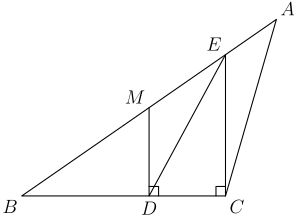
In the obtuse triangle If the area of is then the area of is
not uniquely determined
Small hint:
Draw segment and compare with
Big hint:
Those triangles have the same base and equal altitudes; also is the midpoint of
Solution:
Draw Since points and have equal perpendicular distances from so Therefore Because is the midpoint of triangle has half the area of Thus
Therefore, the correct answer is B.
27.
In is on and is on Also, and Find
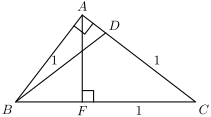
Small hint:
Let and use the altitude-to-hypotenuse similarity relation
Big hint:
Then compare in right triangle and isosceles triangle
Solution:
Let The right-triangle projection relation gives so Since the numerator and denominator in the Law of Cosines satisfy Hence But lies on and in right triangle Thus so and
Therefore, the correct answer is C.
28.
The number of distinct pairs of integers such that is
Small hint:
Use and write both radicands with a common squarefree part
Big hint:
Set and count positive integers with
Solution:
Because the two radicals must have common squarefree part Write and for positive integers Then The possibilities are and producing three distinct pairs
Therefore, the correct answer is D.
29.
Find the largest value of for pairs of real numbers which satisfy
Small hint:
Interpret as the slope of a line through the origin
Big hint:
At an extreme slope, the line is tangent to the circle
Solution:
The circle lies entirely where so is the slope of the line through a point on it. At an extreme, this line is tangent. The distance from the center to must equal so Squaring and simplifying gives hence The larger value is
Therefore, the correct answer is A.
30.
For any complex number is defined to be the real number If then equals
none of these
Small hint:
Let and subtract from
Big hint:
Use and
Solution:
Let Since and Therefore because Thus Therefore, the correct answer is B.