
1988 AMC 12 Problems
30 problems · 75 minutes
Scroll down and press Start to try the exam! Or, go to the printable PDF, answer key, or professional solutions curated by LIVE by Po-Shen Loh.
Or jump straight to a single problem with its solution: 1 · 2 · 3 · 4 · 5 · 6 · 7 · 8 · 9 · 10 · 11 · 12 · 13 · 14 · 15 · 16 · 17 · 18 · 19 · 20 · 21 · 22 · 23 · 24 · 25 · 26 · 27 · 28 · 29 · 30
All problems are used with official legal permission of the Mathematical Association of America (MAA).
Want to learn professionally through interactive video classes?
Learn LIVETimed
1:15:00
1.
Answer: D
Small hint:
Extract the largest square factor from each radicand
Big hint:
After simplifying, the two radicals are like terms
Solution:
We have and Their sum is
Thus the correct answer is D.
2.
Triangles and are similar, with corresponding to and to If and then is
Answer: D
Small hint:
Match with and with
Big hint:
Use the scale factor from the first triangle to the second
Solution:
The scale factor is Therefore and
Thus the correct answer is D.
3.
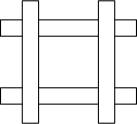
Four rectangular paper strips of length and width are put flat on a table and overlap perpendicularly as shown. How much area of the table is covered?
Answer: A
Small hint:
First add the areas of the four strips
Big hint:
Each perpendicular crossing is a unit square counted twice
Solution:
The strips have total area There are four -by- overlaps, each counted twice, so the covered area is
Thus the correct answer is A.
4.
The slope of the line is
Answer: B
Small hint:
Solve the equation for
Big hint:
In the coefficient is the slope
Solution:
Multiplying by after isolating gives The slope is
Thus the correct answer is B.
5.
If and are constants and then is
Answer: E
Small hint:
Expand the product on the left
Big hint:
Compare the constant term before comparing the coefficient of
Solution:
Expansion gives Thus so and
Thus the correct answer is E.
6.
A figure is an equiangular parallelogram if and only if it is a
rectangle
regular polygon
rhombus
square
trapezoid
Answer: A
Small hint:
The four equal interior angles must add to
Big hint:
No condition here forces adjacent sides to have equal lengths
Solution:
Four equal angles summing to are all right angles. A parallelogram with four right angles is exactly a rectangle.
Thus the correct answer is A.
7.
Estimate the time it takes to send blocks of data over a communications channel if each block consists of “chunks” and the channel can transmit chunks per second.
seconds
seconds
seconds
minutes
hours
Answer: D
Small hint:
Compute the total number of chunks first
Big hint:
Convert the resulting number of seconds to minutes
Solution:
The transmission takes seconds, which is a little over minutes.
Thus the correct answer is D.
8.
If and what is the ratio of to
Answer: B
Small hint:
Write both and as multiples of
Big hint:
Substitute those expressions into
Solution:
We have and Therefore
Thus the correct answer is B.
9.
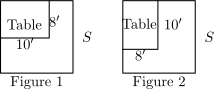
An table sits in the corner of a square room, as in Figure below. The owners desire to move the table to the position shown in Figure The side of the room is feet. What is the smallest integer value of for which the table can be moved as desired without tilting it or taking it apart?
Answer: C
Small hint:
During a quarter-turn, a diagonal becomes perpendicular to a pair of opposite walls
Big hint:
Compare the room side with the table’s diagonal
Solution:
The table diagonal is which is between and During the turn this diagonal must fit across the room, so Conversely, a rectangle can rotate inside a circle whose diameter is its diagonal, so that bound is sufficient. The least integer is
Thus the correct answer is C.
10.
In an experiment, a scientific constant is determined to be with an error of at most The experimenter wishes to announce a value for in which every digit is significant. That is, whatever is, the announced value must be the correct result when is rounded to that number of digits. The most accurate value the experimenter can announce for is
Answer: D
Small hint:
Find the smallest and largest possible values of
Big hint:
Round both endpoints to increasing numbers of significant digits
Solution:
The possible interval is Every number in it rounds to at three significant digits, but the endpoints round differently at four significant digits. Hence is the most accurate guaranteed announcement.
Thus the correct answer is D.
11.
On each horizontal line in the figure below, the five large dots indicate the populations of cities and in the year indicated. Which city had the greatest percentage increase in population from to

Answer: C
Small hint:
Read each city’s two population values from the scale
Big hint:
Compare increase divided by the population, not just absolute increase
Solution:
The percentage increases for are respectively and These are and so city has the greatest percentage increase.
Thus the correct answer is C.
12.
Each integer through is written on a separate slip of paper and all nine slips are put into a hat. Jack picks one of these slips at random and puts it back. Then Jill picks a slip at random. Which digit is most likely to be the units digit of the sum of Jack’s integer and Jill’s integer?
each digit is equally likely
Answer: A
Small hint:
There are equally likely ordered pairs
Big hint:
Count pairs whose sum has each residue modulo
Solution:
For a units digit of the ordered pairs are giving pairs. Each other units digit occurs times among the ordered pairs. Therefore is most likely.
Thus the correct answer is A.
13.
If then what is
Answer: E
Small hint:
Square the given relation and use
Big hint:
The given relation also determines the sign of the product
Solution:
Squaring gives Hence Multiplying by gives
Thus the correct answer is E.
14.
For any real number and positive integer define What is
Answer: A
Small hint:
Cancel the identical denominator
Big hint:
Write the remaining factors as consecutive odd integers and look for telescoping cancellation
Solution:
After canceling the numerator factors have magnitudes while the denominator factors have magnitudes All common odd factors cancel, leaving magnitude The numerator has negative factors and the denominator has so the quotient is
Thus the correct answer is A.
15.
If and are integers such that is a factor of then is
Answer: A
Small hint:
Reduce powers using
Big hint:
A polynomial of degree below divisible by the quadratic must be zero
Solution:
Modulo we have and Thus the polynomial is congruent to Both coefficients must vanish, so and Hence and
Thus the correct answer is A.
16.
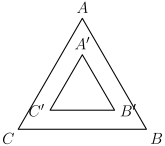
and are equilateral triangles with parallel sides and the same center, as in the figure. The distance between side and side is the altitude of The ratio of the area of to the area of is
Answer: C
Small hint:
A centroid lies one-third of the altitude above the base
Big hint:
Relate the two altitudes using the distance between their parallel bases
Solution:
Let the outer and inner altitudes be and Their common center is above and above Hence so Areas scale as the square of corresponding lengths, giving
Thus the correct answer is C.
17.
If and find
Answer: C
Small hint:
Use each equation to rule out one sign possibility
Big hint:
After determining the signs of and solve a linear system
Solution:
If the first equation gives contradicting the second; hence If the second gives contradicting the first; hence The equations become and Thus and
Thus the correct answer is C.
18.
At the end of a professional bowling tournament, the top bowlers have a play-off. First # bowls # The loser receives th prize and the winner bowls # in another game. The loser of this game receives th prize and the winner bowls # The loser of this game receives rd prize and the winner bowls # The winner of this game gets st prize and the loser gets nd prize. In how many orders can bowlers # through # receive the prizes?
none of these
Answer: B
Small hint:
Exactly four games are played
Big hint:
Each sequence of winners determines a different prize order
Solution:
Each of the four games has two possible winners. A sequence of four outcomes uniquely determines the five prize positions, so there are orders.
Thus the correct answer is B.
19.
Simplify
Answer: B
Small hint:
Separate the and terms
Big hint:
Try to factor the numerator first by
Solution:
Regrouping the numerator gives Dividing by yields
Thus the correct answer is B.
20.
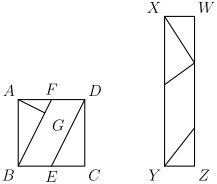
In one of the adjoining figures a square of side is dissected into four pieces so that and are the midpoints of opposite sides and is perpendicular to These four pieces can then be reassembled into a rectangle as shown in the second figure. The ratio of height to base, in this rectangle is
Answer: E
Small hint:
Find and from the side length and midpoint conditions
Big hint:
Use the unchanged area to determine the rectangle’s base
Solution:
Both and have horizontal and vertical changes and so each has length Thus The rectangle has area so Therefore
Thus the correct answer is E.
21.
The complex number satisfies What is Note: if then
Answer: E
Small hint:
Write and compare imaginary parts
Big hint:
Use the real part to relate to
Solution:
Writing gives and Thus Squaring yields Therefore
Thus the correct answer is E.
22.
For how many integers does a triangle with side lengths and have all its angles acute?
more than
Answer: A
Small hint:
Apply the strict Pythagorean inequality to the largest side in each possible ordering
Big hint:
The angle opposite and the angle opposite give the restrictive bounds
Solution:
Acuteness requires and so and For integer this gives All four values also satisfy the triangle inequality, so there are values.
Thus the correct answer is A.
23.
The six edges of tetrahedron measure and units. If the length of edge is then the length of edge is
Answer: B
Small hint:
The edge of length belongs to two triangular faces
Big hint:
In either face containing that edge, the other two edge lengths must differ by less than
Solution:
For a face containing the edge its other two sides must differ by less than Among the remaining lengths, the only disjoint pairs with this property are and so edge is opposite edge With the two possible placements of these pairs can be checked by the triangle inequalities; the placement making the edge opposite equal to fails, while the valid placement has
Thus the correct answer is B.
24.
An isosceles trapezoid is circumscribed around a circle. The longer base of the trapezoid is and one of the base angles is Find the area of the trapezoid.
not uniquely determined
Answer: C
Small hint:
For a circumscribed quadrilateral, the sums of opposite side lengths are equal
Big hint:
Use and to relate the leg, height, and difference of the bases
Solution:
Let the shorter base be and each leg be Tangency gives If the base angle is then and Solving gives and height The area is
Thus the correct answer is C.
25.
and are pairwise disjoint sets of people. The average ages of people in the sets and are given in the table below.
Find the average age of the people in the set
| Set | ||||||
|---|---|---|---|---|---|---|
| Average age of people in the set |
Answer: E
Small hint:
Let be the sizes of the three sets
Big hint:
Each union average gives a linear relation among
Solution:
Let the set sizes be The three union averages give and Thus and The total average is
Thus the correct answer is E.
26.
Suppose that and are positive numbers for which What is the value of
Answer: D
Small hint:
Call the common logarithm value
Big hint:
If compare with
Solution:
Let the common value be Then and Put Dividing the last equation by gives Since
Thus the correct answer is D.
27.
In the figure, and is tangent to the circle with center and diameter In which one of the following cases is the area of an integer?
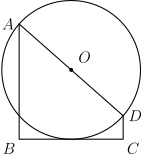
Answer: D
Small hint:
Let the tangent point be and use the diameter to form a rectangle inside the trapezoid
Big hint:
Power of point relates half of to and
Solution:
The tangent point is the midpoint of and the tangent-secant relation gives Thus and the trapezoid area is Only makes the product under the radical a square; the area is
Thus the correct answer is D.
28.
An unfair coin has probability of coming up heads on a single toss. Let be the probability that, in independent tosses of this coin, heads come up exactly times. If then
must be
must be
must be greater than
is not uniquely determined
there is no value of for which
Answer: D
Small hint:
Write as a function of using the binomial coefficient
Big hint:
Check one simple value, then compare the function at and
Solution:
Here At Also while By continuity there is another solution between and Hence is not unique.
Thus the correct answer is D.
29.
You plot weight against height for three of your friends and obtain the points If which of the following is necessarily the slope of the line which best fits the data? “Best fits” means that the sum of the squares of the vertical distances from the data points to the line is smaller than for any other line.
none of these
Answer: A
Small hint:
Translate and scale the -coordinates to
Big hint:
For a least-squares line through symmetric -values, compute the slope from the covariance numerator
Solution:
Translate and scale so the -coordinates are Their mean is so the least-squares slope is
Thus the correct answer is A.
30.
Let Given consider the sequence defined by for all For how many real numbers will the sequence take on only a finite number of different values?
or
or
more than but finitely many
infinitely many
Answer: E
Small hint:
Start with then find numbers mapping successively to
Big hint:
For every solve and choose a new real preimage
Solution:
The starting values give finite orbits , , and More generally, if begins a finite chain ending at solve Its real solutions are Choosing a preimage not already in the chain extends it by one new value. Repeating produces infinitely many distinct starting values with finite orbits.
Thus the correct answer is E.