
1991 AMC 12 Solutions
Scroll down to view professionally curated solutions from LIVE by Po-Shen Loh, print PDF solutions, view answer key, or take the full timed exam.
All problems are used with official legal permission of the Mathematical Association of America (MAA).
1.
If for any three distinct numbers and we define then
Small hint:
Substitute and into the definition
Big hint:
Be careful with the two negative signs in the denominator
Solution:
Direct substitution gives
Thus the correct answer is E.
2.
Small hint:
Recall that
Big hint:
The absolute value of a negative number is its opposite
Solution:
Since the quantity is negative. Therefore
Thus the correct answer is E.
3.
Small hint:
Rewrite the negative first powers as reciprocals
Big hint:
First simplify , then take its reciprocal
Solution:
We have Raising this result to the power takes its reciprocal, giving
Thus the correct answer is A.
4.
Which of the following triangles cannot exist?
An acute isosceles triangle
An isosceles right triangle
An obtuse right triangle
A scalene right triangle
A scalene obtuse triangle
Small hint:
A right triangle already contains an angle of
Big hint:
An obtuse triangle must contain an angle greater than
Solution:
A right triangle has one angle, leaving only for its other two positive angles together. Neither remaining angle can therefore be obtuse. Hence a triangle cannot be both right and obtuse.
Thus the correct answer is C.
5.
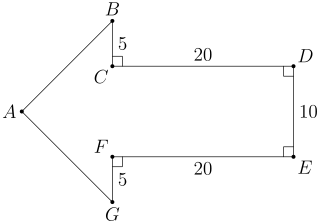
In the arrow-shaped polygon shown, the angles at vertices and are right angles, and The area of the polygon is closest to
Small hint:
Separate the arrowhead from the rectangular shaft
Big hint:
Use and the two right angles at and to determine the arrowhead
Solution:
The shaft is a -by- rectangle, so its area is Also Because and triangle is an isosceles right triangle with hypotenuse Its legs are so its area is The total area is
Thus the correct answer is E.
6.
If then
Small hint:
Work from the innermost square root outward
Big hint:
Rewrite each square root as a power of
Solution:
Starting inside and using fractional exponents,
Thus the correct answer is E.
7.
If and then
Small hint:
Divide the numerator and denominator by
Big hint:
Replace each occurrence of by
Solution:
Dividing both numerator and denominator by the nonzero number gives
Thus the correct answer is B.
8.
Liquid does not mix with water. Unless obstructed, it spreads out on the surface of water to form a circular film cm thick. A rectangular box measuring cm by cm by cm is filled with liquid Its contents are poured onto a large body of water. What will be the radius, in centimeters, of the resulting circular film?
Small hint:
Equate the volume in the box to the volume of the thin circular film
Big hint:
The film volume is
Solution:
The liquid volume is cubic centimeters. Thus so and
Thus the correct answer is C.
9.
From time to time a population increased by and from time to time the population increased by Therefore, from time to time the population increased by
Small hint:
Represent the two increases by multiplication factors
Big hint:
Expand
Solution:
The combined growth factor is Hence the percent increase is
Thus the correct answer is D.
10.
Point is units from the center of a circle of radius How many different chords of the circle contain and have integer lengths?
Small hint:
Find the shortest and longest chord through
Big hint:
Except at the extreme lengths, each attainable chord length occurs in two directions
Solution:
The longest chord through is a diameter of length The shortest is perpendicular to the radius through and has length As the chord rotates between these positions, its length varies continuously from to The endpoint lengths each occur once, while each of the five interior integer lengths occurs twice. Thus the count is
Thus the correct answer is B.
11.
Jack and Jill run kilometers. They start at the same point, run kilometers up a hill, and return to the starting point by the same route. Jack has a -minute head start and runs at the rate of km/hr uphill and km/hr downhill. Jill runs km/hr uphill and km/hr downhill. How far from the top of the hill are they when they pass going in opposite directions?
km
km
km
km
km
Small hint:
Determine Jill’s position when Jack reaches the top
Big hint:
After Jack turns around, use their combined closing speed
Solution:
Jack reaches the top in hour. Jill has then run for hour and is km uphill, so they are km apart. Their closing speed is km/hr, so they meet after hour. Jack descends kilometers.
Thus the correct answer is B.
12.
The measures (in degrees) of the interior angles of a convex hexagon form an arithmetic sequence of positive integers. Let be the measure of the largest interior angle of the hexagon. The largest possible value of is
Small hint:
Write the angles as and use their sum
Big hint:
The equation forces to be even, and convexity bounds the largest angle below
Solution:
The angle sum is so Hence is even. The largest angle is which must be less than Thus and the largest allowable even value is It gives and
Thus the correct answer is D.
13.
Horses and are entered in a three-horse race in which ties are not possible. If the odds against winning are -to- and the odds against winning are -to- what are the odds against winning? (By “odds against winning are -to-” we mean that the probability of winning the race is )
-to-
-to-
-to-
-to-
-to-
Small hint:
Convert each set of odds to a probability
Big hint:
The three winning probabilities sum to
Solution:
The given probabilities are and Therefore The probability that loses is so the odds against are -to-
Thus the correct answer is D.
14.
If is the cube of a positive integer and is the number of positive integers that are divisors of then could be
Small hint:
In the prime factorization of a cube, every exponent is divisible by
Big hint:
Try a cube having only one prime factor
Solution:
For any prime take This is a cube, and its positive divisors are a total of Thus can occur.
Thus the correct answer is C.
15.
A circular table has exactly chairs around it. There are people seated at this table in such a way that the next person to be seated must sit next to someone. The smallest possible value of is
Small hint:
No empty chair can have both neighboring chairs empty
Big hint:
Between consecutive occupied chairs there can be at most two empty chairs
Solution:
The condition says that every empty chair has an occupied neighbor, so no three consecutive chairs may all be empty. Therefore each occupied chair can account for at most itself and the two empty chairs following it, giving and Repeating the pattern occupied-empty-empty around the table attains
Thus the correct answer is B.
16.
One hundred students at Century High School participated in the AHSME last year, and their mean score was The number of non-seniors taking the AHSME was more than the number of seniors, and the mean score of the seniors was higher than that of the non-seniors. What was the mean score of the seniors?
Small hint:
First determine the numbers of seniors and non-seniors
Big hint:
Let the non-senior mean be and form a weighted-average equation
Solution:
If there are seniors, then there are non-seniors, so and Let the non-senior mean be the senior mean is The total score equation is so and the senior mean is
Thus the correct answer is D.
17.
A positive integer is a palindrome if the integer obtained by reversing the sequence of digits of is equal to The year is the only year in the current century with the following two properties:
(a) It is a palindrome.
(b) It factors as a product of a -digit prime palindrome and a -digit prime palindrome.
How many years in the millennium between and (including the year ) have properties (a) and (b)?
Small hint:
Every four-digit palindrome from to has the form
Big hint:
Factor as and test when the three-digit factor is prime
Solution:
The palindromes in the interval are where is a digit. Algebraically, The two-digit prime palindrome must therefore be and must be a three-digit prime palindrome. For the prime values occur for giving Thus there are years.
Thus the correct answer is D.
18.
If is the set of points in the complex plane such that is a real number, then is a
right triangle
circle
hyperbola
line
parabola
Small hint:
Write and expand the product
Big hint:
Set the imaginary part of equal to zero
Solution:
Writing This is real exactly when which is the equation of a line through the origin.
Thus the correct answer is D.
19.
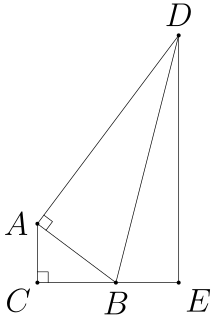
Triangle has a right angle at and Triangle has a right angle at and Points and are on opposite sides of The line through parallel to meets extended at If where and are relatively prime positive integers, then
Small hint:
Place and
Big hint:
Find by using a length- vector perpendicular to
Solution:
Place and Since the length- vector perpendicular to and directed away from is Hence Since we have so and Therefore Thus
Thus the correct answer is B.
20.
The sum of all real such that is
Small hint:
Set and
Big hint:
Factor as
Solution:
Let and The right side is so is equivalent to The cases give or whose real solutions are and respectively. Their sum is
Thus the correct answer is E.
21.
If for all and then
Small hint:
Choose so that
Big hint:
Use
Solution:
Since choose in the definition. Then
Thus the correct answer is A.
22.
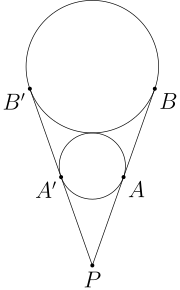
Two circles are externally tangent. Lines and are common tangents with and on the smaller circle and and on the larger circle. If then the area of the smaller circle is
Small hint:
The two circles are related by a dilation centered at
Big hint:
Use to find the dilation ratio, then apply the tangent-length relation to the smaller circle
Solution:
Since and we have The homothety centered at taking the smaller circle to the larger therefore has ratio If the smaller radius is its center is from the centers are on the same ray, their distances from have ratio and their difference is Applying the right triangle formed by the small center, and , Thus so and the area is
Thus the correct answer is B.
23.
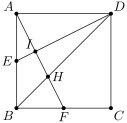
If is a square, is the midpoint of is the midpoint of and intersect at and and intersect at then the area of quadrilateral is
Small hint:
Assign coordinates to the square and write equations for and
Big hint:
Find and then use the shoelace formula on
Solution:
Set and Then and the line intersections are The shoelace formula gives
Thus the correct answer is C.
24.
The graph, of is rotated counter-clockwise about the origin to obtain a new graph Which of the following is an equation for
Small hint:
A counter-clockwise rotation sends to
Big hint:
Rename the rotated coordinates and solve the logarithmic relation for the new
Solution:
A point rotates to Hence so and
Thus the correct answer is D.
25.
If and for then is closest to which of the following numbers?
Small hint:
Factor and simplify each factor
Big hint:
Write each factor as and telescope
Solution:
Since and The product telescopes: For this is just under and is closest to
Thus the correct answer is D.
26.
An -digit positive integer is cute if its digits are an arrangement of the set and its first digits form an integer that is divisible by for For example, is a cute -digit integer because divides divides and divides How many cute -digit integers are there?
Small hint:
The second digit must be even, the third-prefix digit sum must be divisible by and the fourth prefix must be divisible by
Big hint:
The fifth digit must be and the full number must be even and divisible by
Solution:
Divisibility by forces the fifth digit to be Divisibility by and forces the second and sixth digits to be even. Now apply the divisibility tests successively: the first three digits must have sum divisible by and the two-digit number formed by the third and fourth digits must be divisible by Checking the remaining choices from leaves and Each number directly satisfies all six prefix divisibility conditions, so there are
Thus the correct answer is C.
27.
If then
Small hint:
Rationalize
Big hint:
The last two terms of the requested expression are conjugates
Solution:
Because the given equation implies Its reciprocal is so adding yields and Also Therefore the requested expression is
Thus the correct answer is C.
28.
Initially an urn contains black marbles and white marbles. Repeatedly, three marbles are removed from the urn and replaced from a pile outside the urn as follows:
Which of the following sets of marbles could be the contents of the urn after repeated applications of this procedure?
| Marbles removed | Replaced with |
|---|---|
| black | black |
| black, white | black, white |
| black, white | white |
| white | black, white |
black marbles
white marbles
black marble
black and white marble
white marble
Small hint:
The number of white marbles always changes by or
Big hint:
When an operation first leaves at most two marbles, inspect the possible outputs of that final operation
Solution:
The parity of the number of white marbles never changes, so choices with one white marble are impossible. Also a final operation starting with three marbles can leave black, black and white, or white, but never black. The state with white is attainable: repeatedly replace black by black until black remain; twice use the -black--white rule, leaving white; then alternate the -white rule with the -black--white rule, reducing the number of white marbles by per pair until remain.
Thus the correct answer is B.
29.
Equilateral triangle has been creased and folded so that vertex now rests at on as shown. If and then the length of crease is
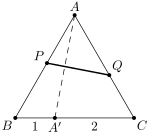
Small hint:
A fold crease is the perpendicular bisector of the segment joining a point to its image
Big hint:
Place and
Solution:
With the coordinates in the hint, the perpendicular-bisector condition for is which simplifies to Intersecting this line with gives Intersecting it with gives Hence
Thus the correct answer is B.
30.
For any set let denote the number of elements in and let be the number of subsets of including the empty set and the set itself. If and are sets for which then what is the minimum possible value of
Small hint:
Use and determine and
Big hint:
Within the union, count how many elements each of and can omit
Solution:
Let and Since the equation becomes The two summands must be equal, so and Within the union, and omit and elements. Thus at most five distinct elements are absent from the triple intersection, giving Equality is attained by making those omissions distinct.
Thus the correct answer is B.