
1993 AMC 8 Solutions
Scroll down to view professionally curated solutions from LIVE by Po-Shen Loh, print PDF solutions, view answer key, or take the full timed exam.
All problems are used with official legal permission of the Mathematical Association of America (MAA).
1.
Which pair of numbers does not have a product equal to
Small hint:
Multiply the two numbers in each pair and check which product is not
Big hint:
A negative times a negative is positive, so watch the signs of
Solution:
Checking each pair: and
Only fails to equal
Thus, the correct answer is C .
2.
When the fraction is expressed in simplest form, then the sum of the numerator and the denominator will be
Small hint:
Find the greatest common factor of and
Big hint:
and so divide both by
Solution:
Since and the fraction reduces to
The sum of numerator and denominator is
Thus, the correct answer is C .
3.
Which of the following numbers has the largest prime factor?
Small hint:
Factor each number completely into primes
Big hint:
Compare the largest prime in each factorization; note
Solution:
Factoring: and
The largest prime factor among these is which is a factor of
Thus, the correct answer is B .
4.
Small hint:
Group the powers of ten:
Big hint:
so the product is
Solution:
Regroup as
Since the product is
Thus, the correct answer is E .
5.
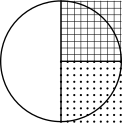
Which one of the following bar graphs could represent the data from the circle graph shown?


Small hint:
Decide what fraction of the whole circle each of the three regions takes up
Big hint:
Each shaded region is a quarter and the unshaded region is a half, so the three bars should have heights in the ratio
Solution:
The two shaded regions are each one quarter of the circle, and the unshaded region is one half. So the three quantities are in the ratio or
A matching bar graph must have the two shaded bars equal in height and the unshaded bar exactly twice as tall. Only one bar graph has two equal shaded bars with the white bar double their height.
Thus, the correct answer is C .
6.
A can of soup can feed adults or children. If there are cans of soup and children are fed, then how many adults would the remaining soup feed?
Small hint:
children need cans, so find how many cans remain
Big hint:
Each remaining can feeds adults
Solution:
Feeding children uses cans, leaving cans.
Those cans feed adults.
Thus, the correct answer is B .
7.
Small hint:
Adding three copies of is the same as
Big hint:
Solution:
Adding three equal terms,
Thus, the correct answer is A .
8.
To control her blood pressure, Jill’s grandmother takes one half of a pill every other day. If one supply of medicine contains pills, then the supply of medicine will last approximately
month
months
months
months
year
Small hint:
Half a pill every other day means one whole pill covers days
Big hint:
Find the total number of days, then convert to months using about days per month
Solution:
She takes half a pill every two days, so one pill lasts days. Then pills last days.
At about days per month, that is roughly months.
Thus, the correct answer is D .
9.
Consider the operation defined by the following table:
For example, Then
Small hint:
Read from row column and from row column
Big hint:
Both inner values equal so compute from the table
Solution:
From the table, and
Then
Thus, the correct answer is D .
10.
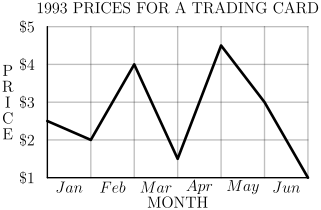
This line graph represents the price of a trading card during the first months of The greatest monthly drop in price occurred during which month?
January
March
April
May
June
Small hint:
A drop happens where the line goes down from one month to the next; measure how far it falls each time
Big hint:
Compare only the downward segments and find the steepest one
Solution:
The price changes month to month are: January (drop ), February (rise), March (drop ), April (rise), May (drop ), and June (drop ).
The largest drop is which occurred during March.
Thus, the correct answer is B .
11.
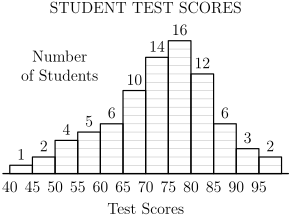
Consider this histogram of the scores for students taking a test. The median is in the interval labeled which value?
Small hint:
With scores in order, the median is the middle one: the st score counting from the lowest
Big hint:
Add the bar heights from left to right until the running total first reaches
Solution:
Since students took the test, the median is the st score counting up from the lowest.
Adding the bar heights from the left gives running totals The total first passes at the interval labeled which contains the th through nd scores. So the st score lies in the interval labeled
Thus, the correct answer is C .
12.
If each of the three operation signs, is used exactly once in one of the blanks in the expression
then the value of the result could equal
Small hint:
Multiplication happens before addition and subtraction, so where you place matters most
Big hint:
Work through each way of assigning to the three blanks and compute the result
Solution:
The six arrangements give and
The only value among the choices is
Thus, the correct answer is E .
13.
The word “HELP” in block letters is painted as a shaded region with strokes unit wide on a by rectangular sign. Each letter is units wide with a -unit gap between letters, as shown. The area of the unshaded portion of the sign, in square units, is

Small hint:
The whole sign is square units
Big hint:
Count the shaded unit squares making up each letter, then subtract the total from
Solution:
The full sign has area square units. Counting the shaded unit squares in each letter gives and for a shaded total of
The unshaded area is
Thus, the correct answer is D .
14.
The nine squares in the table shown are to be filled so that every row and every column contains each of the numbers Then
Small hint:
Each row and each column must contain exactly once
Big hint:
Once two entries of a row or column are known, the third is forced; fill in step by step
Solution:
Filling the grid so each row and column has the top row becomes the middle row and the bottom row The middle row forces and the last column forces
So
Thus, the correct answer is C .
15.
The arithmetic mean (average) of four numbers is If the largest of these numbers is then the mean of the remaining three numbers is
Small hint:
The four numbers sum to
Big hint:
Subtract the largest number, then divide the remaining sum by
Solution:
The four numbers sum to so the remaining three sum to
Their mean is
Thus, the correct answer is A .
16.
What is the value of the following expression?
Small hint:
Work from the bottom up: first simplify
Big hint:
Then and take the reciprocal
Solution:
Starting inside, so
Then and the whole expression is
Thus, the correct answer is C .
17.
Square corners, units on a side, are removed from a unit by unit rectangular sheet of cardboard. The sides are then folded to form an open box. The surface area, in square units, of the interior of the box is
Small hint:
Folding does not change area; the interior surface equals the sheet minus the four corner squares
Big hint:
The sheet is subtract four corner squares
Solution:
The interior surface is exactly one face of the cardboard after the corners are removed. The sheet has area and each removed corner has area
So the interior surface area is
Thus, the correct answer is B .
18.
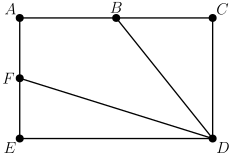
The rectangle shown has length width and and are midpoints of and respectively. The area of the quadrilateral is
Small hint:
The rectangle has area remove the parts outside
Big hint:
Subtract triangle and triangle from the full rectangle
Solution:
Rectangle has area Triangle has area and triangle has area
The remaining region has area
Thus, the correct answer is A .
19.
What is the value of the following expression?
Small hint:
Pair each term with the one below it:
Big hint:
Each of the pairs has difference
Solution:
Each number in the first sum is exactly more than the matching number in the second sum, and there are such pairs.
So the difference is
Thus, the correct answer is A .
20.
When is expressed as a single whole number, the sum of the digits is
Small hint:
is a followed by zeros; subtracting changes only the right end
Big hint:
The result is a block of nines ending in determine how many nines there are
Solution:
Subtracting from (a followed by zeros) gives a number that is nines followed by
The digit sum is
Thus, the correct answer is D .
21.
If the length of a rectangle is increased by and its width is increased by then the area is increased by
Small hint:
New area (new length) (new width) times the old area
Big hint:
Multiply the two growth factors and to get the factor by which the area grows
Solution:
The new length is times the old and the new width is times the old, so the new area is times the old area.
That is an increase of
Thus, the correct answer is D .
22.
Pat Peano has plenty of ’s, ’s, ’s, ’s, ’s, ’s, ’s, ’s and ’s, but he has only twenty-two ’s. How far can he number the pages of his scrapbook with these digits?
Small hint:
Count how many ’s appear when numbering pages through
Big hint:
Ten ’s appear in the units place and ten in the tens place through then track the remaining twos past
Solution:
Numbering through uses ten ’s in the units place and ten in the tens place, a total of twenty ’s. Pages and use none.
The remaining two ’s are used on pages and After that, pages through need no but would require another so he can number up to
Thus, the correct answer is D .
23.
Five runners, have a race, and beats beats beats and finishes after and before Who could not have finished third in the race?
and
and
and
and
and
Small hint:
finishes ahead of and while finishes ahead of determine ’s place
Big hint:
If several runners must all finish ahead of a given runner, that runner cannot be as high as third
Solution:
Since beats and finishes ahead of and beats runner finishes first and so cannot be third.
The clues give the chain before before before So and all finish ahead of meaning is no better than fourth and cannot be third either.
Each of can finish third: for example puts third; puts third; and puts third. So only and cannot be third.
Thus, the correct answer is C .
24.
What number is directly above in this array of numbers?
Small hint:
Each row ends at a perfect square: row ends at
Big hint:
is in the row ending at the row above ends at and the rows line up at their right edges
Solution:
Each row ends at a perfect square, so the row containing ends at and the row above it ends at
Since the rows are aligned at their right edges, sits directly above and therefore sits directly above
Thus, the correct answer is C .
25.
A checkerboard consists of one-inch squares. A square card, inches on a side, is placed on the board so that it covers part or all of the area of each of squares. The maximum possible value of is
or
or
or
or
or more
Small hint:
A tilted card can cross more grid lines than a card lined up with the squares; the card’s diagonal has length
Big hint:
Try tilting the card with its center on a grid corner, and count how many squares each corner of the card pokes into
Solution:
Tilt the card and center it on a corner where four grid squares meet, as shown. Because the card’s diagonal, is longer than each of the four corners of the card reaches past a grid line into the next square.
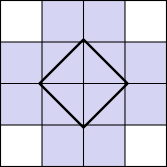
The card covers the central block of squares and pokes into more squares on each of its four sides, giving squares.
This is also the most possible. The card is only inches wide, so its overall width and height are each at most inches; it therefore lies within a block of squares. Its four pointed corners are the only parts that reach the edge of that block, so it can never reach the four corner squares of the block, leaving at most Since is achievable, the maximum is which falls in the range “ or more.”
Thus, the correct answer is E .