
Problemas del 2018 AMC 10B
¡Desplázate hacia abajo y presiona Iniciar para intentar el examen! O ve al PDF imprimible, la clave de respuestas, o las soluciones profesionales preparadas por LIVE by Po-Shen Loh.
Todos los problemas se usan con el permiso legal oficial de la Mathematical Association of America (MAA).
O salta directamente a un solo problema con su solución: 1 · 2 · 3 · 4 · 5 · 6 · 7 · 8 · 9 · 10 · 11 · 12 · 13 · 14 · 15 · 16 · 17 · 18 · 19 · 20 · 21 · 22 · 23 · 24 · 25
¿Quieres aprender de forma profesional con clases interactivas en video?
Con tiempo
1:15:00
1.
Kate hornea una bandeja de pan de maíz de pulgadas por pulgadas. El pan de maíz se corta en piezas que miden pulgadas por pulgadas. ¿Cuántas piezas de pan de maíz contiene la bandeja?
Kate bakes a -inch by -inch pan of cornbread. The cornbread is cut into pieces that measure inches by inches. How many pieces of cornbread does the pan contain?
Respuesta: A
Pista pequeña:
La bandeja y cada pieza son rectángulos; compara sus áreas.
The pan and each piece are rectangles; compare their areas
Pista grande:
Divide el área total entre el área de una pieza de .
Divide the total area by the area of one piece
Solución:
Toda la bandeja tiene un área de pulgadas cuadradas. Cada pieza es de pulgadas cuadradas. Así, el número de piezas es Por lo tanto, A es la respuesta correcta.
The whole pan has area square inches. Each piece is square inches. So the number of pieces is Thus, A is the correct answer.
2.
Sam condujo millas en minutos. Su velocidad promedio durante los primeros minutos fue de mph (millas por hora), y su velocidad promedio durante los segundos minutos fue de mph. ¿Cuál fue su velocidad promedio, en mph, durante los últimos minutos?
Sam drove miles in minutes. His average speed during the first minutes was mph (miles per hour), and his average speed during the second minutes was mph. What was his average speed, in mph, during the last minutes?
Respuesta: D
Pista pequeña:
Distancia = velocidad tiempo, y cada tramo de minutos es media hora.
Distance = rate time, and each -minute leg is half an hour
Pista grande:
Resta de la distancia recorrida en la primera hora para obtener la distancia del último tramo.
Subtract the distance covered in the first hour from to get the last leg’s distance
Solución:
Cada tramo dura media hora. En el primero, Sam condujo millas; en el segundo, millas. Eso da millas hasta ahora. Quedan millas para la última media hora, lo que corresponde a una velocidad de mph. Por lo tanto, la respuesta es D.
Each leg is half an hour. In the first, Sam drove miles; in the second, miles. That’s miles so far. That leaves miles for the last half hour, which is a speed of mph. Therefore, the answer is D.
3.
En la expresión cada espacio en blanco debe llenarse con uno de los dígitos o usando cada dígito una sola vez. ¿Cuántos valores diferentes se pueden obtener?
In the expression each blank is to be filled in with one of the digits or with each digit being used once. How many different values can be obtained?
Respuesta: B
Pista pequeña:
Ni la multiplicación ni la suma final dependen del orden, así que solo importa cómo se dividen los cuatro dígitos en dos pares.
Neither multiplication nor the final addition depends on order, so only the way the four digits are split into two pairs matters
Pista grande:
Enumera las tres maneras de dividir en dos pares.
List the three ways to split into two pairs
Solución:
El orden dentro de un producto no importa, y tampoco importa el orden en que sumamos los dos productos. Así que lo único que importa es cómo se dividen los cuatro dígitos en dos pares. Hay tres divisiones: y Eso da valores diferentes. Por lo tanto, B es la respuesta correcta.
Order inside a product doesn’t matter, and neither does the order we add the two products. So all that matters is how the four digits split into two pairs. There are three splits: and That’s different values. Thus, B is the correct answer.
4.
Una caja rectangular tridimensional con dimensiones y tiene caras cuyas áreas superficiales son y unidades cuadradas. ¿Cuánto vale ?
A three-dimensional rectangular box with dimensions and has faces whose surface areas are and square units. What is
Respuesta: B
Pista pequeña:
Las tres áreas de cara distintas son los productos por pares iguales a .
The three distinct face areas are the pairwise products equal to
Pista grande:
Multiplicar los tres da toma la raíz cuadrada y luego divide entre cada área de cara.
Multiplying all three gives take the square root, then divide by each face area
Solución:
Las tres áreas de cara distintas son los productos por pares en algún orden. Multiplica los tres: así que Ahora divide entre cada área de cara. Obtenemos y de modo que Por lo tanto, la respuesta es B.
The three distinct face areas are the pairwise products in some order. Multiply all three: so Now divide by each face area. We get and so Therefore, the answer is B.
5.
¿Cuántos subconjuntos de contienen al menos un número primo?
How many subsets of contain at least one prime number?
Respuesta: D
Pista pequeña:
Cuenta los subconjuntos sin ningún primo y réstalos del número total de subconjuntos.
Count the subsets with no prime and subtract from the total number of subsets
Pista grande:
Los elementos que no son primos son cualquier subconjunto formado solo por ellos no contiene ningún primo.
The non-prime elements are any subset of just those contains no prime
Solución:
Cuenta el complemento. El conjunto tiene subconjuntos en total. Un subconjunto evita todos los primos exactamente cuando se limita a los no primos y hay de esos. Así, subconjuntos contienen al menos un primo. Por lo tanto, D es la respuesta correcta.
Count the complement. The set has subsets total. A subset avoids every prime exactly when it sticks to the non-primes and there are of those. So subsets contain at least one prime. Thus, D is the correct answer.
6.
Una caja contiene fichas, numeradas y Se extraen fichas al azar una a la vez sin reemplazo hasta que la suma de los valores extraídos supere ¿Cuál es la probabilidad de que se necesiten extracciones?
A box contains chips, numbered and Chips are drawn randomly one at a time without replacement until the sum of the values drawn exceeds What is the probability that draws are required?
Respuesta: D
Pista pequeña:
Se necesita una tercera extracción exactamente cuando las dos primeras fichas siguen sumando a lo sumo .
A third draw is needed exactly when the first two chips still sum to at most
Pista grande:
¿Qué pares de fichas distintas suman o menos? Cuéntalos entre todos los resultados ordenados de las dos primeras extracciones.
Which pairs of distinct chips sum to or less? Count them among all ordered first-two-draw outcomes
Solución:
Necesitamos una tercera extracción exactamente cuando las dos primeras fichas todavía suman o menos. Los únicos pares no ordenados así son y Cada uno puede extraerse en cualquiera de los dos órdenes, lo que da prefijos ordenados favorables.
Imagina que de antemano se fija un orden aleatorio completo de las cinco fichas. Entonces los prefijos ordenados de dos fichas son igualmente probables, incluso cuando el proceso real se detendría después de la primera ficha. Así, la probabilidad es Por lo tanto, la respuesta es D.
We need a third draw exactly when the first two chips still sum to or less. The only such unordered pairs are and Each can be drawn in either order, giving favorable ordered prefixes.
Imagine that a complete random ordering of all five chips is chosen in advance. Then all ordered first-two-chip prefixes are equally likely, even when the actual process would stop after the first chip. Thus the probability is Therefore, the answer is D.
7.
En la figura de abajo, se dibujan semicírculos congruentes a lo largo de un diámetro de un semicírculo grande, con sus diámetros cubriendo el diámetro del semicírculo grande sin superposición. Sea el área combinada de los semicírculos pequeños y el área de la región dentro del semicírculo grande pero fuera de los semicírculos pequeños. La razón es ¿Cuánto vale ?
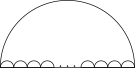
In the figure below, congruent semicircles are drawn along a diameter of a large semicircle, with their diameters covering the diameter of the large semicircle with no overlap. Let be the combined area of the small semicircles and be the area of the region inside the large semicircle but outside the small semicircles. The ratio is What is
Respuesta: D
Pista pequeña:
Si cada semicírculo pequeño tiene radio el semicírculo grande tiene radio .
If each small semicircle has radius the large semicircle has radius
Pista grande:
Demuestra que y luego iguálalo a .
Show then set this equal to
Solución:
Sea el radio de cada semicírculo pequeño igual a Los diámetros cubren el diámetro grande, así que el radio grande es Entonces y el semicírculo grande tiene área por lo que la región restante es Esto da Pon y Por lo tanto, D es la respuesta correcta.
Let each small semicircle have radius The diameters cover the big diameter, so the large radius is Then and the large semicircle has area so the leftover region is This gives Set and Thus, D is the correct answer.
8.
Sara construye una escalera con palillos, como se muestra:

Esta es una escalera de escalones y usa palillos. ¿Cuántos escalones tendría una escalera que usara palillos?
Sara makes a staircase out of toothpicks as shown:
This is a -step staircase and uses toothpicks. How many steps would be in a staircase that used toothpicks?
Respuesta: C
Pista pequeña:
Cuenta los palillos en una escalera de escalones; los verticales suman .
Count the toothpicks in an -step staircase; the vertical ones number
Pista grande:
Como hay igual número de horizontales y verticales, el total es resuelve .
With equal horizontal and vertical counts the total is solve
Solución:
En una escalera de escalones, los palillos verticales suman y hay otros tantos horizontales. Eso da un total de Comprobación: da como debe ser. Ahora resuelve Esto se factoriza como así que Por lo tanto, la respuesta es C.
In an -step staircase the vertical toothpicks number and there are just as many horizontal ones. That’s a total of Check: gives as it should. Now solve This factors as so Therefore, the answer is C.
9.
Las caras de cada uno de dados estándar están etiquetadas con los enteros del al Sea la probabilidad de que, al lanzar los dados, la suma de los números de las caras superiores sea ¿Qué otra suma ocurre con la misma probabilidad ?
The faces of each of standard dice are labeled with the integers from to Let be the probability that when all dice are rolled, the sum of the numbers on the top faces is What other sum occurs with the same probability
Respuesta: D
Pista pequeña:
Reemplazar cada valor de un dado por empareja resultados igualmente probables.
Replacing each die value by pairs up equally likely outcomes
Pista grande:
Este reemplazo convierte un total de en un total de .
This replacement sends a total of to a total of
Solución:
Reemplaza el valor de cada dado por Esto empareja los resultados uno a uno y conserva sus probabilidades, y convierte un total de en Así, las sumas y son igualmente probables. La pareja de es Por lo tanto, D es la respuesta correcta.
Replace each die’s value by This pairs up outcomes one-to-one and keeps their probabilities, and it sends a total of to So the sums and are equally likely. The partner of is Thus, D is the correct answer.
10.
En el paralelepípedo rectangular mostrado, y El punto es el punto medio de ¿Cuál es el volumen de la pirámide rectangular con base y ápice ?

In the rectangular parallelepiped shown, and Point is the midpoint of What is the volume of the rectangular pyramid with base and apex
Respuesta: E
Pista pequeña:
Coloca en el origen con las aristas a lo largo de los ejes; halla el rectángulo y su área.
Place at the origin with the edges along the axes; find the rectangle and its area
Pista grande:
Volumen .
Volume
Solución:
Coloca en el origen con las aristas a lo largo de los ejes: de modo que La base es un rectángulo con y por lo que su área es Su plano es y está a distancia de él. El volumen es Por lo tanto, la respuesta es E.
Put at the origin with edges along the axes: so The base is a rectangle with and hence area Its plane is and sits at distance from it. The volume is Therefore, the answer is E.
11.
¿Cuál de las siguientes expresiones nunca es un número primo cuando es un número primo?
Which of the following expressions is never a prime number when is a prime number?
Respuesta: C
Pista pequeña:
Prueba las expresiones módulo para un primo se tiene .
Test the expressions modulo for a prime
Pista grande:
Para la opción correcta, comprueba también por separado, y luego muestra que es múltiplo de para todos los demás primos.
For the correct choice, also check separately, then show it is a multiple of for all other primes
Solución:
Observa Cuando vale Para cualquier otro primo, no es divisible entre así que y En cualquier caso es múltiplo de mayor que por lo tanto compuesto. Así que nunca es primo. Por lo tanto, C es la respuesta correcta.
Look at When it’s For any other prime, isn’t divisible by so and Either way it’s a multiple of bigger than hence composite. So it’s never prime. Thus, C is the correct answer.
12.
El segmento es un diámetro de un círculo con El punto distinto de y está en el círculo. A medida que el punto se mueve alrededor del círculo, el centroide (centro de masa) de traza una curva cerrada a la que le faltan dos puntos. Redondeando al entero positivo más cercano, ¿cuál es el área de la región limitada por esta curva?
Line segment is a diameter of a circle with Point not equal to or lies on the circle. As point moves around the circle, the centroid (center of mass) of traces out a closed curve missing two points. To the nearest positive integer, what is the area of the region bounded by this curve?
Respuesta: C
Pista pequeña:
El centroide de es y es el doble del centro.
The centroid of is and is twice the center
Pista grande:
A medida que se mueve sobre un círculo de radio el centroide se mueve sobre un círculo de un tercio del radio.
As moves on a circle of radius the centroid moves on a circle of one third the radius
Solución:
Coloca el centro en el origen, de modo que y mientras que recorre el círculo de radio Entonces así que el centroide es A medida que da la vuelta, traza un círculo de radio (menos los dos puntos donde o ). Su área es Por lo tanto, la respuesta es C.
Put the center at the origin, so and while runs over the circle of radius Then so the centroid is As circles, traces a circle of radius (minus the two points where or ). Its area is Therefore, the answer is C.
13.
¿Cuántos de los primeros números de la sucesión son divisibles entre ?
How many of the first numbers in the sequence are divisible by
Respuesta: C
Pista pequeña:
El -ésimo término es que es divisible entre cuando .
The -th term is which is divisible by when
Pista grande:
así que exactamente cuando .
so exactly when
Solución:
El -ésimo término es al cual divide si y solo si Nota que Así, exactamente cuando es decir o sea Entre los valores suman Por lo tanto, C es la respuesta correcta.
The -th term is which divides iff Notice So exactly when meaning that is Among the values number Thus, C is the correct answer.
14.
Una lista de enteros positivos tiene una única moda, que aparece exactamente veces. ¿Cuál es el menor número de valores distintos que pueden aparecer en la lista?
A list of positive integers has a unique mode, which occurs exactly times. What is the least number of distinct values that can occur in the list?
Respuesta: D
Pista pequeña:
Todo valor distinto de la moda puede aparecer a lo sumo veces, para que la moda siga siendo única.
Every value other than the mode can appear at most times, to keep the mode unique
Pista grande:
Con valores distintos, la lista contiene a lo sumo elementos; haz que esto sea al menos .
With distinct values the list holds at most entries; make this at least
Solución:
La moda aparece veces. Para mantener pequeño el número de valores distintos, deja que cada otro valor se repita tanto como permitan las reglas, que es veces cada uno (más igualaría a la moda). Con valores distintos, la lista contiene a lo sumo elementos. Necesitamos así que lo que da Por lo tanto, la respuesta es D.
The mode shows up times. To keep the number of distinct values small, let every other value repeat as much as the rules allow, which is times each (any more would tie the mode). With distinct values the list holds at most entries. We need so giving Therefore, the answer is D.
15.
Una caja cerrada de base cuadrada se va a envolver con una hoja cuadrada de papel. La caja se centra sobre el papel, con los vértices de la base sobre las líneas medias de la hoja cuadrada, como muestra la figura izquierda. Las cuatro esquinas del papel se doblan sobre los lados de la caja y se juntan en el centro de la cara superior, el punto de la figura derecha. La base de la caja tiene lado y altura ¿Cuál es el área de la hoja de papel?
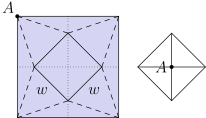
A closed box with a square base is to be wrapped with a square sheet of wrapping paper. The box is centered on the wrapping paper with the vertices of the base lying on the midlines of the square sheet of paper, as shown in the figure on the left. The four corners of the wrapping paper are to be folded up over the sides and brought together to meet at the center of the top of the box, point in the figure on the right. The box has base length and height What is the area of the sheet of wrapping paper?
Respuesta: A
Pista pequeña:
Si la hoja tiene lado la distancia de su centro a una esquina es .
If the sheet has side its center-to-corner distance is
Pista grande:
Doblar una esquina hacia el centro superior cubre, en línea recta, la mitad de la base, luego el lado de altura y luego la otra mitad de la parte superior.
Folding a corner to the top center covers, in a straight line, half the base, then the side of height then the other half of the top
Solución:
Sea el lado de la hoja igual a La base se dispone como un cuadrado de lado girado así que el centro está a de cada borde de la base. Una esquina de la hoja está a del centro. Doblar esa esquina hasta el centro superior traza una línea recta: hasta el borde de la base, luego subiendo por el lado, y luego cruzando la parte superior. Así que Entonces y el área es Por lo tanto, A es la respuesta correcta.
Let the sheet have side The base sits as a square of side turned so the center is from each base edge. A corner of the sheet lies from the center. Folding that corner up to the top center traces a straight line: out to the base edge, then up the side, then across the top. So Then and the area is Thus, A is the correct answer.
16.
Sea una sucesión estrictamente creciente de enteros positivos tal que
¿Cuál es el residuo cuando se divide entre ?
Let be a strictly increasing sequence of positive integers such that
What is the remainder when is divided by
Respuesta: E
Pista pequeña:
porque es un producto de tres enteros consecutivos.
because is a product of three consecutive integers
Pista grande:
Por lo tanto, la suma de cubos es congruente con reduce eso módulo .
So the sum of cubes is congruent to reduce that modulo
Solución:
Para cualquier entero es un producto de tres enteros consecutivos, así que es divisible entre Eso significa que Sumando, Ahora bien, y las potencias de módulo alternan El exponente es par, así que El residuo es Por lo tanto, la respuesta es E.
For any integer is a product of three consecutive integers, so it’s divisible by That means Summing, Now and powers of mod alternate The exponent is even, so The remainder is Therefore, the answer is E.
17.
En el rectángulo y Los puntos y están en los puntos y están en los puntos y están en y los puntos y están en de modo que y el octágono convexo es equilátero. La longitud de un lado de este octágono se puede expresar en la forma donde y son enteros y no es divisible entre el cuadrado de ningún primo. ¿Cuánto vale ?
In rectangle and Points and lie on points and lie on points and lie on and points and lie on so that and the convex octagon is equilateral. The length of a side of this octagon can be expressed in the form where and are integers and is not divisible by the square of any prime. What is
Respuesta: B
Pista pequeña:
Las cuatro esquinas cortadas son triángulos rectángulos congruentes con catetos (sobre los lados de longitud ) y (sobre los lados de longitud ).
The four cut corners are congruent right triangles with legs (on the sides of length ) and (on the sides of length )
Pista grande:
Los lados iguales dan la primera igualdad da luego sustituye y eleva al cuadrado.
The equal sides give the first equality gives then substitute and square
Solución:
Sea la longitud del lado del octágono y sea Los triángulos rectángulos y tienen la misma hipotenusa y un cateto de longitud así que son congruentes; escribamos Como y los lados verticales del rectángulo miden se sigue que Los triángulos rectángulos en y son entonces congruentes, así que Como y cada una de estas longitudes iguales es Así, las cuatro esquinas recortadas tienen catetos y
Los lados iguales del octágono dan La primera igualdad da Al sustituir y elevar al cuadrado, obtenemos por lo que la raíz con es
La longitud del lado es así que Por lo tanto, B es la respuesta correcta.
Let be the octagon’s side length and let The right triangles and have the same hypotenuse and a leg of length so they are congruent; write Because and the vertical sides of the rectangle both have length it follows that The right triangles at and are then congruent, so Since and each of these equal lengths is Thus all four cut corners have legs and
The equal octagon sides give The first equality gives Substituting and squaring gives so the root with is
The side length is so Thus, B is the correct answer.
18.
Tres jóvenes parejas de hermano y hermana de distintas familias necesitan hacer un viaje en una furgoneta. Estos seis niños ocuparán la segunda y la tercera fila de la furgoneta, cada una con tres asientos. Para evitar alborotos, los hermanos no pueden sentarse justo al lado del otro en la misma fila, y ningún niño puede sentarse directamente delante de su hermano o hermana. ¿Cuántas disposiciones de asientos son posibles para este viaje?
Three young brother-sister pairs from different families need to take a trip in a van. These six children will occupy the second and third rows in the van, each of which has three seats. To avoid disruptions, siblings may not sit right next to each other in the same row, and no child may sit directly in front of his or her sibling. How many seating arrangements are possible for this trip?
Respuesta: D
Pista pequeña:
Demuestra que cada fila debe contener exactamente un niño de cada familia.
Show that each row must contain exactly one child from each family
Pista grande:
Las familias de la tercera fila deben diferir de las de la segunda fila en cada columna (un desarreglo), y los dos niños de cada pareja pueden intercambiarse entre sus asientos.
The third row’s families must differ from the second row’s in every column (a derangement), and each pair’s two children can be swapped between their seats
Solución:
Supón que alguna familia coloca a sus dos niños en una fila. Tendrían que ocupar los asientos no adyacentes y lo que obliga a los dos niños de la familia del medio a quedar en la misma columna. No está permitido. Así que cada fila tiene exactamente un niño de cada familia. La segunda fila es una permutación de las tres familias, maneras. La tercera fila necesita una familia diferente en cada columna, un desarreglo del orden de la segunda fila, y hay de esos. Por último, cada pareja puede intercambiar a sus dos niños entre sus asientos, maneras. El total es Por lo tanto, la respuesta es D.
Suppose some family put both children in one row. They’d have to take the non-adjacent seats and which forces the middle family’s two children into the same column. Not allowed. So each row holds exactly one child from each family. The second row is a permutation of the three families, ways. The third row needs a different family in every column, a derangement of the second row’s order, and there are of those. Finally, each pair can swap its two children between their seats, ways. The total is Therefore, the answer is D.
19.
Joey y Chloe y su hija Zoe cumplen años el mismo día. Joey es año mayor que Chloe, y Zoe tiene hoy exactamente año. Hoy es el primero de los cumpleaños en los que la edad de Chloe será un múltiplo entero de la edad de Zoe. ¿Cuál será la suma de los dos dígitos de la edad de Joey la próxima vez que su edad sea un múltiplo de la de Zoe?
Joey and Chloe and their daughter Zoe all have the same birthday. Joey is year older than Chloe, and Zoe is exactly year old today. Today is the first of the birthdays on which Chloe’s age will be an integral multiple of Zoe’s age. What will be the sum of the two digits of Joey’s age the next time his age is a multiple of Zoe’s age?
Respuesta: E
Pista pequeña:
Sea la edad de Chloe hoy. En años su edad es un múltiplo de la de Zoe si y solo si divide a .
Let Chloe be today. In years her age is a multiple of Zoe’s iff divides
Pista grande:
Que haya exactamente de esos cumpleaños significa que tiene divisores; halla el valor de dos dígitos, luego repite la idea de los divisores para Joey.
Exactly such birthdays means has divisors; find the two-digit value, then repeat the divisor idea for Joey
Solución:
Sea la edad actual de Chloe; Zoe tiene Dentro de años, la razón de sus edades será que es entera exactamente cuando divide a Por tanto, tiene exactamente divisores positivos.
Un número con divisores tiene la forma o La única posibilidad de dos cifras es así que Chloe tiene años y Joey tiene
La edad de Joey, , es múltiplo de la edad de Zoe, , exactamente cuando divide a La siguiente vez ocurre para cuando Joey tiene La suma de sus cifras es Así, E es la respuesta correcta.
Let Chloe be today; Zoe is In years their age ratio is which is an integer exactly when divides Thus has exactly positive divisors.
A number with divisors has the form or The only two-digit possibility is so Chloe is and Joey is
Joey’s age is a multiple of Zoe’s age exactly when divides The next time is when Joey is Its digit sum is Thus, E is the correct answer.
20.
Una función se define recursivamente por y
para todos los enteros ¿Cuánto vale ?
A function is defined recursively by and
for all integers What is
Respuesta: B
Pista pequeña:
Busca una solución particular de la forma restarla deja .
Look for a particular solution of the form subtracting it leaves
Pista grande:
Esa recursión homogénea es periódica con periodo reduce módulo .
That homogeneous recursion is periodic with period reduce modulo
Solución:
Nota que resuelve la recurrencia por sí sola, así que escribe Entonces satisface la versión homogénea Con y esta se repite con periodo : Como obtenemos así que Por lo tanto, la respuesta es B.
Notice solves the recurrence on its own, so write Then satisfies the homogeneous version With and it cycles with period : Since we get so Therefore, the answer is B.
21.
Mary eligió un número par de dígitos Escribió todos los divisores de en orden creciente de izquierda a derecha: En cierto momento Mary escribió como divisor de ¿Cuál es el menor valor posible del siguiente divisor escrito a la derecha de ?
Mary chose an even -digit number She wrote down all the divisors of in increasing order from left to right: At some moment Mary wrote as a divisor of What is the smallest possible value of the next divisor written to the right of
Respuesta: C
Pista pequeña:
y es un múltiplo par de dígitos de .
and is an even -digit multiple of
Pista grande:
Para un candidato a siguiente divisor debe ser un múltiplo de halla el menor que lo mantenga por debajo de .
For a candidate next divisor must be a multiple of find the smallest keeping that under
Solución:
Sea el siguiente divisor después de Si entonces es múltiplo de lo que es imposible para un número de cuatro cifras. Por tanto,
Como este máximo común divisor es al menos También divide a así que y, por tanto,
Esta cota se alcanza: para tanto como son divisores. La cota inferior muestra que no hay divisores entre ellos. Así, el menor divisor siguiente posible es y C es la respuesta correcta.
Let be the next divisor after If then is a multiple of impossible for a four-digit number. Thus
Since this gcd is at least It also divides so and hence
This bound is attained: for both and are divisors. The lower bound shows there is no divisor between them. Thus the smallest possible next divisor is and C is the correct answer.
22.
Los números reales y se eligen de forma independiente y uniforme al azar del intervalo ¿Cuál de los siguientes números es el más cercano a la probabilidad de que y sean las longitudes de los lados de un triángulo obtuso?
Real numbers and are chosen independently and uniformly at random from the interval Which of the following numbers is closest to the probability that and are the side lengths of an obtuse triangle?
Respuesta: C
Pista pequeña:
Un triángulo con lados requiere como es el lado más largo, es obtuso cuando .
A triangle with sides needs since is the longest side it is obtuse when
Pista grande:
En el cuadrado unitario, esta región es un cuarto de disco al que se le quita el triángulo por debajo de .
In the unit square this region is a quarter disk with the triangle below removed
Solución:
Las tres longitudes forman un triángulo si y solo si Como es el lado más largo, ese triángulo es obtuso si y solo si Así, en el cuadrado unitario queremos la región dentro del cuarto de círculo pero por encima de la recta Ese es el cuarto de disco al que se le quita el triángulo rectángulo bajo la cuerda: La opción más cercana es Por lo tanto, la respuesta es C.
The three lengths make a triangle iff Since is the longest side, that triangle is obtuse iff So in the unit square we want the region inside the quarter circle but above the line That’s the quarter disk with the right triangle under the chord removed: The closest choice is Therefore, the answer is C.
23.
¿Cuántos pares ordenados de enteros positivos satisfacen la ecuación
donde denota el máximo común divisor de y y denota su mínimo común múltiplo?
How many ordered pairs of positive integers satisfy the equation
where denotes the greatest common divisor of and and denotes their least common multiple?
Respuesta: B
Pista pequeña:
Usa sea y .
Use let and
Pista grande:
La ecuación se convierte en además debe dividir a .
The equation becomes also must divide
Solución:
Recuerda que Sea y La ecuación se transforma en
Las factorizaciones positivas dan y Las factorizaciones negativas harían negativo a o a así que son imposibles. Además, debe dividir a y solo cumple esa condición.
Escribe y Entonces y así que o Por lo tanto, los dos pares ordenados son y y B es la respuesta correcta.
Recall Let and The equation becomes
The positive factor pairs give and The negative factor pairs make either or negative, so they are impossible. Also must divide and only passes.
Write and Then and so or Hence the two ordered pairs are and and B is the correct answer.
24.
Sea un hexágono regular con longitud de lado Denota por y los puntos medios de los lados y respectivamente. ¿Cuál es el área del hexágono convexo cuyo interior es la intersección de los interiores de y ?
Let be a regular hexagon with side length Denote by and the midpoints of sides and respectively. What is the area of the convex hexagon whose interior is the intersection of the interiors of and
Respuesta: C
Pista pequeña:
es equilátero con lado es equilátero con lado .
is equilateral with side is equilateral with side
Pista grande:
Centrados en el centro del hexágono, los dos triángulos son concéntricos y están rotados la superposición es menos sus tres triángulos de esquina que sobresalen.
Centered at the hexagon’s center the two triangles are concentric and rotated the overlap is minus its three protruding corner triangles
Solución:
El triángulo es equilátero con lado así que su área es
Los triángulos y son concéntricos y están rotados entre sí. En cada vértice de los lados de recortan un triángulo -- cuya hipotenusa es el segmento de medio lado Sus catetos son y así que cada esquina tiene área
Al quitar las tres esquinas, obtenemos Por tanto, la respuesta es C.
The triangle is equilateral with side so its area is
The triangles and are concentric and rotated from each other. At each vertex of the sides of cut off a -- triangle whose hypotenuse is the half-side segment Its legs are and so each corner has area
Removing the three corners gives Therefore, the answer is C.
25.
Sea el mayor entero menor o igual que ¿Cuántos números reales satisfacen la ecuación ?
Let denote the greatest integer less than or equal to How many real numbers satisfy the equation
Respuesta: C
Pista pequeña:
Escribiendo la ecuación es así que .
Writing the equation is so
Pista grande:
En cada intervalo hay una solución exactamente cuando .
On each interval there is a solution exactly when
Solución:
Sea La ecuación se lee y como esto obliga a así que En cada intervalo la cantidad crece desde y se aproxima, sin alcanzarlo, a Alcanza exactamente una vez precisamente cuando Eso se cumple para los enteros que son soluciones. Por lo tanto, C es la respuesta correcta.
Let The equation reads and since this forces so On each interval the quantity increases from and approaches, but does not reach, It hits exactly once precisely when That holds for the integers which is solutions. Thus, C is the correct answer.