
Soluciones del 1996 AMC 12
Desplázate hacia abajo para ver las soluciones preparadas profesionalmente de LIVE by Po-Shen Loh, imprime las soluciones en PDF, consulta la clave de respuestas, o haz el examen cronometrado completo.
Todos los problemas se usan con el permiso legal oficial de la Mathematical Association of America (MAA).
1.
La suma siguiente es incorrecta. ¿Cuál es la cifra mayor que se puede cambiar para que la suma sea correcta?
The addition below is incorrect. What is the largest digit that can be changed to make the addition correct?
Pista pequeña:
Compara la suma mostrada con la suma real de los tres sumandos
Compare the displayed sum with the actual sum of the three addends
Pista grande:
La corrección debe reducir el total en una unidad de una posición determinada
The correction must lower the total by one unit in a particular place
Solución:
La suma de los tres sumandos es que excede en el resultado correcto. Cambiar la cifra de las decenas de por reduce la suma en y da Ninguna cifra mayor de las opciones permite efectuar ese cambio, así que la respuesta correcta es D.
The three addends total which is too large. Changing the tens digit in to lowers the sum by and gives No larger listed digit can make that change, so the correct answer is D.
2.
Cada día, Walter recibe por hacer sus tareas domésticas o por hacerlas excepcionalmente bien. Después de hacerlas todos los días durante días, Walter ha recibido un total de ¿Cuántos días las hizo excepcionalmente bien?
Each day Walter gets for doing his chores or for doing them exceptionally well. After days of doing his chores daily, Walter has received a total of On how many days did Walter do them exceptionally well?
Pista pequeña:
Comienza con la cantidad que Walter ganaría a la tarifa ordinaria durante los diez días
Begin with the amount Walter would earn at the ordinary rate on all ten days
Pista grande:
Cada día de trabajo excepcional añade la misma cantidad a ese valor de referencia
Each exceptionally good day adds the same amount to that baseline
Solución:
Diez días ordinarios pagarían dólares. Cada día excepcional añade dólares, y el total real es dólares mayor. Por tanto, hubo días excepcionales, así que la respuesta correcta es A.
Ten ordinary days would pay dollars. Each exceptional day adds dollars, and the actual total is dollars higher. Thus there were exceptional days, so the correct answer is A.
3.
Pista pequeña:
Evalúa el factorial interior antes que el factorial exterior
Evaluate the inner factorial before the outer factorial
Pista grande:
Cancela el denominador con el producto del numerador
Cancel the denominator from the product in the numerator
Solución:
Como la expresión es Por lo tanto, la respuesta correcta es E.
Since the expression is Thus the correct answer is E.
4.
Seis números de una lista de nueve enteros son y El mayor valor posible de la mediana de los nueve números de la lista es
Six numbers from a list of nine integers are and The largest possible value of the median of all nine numbers in this list is
Pista pequeña:
La mediana es el quinto número después de ordenar los nueve
The median is the fifth number after all nine are sorted
Pista grande:
Para maximizar la mediana, toma cada uno de los tres números no especificados tan grande como sea necesario
To maximize the median, take each of the three unspecified numbers as large as needed
Solución:
Los seis valores especificados, en orden, son Incluso si los tres enteros no especificados son mayores que la quinta entrada de la lista completa ordenada es Esto se puede alcanzar, así que la respuesta correcta es D.
The six specified values in order are Even if all three unspecified integers exceed the fifth entry of the full sorted list is This is attainable, so the correct answer is D.
5.
Dado que ¿cuál de las siguientes expresiones es la mayor?
Given that which of the following is the largest?
Pista pequeña:
Una fracción positiva aumenta cuando crece su numerador o disminuye su denominador
A positive fraction grows when its numerator increases or its denominator decreases
Pista grande:
Compara cada numerador y cada denominador con y , respectivamente
Compare every numerator and denominator with and , respectively
Solución:
Entre los numeradores mostrados, es el mayor; entre los denominadores, es el menor. Por tanto, supera a todas las demás fracciones positivas de la lista, así que la respuesta correcta es E.
Among the displayed numerators, is largest; among the denominators, is smallest. Therefore exceeds every other positive fraction listed, so the correct answer is E.
6.
Si entonces
If then
Pista pequeña:
Evalúa por separado los cuatro valores de la función, prestando atención a los exponentes cero
Evaluate the four function values separately, paying attention to zero exponents
Pista grande:
Los términos para y se anulan antes de que sea necesario considerar alguna potencia problemática
The terms at and vanish before any problematic power is needed
Solución:
La sustitución directa da Su suma es así que la respuesta correcta es E.
Direct substitution gives Their sum is so the correct answer is E.
7.
Un padre lleva a sus gemelos y a un hijo menor a cenar el día del cumpleaños de los gemelos. El restaurante cobra por el padre y por cada año de edad de un niño, donde la edad se define como la cumplida en el cumpleaños más reciente. Si la cuenta es de ¿cuál de las siguientes podría ser la edad del hijo menor?
A father takes his twins and a younger child out to dinner on the twins’ birthday. The restaurant charges for the father and for each year of a child’s age, where age is defined as the age at the most recent birthday. If the bill is which of the following could be the age of the youngest child?
Pista pequeña:
Resta de la cuenta el costo del padre y divide el resto entre el precio por año
Subtract the father’s charge and divide the remainder by the price per year
Pista grande:
Si los gemelos tienen años y el hijo menor tiene , impón y
If the twins are years old and the younger child is , impose both and
Solución:
Los niños representan dólares de la cuenta, así que la suma de sus edades es Si cada gemelo tiene años y el hijo menor tiene entonces con Entre las opciones, da lo cual funciona. Por lo tanto, la respuesta correcta es B.
The children account for dollars, so their ages total If each twin is and the younger child is then with Of the choices, gives which works. Thus the correct answer is B.
8.
Si y entonces
If and then
Pista pequeña:
Divide la segunda ecuación entre la primera para eliminar
Divide the second equation by the first to eliminate
Pista grande:
Reescribe como una sola potencia de
Rewrite as a single power of
Solución:
Al dividir las ecuaciones se obtiene Por tanto, así que la respuesta correcta es D.
Dividing the equations gives Hence so the correct answer is D.
9.
El triángulo y el cuadrado están en planos perpendiculares. Dado que y ¿cuánto mide ?
Triangle and square are in perpendicular planes. Given that and what is
Pista pequeña:
Primero identifica el ángulo recto en el triángulo -- llamado
First identify the right angle in the -- triangle
Pista grande:
Una recta de uno de los planos perpendicular a la intersección de los planos es perpendicular al otro plano
A line in one plane perpendicular to the planes’ intersection is perpendicular to the other plane
Solución:
Como el triángulo es rectángulo en En el cuadrado y Como los dos planos son perpendiculares a lo largo de es perpendicular al plano de y, por tanto, a Así, La respuesta correcta es B.
Since triangle is right at In square and Because the two planes are perpendicular along is perpendicular to the plane of and hence to Thus The correct answer is B.
10.
¿Cuántos segmentos tienen ambos extremos en los vértices de un cubo dado?
How many line segments have both their endpoints located at the vertices of a given cube?
Pista pequeña:
Un segmento queda determinado al elegir dos vértices distintos del cubo
A segment is determined by choosing two distinct cube vertices
Pista grande:
Cuenta los pares no ordenados entre los ocho vértices del cubo
Count unordered pairs among the cube’s eight vertices
Solución:
Cada par no ordenado de los vértices del cubo determina un segmento, incluidas las aristas y las diagonales. Hay así que la respuesta correcta es D.
Every unordered pair of the cube’s vertices determines one segment, including edges and diagonals. There are so the correct answer is D.
11.
Dado un círculo de radio hay muchos segmentos de longitud tangentes al círculo en sus puntos medios. Halla el área de la región formada por todos esos segmentos.
Given a circle of radius there are many line segments of length that are tangent to the circle at their midpoints. Find the area of the region consisting of all such line segments.
Pista pequeña:
Cada segmento tangente se extiende una unidad en cada dirección desde su punto medio
Each tangent segment extends one unit in each direction from its midpoint
Pista grande:
Usa un triángulo rectángulo desde el centro del círculo para hallar los radios interior y exterior de la región barrida
Use a right triangle from the circle’s center to locate the inner and outer radii of the swept region
Solución:
Cada segmento está centrado en un punto de tangencia situado a unidades del centro del círculo y se extiende unidad sobre la tangente en ambas direcciones. Al girar el punto de tangencia, los segmentos llenan el anillo de radio interior y radio exterior Su área es así que la respuesta correcta es D.
Each segment is centered at a tangency point units from the circle’s center and extends unit along the tangent in both directions. As the tangency point rotates, the segments fill the annulus with inner radius and outer radius Its area is so the correct answer is D.
12.
Una función de los enteros a los enteros se define de la siguiente manera: Supón que es impar y que ¿Cuál es la suma de las cifras de ?
A function from the integers to the integers is defined as follows: Suppose is odd and What is the sum of the digits of
Pista pequeña:
Como es impar, la primera iteración es , que es par
Because is odd, the first iterate is , which is even
Pista grande:
Trabaja hacia atrás desde , comprobando la paridad que exige cada rama inversa
Work backward from , checking the parity required by each inverse branch
Solución:
Como es impar, es par, así que Si este valor fuera impar, sumar no podría producir , pues eso exigiría que el valor fuera Por tanto, es par y al dividirlo entre dos se obtiene de modo que Así, cuyas cifras suman La respuesta correcta es B.
Since is odd, is even, so If this value were odd, adding could not produce because that would require the value Therefore it is even and is halved to so Hence whose digits sum to The correct answer is B.
13.
Sunny corre a velocidad constante y Moonbeam corre veces más rápido, donde es un número mayor que Si Moonbeam da a Sunny una ventaja inicial de metros, ¿cuántos metros debe correr Moonbeam para alcanzarlo?
Sunny runs at a steady rate, and Moonbeam runs times as fast, where is a number greater than If Moonbeam gives Sunny a head start of meters, how many meters must Moonbeam run to overtake Sunny?
Pista pequeña:
Sea la velocidad de Sunny y la velocidad de Moonbeam
Let Sunny’s speed be and Moonbeam’s speed be
Pista grande:
Si Moonbeam corre metros, expresa en función de la distancia que recorre Sunny durante el mismo tiempo
If Moonbeam runs meters, express Sunny’s distance during the same time in terms of
Solución:
Supón que Moonbeam corre metros. El tiempo transcurrido es así que Sunny recorre metros después de la salida. Al alcanzarlo, Al resolver se obtiene así que la respuesta correcta es D.
Suppose Moonbeam runs meters. The elapsed time is so Sunny runs meters after the start. At the catch, Solving gives so the correct answer is D.
14.
Sea la suma de las cifras pares de Por ejemplo, Halla
Let denote the sum of the even digits of For example, Find
Pista pequeña:
Incluye ceros iniciales y considera los enteros desde hasta
Include leading zeros and consider the integers from through
Pista grande:
En cada posición, todas las cifras aparecen el mismo número de veces
In each digit position, every digit occurs equally often
Solución:
Desde hasta cada cifra aparece veces en cada una de las dos posiciones. Las cifras pares positivas suman así que la contribución total es El número no aporta ninguna cifra par positiva, así que la respuesta correcta es C.
From through each digit occurs times in each of the two positions. The positive even digits sum to so the total contribution is The number contributes no even positive digit, so the correct answer is C.
15.
Dos lados opuestos de un rectángulo se dividen, cada uno, en segmentos congruentes, y los extremos de uno de estos segmentos se unen al centro para formar el triángulo Los otros dos lados se dividen, cada uno, en segmentos congruentes, y los extremos de uno de estos segmentos se unen al centro para formar el triángulo (Se muestra el caso ) ¿Cuál es la razón entre el área del triángulo y el área del triángulo ?
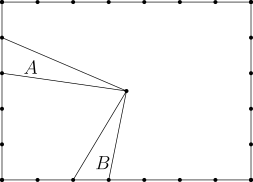
Two opposite sides of a rectangle are each divided into congruent segments, and the endpoints of one segment are joined to the center to form triangle The other sides are each divided into congruent segments, and the endpoints of one of these segments are joined to the center to form triangle [See figure for ] What is the ratio of the area of triangle to the area of triangle
Pista pequeña:
Representa las longitudes de los lados del rectángulo por y
Write the rectangle’s side lengths as and
Pista grande:
Cada triángulo tiene como base uno de los segmentos de la división y como altura la mitad de la longitud del lado opuesto
Each triangle has a base that is one divided segment and an altitude equal to half the opposite side length
Solución:
El triángulo tiene base y altura así que su área es El triángulo tiene base y altura así que su área es Su razón es y la respuesta correcta es B.
Triangle has base and altitude so its area is Triangle has base and altitude so its area is Their ratio is and the correct answer is B.
16.
Se lanza tres veces un dado estándar, justo y de seis caras. Dado que la suma de los dos primeros lanzamientos es igual al tercero, ¿cuál es la probabilidad de que se obtenga al menos un ?
A fair standard six-sided dice is tossed three times. Given that the sum of the first two tosses equals the third, what is the probability that at least one is tossed?
Pista pequeña:
Bajo la condición dada, cuenta los pares ordenados de los dos primeros lanzamientos cuya suma es a lo sumo
Under the stated condition, count ordered pairs for the first two tosses whose sum is at most
Pista grande:
Para el recuento favorable, separa el caso en que el tercer lanzamiento es de los pares que tienen un entre los dos primeros
For the favorable count, separate a third-toss from pairs having a among the first two tosses
Solución:
Para terceros lanzamientos de las cantidades de pares ordenados de los dos primeros lanzamientos son lo que da resultados condicionales igualmente probables. Un tercer lanzamiento de aporta Un en la primera posición da resultados y un en la segunda da con contado dos veces. Por tanto, hay resultados favorables, y la respuesta correcta es D.
For third tosses the numbers of ordered first-two-toss pairs are for equally likely conditional outcomes. A third toss of contributes A in the first position gives outcomes and a in the second gives with counted twice. Thus there are favorable outcomes, and the correct answer is D.
17.
En el rectángulo el ángulo está trisecado por y donde está en está en y ¿Cuál de los siguientes números es el más cercano al área del rectángulo ?
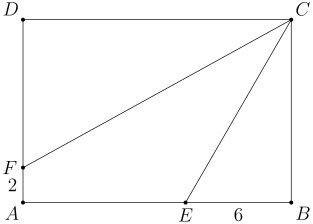
In rectangle angle is trisected by and where is on is on and Which of the following is closest to the area of the rectangle
Pista pequeña:
Cada uno de los tres ángulos en mide
Each of the three angles at is
Pista grande:
Usa los dos triángulos rectángulos adyacentes a los lados y para determinar la altura y el ancho del rectángulo
Use the two right triangles adjacent to sides and to determine the rectangle’s height and width
Solución:
Sean y el ancho y la altura del rectángulo. En el triángulo rectángulo así que En el triángulo formado por el desplazamiento horizontal es y el descenso vertical es por lo que Así, El área es cuyo valor más cercano es Por lo tanto, la respuesta correcta es E.
Let the rectangle have width and height In right triangle so In the triangle using the horizontal run is and the vertical drop is so Hence The area is closest to Thus the correct answer is E.
18.
Un círculo de radio tiene centro en Un círculo de radio tiene centro en Una recta es tangente a los dos círculos en puntos del primer cuadrante. ¿Cuál de los siguientes números es el más cercano al intercepto con el eje de la recta?
A circle of radius has center at A circle of radius has center at A line is tangent to the two circles at points in the first quadrant. Which of the following is closest to the -intercept of the line?
Pista pequeña:
Escribe la tangente como y usa la distancia de cada centro a la recta
Write the tangent as and use point-to-line distance for each center
Pista grande:
Resta las dos ecuaciones de distancia para determinar la pendiente antes de hallar el intercepto
Subtract the two distance equations to determine the slope before solving for the intercept
Solución:
Escribe la tangente común superior como y sea Las dos distancias de los centros a la recta dan Por tanto, así que y De la segunda ecuación, Por lo tanto, la respuesta correcta es D.
Write the upper common tangent as and let The two center-to-line distances give Thus so and From the second equation, Therefore the correct answer is D.
19.
Los puntos medios de los lados de un hexágono regular se unen para formar un hexágono menor. ¿Qué fracción del área de queda encerrada por el hexágono menor?
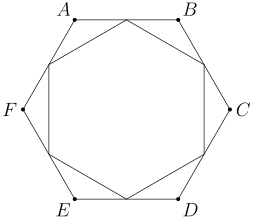
The midpoints of the sides of a regular hexagon are joined to form a smaller hexagon. What fraction of the area of is enclosed by the smaller hexagon?
Pista pequeña:
Compara la distancia entre los puntos medios de dos lados adyacentes con la longitud del lado original
Compare the distance between adjacent side midpoints with the original side length
Pista grande:
Los hexágonos menor y mayor son semejantes, así que eleva al cuadrado la razón de sus lados
The smaller and larger hexagons are similar, so square their side-length ratio
Solución:
Dos puntos medios adyacentes y su vértice común forman un triángulo con dos lados de longitud y ángulo comprendido de El cuadrado de la longitud del lado opuesto es Por tanto, el hexágono menor tiene factor de escala y su razón de áreas es La respuesta correcta es D.
Two adjacent midpoints and their shared vertex form a triangle with two sides and included angle Its opposite side has squared length Thus the smaller hexagon has scale factor and its area ratio is The correct answer is D.
20.
En el plano , ¿cuál es la longitud del camino más corto de a que no entra en el círculo ?
In the -plane, what is the length of the shortest path from to that does not go inside the circle
Pista pequeña:
El centro del círculo es el punto medio de los dos extremos
The circle’s center is the midpoint of the two endpoints
Pista grande:
El camino permitido más corto consta de dos segmentos tangentes y el arco menor entre sus puntos de tangencia
The shortest permitted path consists of two tangent segments and the shorter arc between their tangency points
Solución:
Cada extremo está a unidades del centro del círculo, así que cada segmento tangente tiene longitud En el triángulo rectángulo de un punto de tangencia, el ángulo en el centro mide Como los rayos hacia los extremos son opuestos, el arco menor intermedio subtiende por lo que su longitud es El total es y la respuesta correcta es C.
Each endpoint is units from the circle’s center, so each tangent segment has length In the right triangle at a tangency point, the angle at the center is Since the endpoint rays are opposite, the intervening minor arc subtends so its length is The total is and the correct answer is C.
21.
Los triángulos y son isósceles, con y corta a en Si entonces es
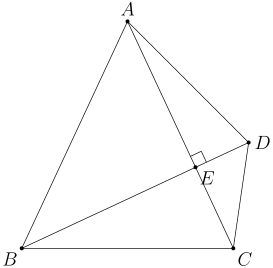
Triangles and are isosceles with and intersects at If then is
no está determinado de manera única
not uniquely determined
Pista pequeña:
Sea y expresa usando el triángulo isósceles
Let and express using isosceles triangle
Pista grande:
Usa para hallar el ángulo del vértice del triángulo isósceles
Use to find the vertex angle at of isosceles triangle
Solución:
Sea Como Como el ángulo entre y es En el triángulo isósceles así que sus dos ángulos de la base son Su suma es así que la respuesta correcta es D.
Let Since Because the angle between and is In isosceles triangle so its two base angles are Their sum is so the correct answer is D.
22.
Se eligen cuatro puntos distintos, y entre puntos uniformemente espaciados alrededor de un círculo. Todos los cuádruples tienen la misma probabilidad de ser elegidos. ¿Cuál es la probabilidad de que la cuerda corte a la cuerda ?
Four distinct points, and are to be selected from points evenly spaced around a circle. All quadruples are equally likely to be chosen. What is the probability that the chord intersects the chord
Pista pequeña:
Fija cuatro puntos cualesquiera y examina las tres maneras de emparejarlos para formar dos cuerdas
Fix any four selected points and examine the three ways to pair them into two chords
Pista grande:
Exactamente un emparejamiento une puntos alternados alrededor del círculo
Exactly one pairing joins alternating points around the circle
Solución:
Para cuatro puntos fijos, hay tres maneras de dividir sus rótulos en dos pares no ordenados de cuerdas. Exactamente un emparejamiento une puntos alternados alrededor del círculo y, por ello, se cruza. El par designado tiene la misma probabilidad de ser cualquiera de esos tres emparejamientos, así que la probabilidad es La respuesta correcta es B.
For any fixed four points, there are three ways to partition their labels into two unordered chord pairs. Exactly one pairing joins alternating points around the circle and therefore crosses. The named pair is equally likely to be any of these three pairings, so the probability is The correct answer is B.
23.
La suma de las longitudes de las doce aristas de una caja rectangular es y la distancia de un vértice al vértice más lejano es El área superficial total de la caja es
The sum of the lengths of the twelve edges of a rectangular box is and the distance from one corner of the box to the farthest corner is The total surface area of the box is
Pista pequeña:
Si las longitudes de los lados son , traduce a ecuaciones la suma de las aristas y la diagonal espacial
If the side lengths are , translate the edge sum and space diagonal into equations
Pista grande:
Expande para obtener directamente
Expand to obtain directly
Solución:
La suma de las aristas da por lo que La diagonal espacial da Por tanto, el área superficial es Por lo tanto, la respuesta correcta es B.
The edge sum gives so The space diagonal gives Therefore the surface area is Thus the correct answer is B.
24.
La sucesión consta de separados por bloques de , con cifras en el -ésimo bloque. La suma de los primeros términos de esta sucesión es
The sequence consists of ’s separated by blocks of ’s with ’s in the th block. The sum of the first terms of this sequence is
Pista pequeña:
Cuenta el número total de términos hasta el final del -ésimo bloque
Count the total number of terms through the end of the th block
Pista grande:
Halla el último bloque completo antes del término y luego cuenta la parte utilizada del bloque siguiente
Find the last complete block before term , then account for the partial next block
Solución:
Hasta el bloque hay unos y doses, por lo que hay términos. Para , esto es Su suma es Los términos siguientes son un y nueve , cuya suma es La suma solicitada es así que la respuesta correcta es B.
Through block there are ones and twos, hence terms. For this is Their sum is The next terms are one and nine ’s, with sum The requested sum is so the correct answer is B.
25.
Dado que ¿cuál es el mayor valor posible de ?
Given that what is the largest possible value that can have?
Pista pequeña:
Completa cuadrados para identificar el centro y el radio del círculo
Complete the square to identify the circle’s center and radius
Pista grande:
El máximo de es su valor en el centro más el radio por
The maximum of is its value at the center plus the radius times
Solución:
Al completar cuadrados se obtiene En el centro, Moverse unidades en la dirección del vector aumenta la expresión en El máximo es así que la respuesta correcta es B.
Completing the square gives At the center, Moving units in the direction of the vector increases the expression by The maximum is so the correct answer is B.
26.
Una urna contiene canicas de cuatro colores: rojo, blanco, azul y verde. Al extraer cuatro canicas sin reemplazo, los siguientes sucesos tienen la misma probabilidad:
(a) seleccionar cuatro canicas rojas;
(b) seleccionar una canica blanca y tres rojas;
(c) seleccionar una canica blanca, una azul y dos rojas; y
(d) seleccionar una canica de cada color.
¿Cuál es el menor número de canicas que satisface la condición dada?
An urn contains marbles of four colors: red, white, blue, and green. When four marbles are drawn without replacement, the following events are equally likely:
(a) the selection of four red marbles;
(b) the selection of one white and three red marbles;
(c) the selection of one white, one blue, and two red marbles; and
(d) the selection of one marble of each color.
What is the smallest number of marbles satisfying the given condition?
más de
more than
Pista pequeña:
Sean las cantidades de los cuatro colores e iguala los conteos combinatorios de los cuatro sucesos
Let the four color counts be and equate the combination counts for the four events
Pista grande:
Los cocientes sucesivos determinan en función de ; luego halla el menor que hace enteros a los tres
Successive ratios determine in terms of ; then find the smallest making all three integers
Solución:
Las probabilidades iguales tienen el mismo denominador común, así que sus números de selecciones favorables satisfacen Los cocientes sucesivos dan y El menor que hace enteros positivos a los tres es Entonces y hay canicas. Por lo tanto, la respuesta correcta es B.
Equal probabilities have the same common denominator, so their favorable selection counts satisfy Successive ratios give and The least making all three positive integers is Then for marbles. Thus the correct answer is B.
27.
Considera dos bolas esféricas macizas: una con centro en y radio y la otra con centro en y radio ¿Cuántos puntos de coordenadas enteras (puntos de la retícula) hay en la intersección de las bolas?
Consider two solid spherical balls, one centered at with radius and the other centered at with radius How many points with only integer coordinates (lattice points) are there in the intersection of the balls?
Pista pequeña:
Primero interseca los intervalos enteros posibles para la coordenada en las dos bolas
First intersect the possible integer ranges for the -coordinate in the two balls
Pista grande:
En la única altura posible, reduce ambas desigualdades esféricas a una cota para
At the only possible height, reduce both sphere inequalities to a bound on
Solución:
La primera bola permite alturas enteras de a mientras que la segunda permite de a así que un punto de la retícula en la intersección debe tener A esa altura, las dos cotas son Por tanto, puede ser o Estos valores dan y pares enteros ordenados, respectivamente, para un total de puntos. La respuesta correcta es D.
The first ball permits integer heights through while the second permits through so an intersection lattice point must have At that height the two bounds are Thus can be or These give and ordered integer pairs, respectively, for points. The correct answer is D.
28.
En un paralelepípedo rectangular de , los vértices y son adyacentes al vértice La distancia perpendicular de al plano que contiene y es aproximadamente
On a rectangular parallelepiped, vertices and are adjacent to vertex The perpendicular distance from to the plane containing and is closest to
Pista pequeña:
Coloca en el origen con las tres aristas adyacentes sobre los ejes coordenados
Place at the origin with the three adjacent edges along coordinate axes
Pista grande:
Escribe la forma de interceptos del plano que pasa por
Write the intercept form of the plane through
Solución:
Pon y toma los vértices adyacentes como Su plano es Su distancia al origen es cuyo valor más cercano es Por lo tanto, la respuesta correcta es C.
Put and take the adjacent vertices as Their plane is Its distance from the origin is closest to Thus the correct answer is C.
29.
Si es un entero positivo tal que tiene divisores positivos y tiene divisores positivos, ¿cuántos divisores positivos tiene ?
If is a positive integer such that has positive divisors and has positive divisors, then how many positive divisors does have?
Pista pequeña:
Escribe , donde es coprimo con , y sea el número de divisores de
Write , where is relatively prime to , and let be the number of divisors of
Pista grande:
Usa las dos ecuaciones de conteo de divisores para restringir a un divisor común de y
Use the two divisor-count equations to restrict to a divisor of both and
Solución:
Escribe con y sea Entonces Por tanto, es o Al comprobar los pares de factores de , no se obtiene solución para Al comprobar los de para , se obtiene la solución única Por consiguiente, así que la respuesta correcta es C.
Write with and let Then Hence is or Checking the factor pairs of gives no solution when Checking those of when gives the unique solution Therefore so the correct answer is C.
30.
Un hexágono inscrito en un círculo tiene tres lados consecutivos de longitud cada uno y otros tres lados consecutivos de longitud cada uno. La cuerda que divide el hexágono en dos trapecios, uno con tres lados de longitud cada uno y el otro con tres lados de longitud cada uno, tiene longitud donde y son enteros positivos coprimos. Halla
A hexagon inscribed in a circle has three consecutive sides each of length and three consecutive sides each of length The chord of the circle that divides the hexagon into two trapezoids, one with three sides each of length and the other with three sides each of length has length equal to where and are relatively prime positive integers. Find
Pista pequeña:
Sean y los semiángulos centrales subtendidos por los lados de longitudes y
Let and be the half-central angles subtended by sides and
Pista grande:
Usa y la razón de las cuerdas para hallar , y luego aplica
Use and the chord ratio to find , then apply
Solución:
Sea el radio del círculo, y sean los semiángulos centrales correspondientes a los lados Entonces y Por tanto, de modo que y La cuerda divisoria abarca los tres lados consecutivos de longitud así que Por consiguiente, de modo que La respuesta correcta es E.
Let the circle have radius and let be the half-central angles for the sides Then and Thus so and The dividing chord spans the three consecutive sides of length so Therefore so The correct answer is E.