
2002 AMC 10B Problems
25 problems · 75 minutes
Scroll down and press Start to try the exam! Or, go to the printable PDF, answer key, or professional solutions curated by LIVE by Po-Shen Loh.
Or jump straight to a single problem with its solution: 1 · 2 · 3 · 4 · 5 · 6 · 7 · 8 · 9 · 10 · 11 · 12 · 13 · 14 · 15 · 16 · 17 · 18 · 19 · 20 · 21 · 22 · 23 · 24 · 25
All problems are used with official legal permission of the Mathematical Association of America (MAA).
Want to learn professionally through interactive video classes?
Learn LIVETimed
1:15:00
1.
What is the value of the ratio
Answer: E
Concepts:exponent
Small hint:
Write as
Big hint:
Cancel the common powers of and from top and bottom
Solution:
Since the ratio becomes
Thus, the correct answer is E.
2.
For the nonzero numbers and define What is
Answer: C
Small hint:
Substitute into the definition
Big hint:
The numerator is and the denominator is
Solution:
Substituting directly,
Thus, the correct answer is C.
3.
The arithmetic mean of the nine numbers in the set is a -digit number all of whose digits are distinct. Which digit does the number not contain?
Answer: A
Small hint:
Each term is times a repunit, so divide the sum by first
Big hint:
Solution:
The mean is
Adding these nine repunits column by column gives
The only digit missing from is
Thus, the correct answer is A.
4.
What is the value of when
Answer: D
Small hint:
Factor out of the first two terms before plugging in
Big hint:
The bracket collapses to
Solution:
Factoring from the first two terms,
At this equals
Thus, the correct answer is D.
5.
Circles of radius and are externally tangent and are circumscribed by a third circle, as shown in the figure. What is the area of the shaded region?
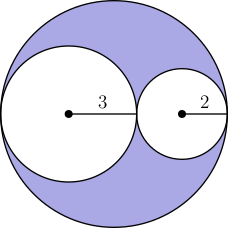
Answer: E
Small hint:
The two small circles lie along a diameter of the large circle
Big hint:
The shaded area is the large disk minus the two smaller disks
Solution:
The two small circles line up along a diameter of the big circle, so that diameter is and the large radius is
The shaded region is the large disk with the two small disks removed:
Thus, the correct answer is E.
6.
For how many positive integers is a prime number?
none
one
two
more than two, but finitely many
infinitely many
Small hint:
Factor
Big hint:
For to be prime, one factor must equal
Solution:
Factor as
For both factors exceed so the product is composite. For and the value is and for the value is which is prime.
So exactly one value of works.
Thus, the correct answer is B.
7.
Let be a positive integer such that is an integer. Which of the following statements is not true?
divides
divides
divides
divides
Answer: E
Small hint:
The sum is positive and less than so it must equal exactly
Big hint:
Solve for
Solution:
The sum is greater than and less than so as an integer it must equal
Since we need so
Then and all divide but is not greater than So the false statement is
Thus, the correct answer is E.
8.
Suppose July of year has five Mondays. Which of the following must occur five times in August of year (Note: both months have days.)
Monday
Tuesday
Wednesday
Thursday
Friday
Answer: D
Small hint:
A -day month has exactly three weekdays that occur five times
Big hint:
Those are the weekdays of days and ; find where a five-Monday July forces them
Solution:
A -day month is weeks plus extra days, so exactly the weekdays of the st, nd, and rd of the month occur five times.
For July to have five Mondays, Monday must be one of July or In all three cases August lands on a Tuesday, Wednesday, or Thursday, and the common weekday among the resulting five-time days is Thursday.
More directly, since July has days, August is the same weekday as July With Monday on July or the three five-time weekdays of August always include Thursday.
Thus, the correct answer is D.
9.
Using the letters and we can form five-letter “words.” If these “words” are arranged in alphabetical order, then the “word” occupies which position?
Answer: D
Small hint:
Words starting with or come first; count them
Big hint:
Among the words starting with find how many precede
Solution:
The alphabetical order of the letters is Words beginning with or fill positions through (four choices of first letter, each).
Words beginning with occupy positions – Listing them alphabetically, is the th such word, so it occupies position
Thus, the correct answer is D.
10.
Suppose that and are nonzero real numbers, and that the equation has solutions and What is the pair
Answer: C
Small hint:
By Vieta’s formulas, the sum of the roots is and the product is
Big hint:
So and ; use
Solution:
Since the roots are and Vieta’s formulas give and
From with we get Then gives so
Thus and the correct answer is C.
11.
The product of three consecutive positive integers is times their sum. What is the sum of their squares?
Answer: B
Small hint:
Call the integers ; their sum is
Big hint:
The product is which equals
Solution:
Let the integers be Their product is and their sum is so
Since we get so and
The three integers are and and
Thus, the correct answer is B.
12.
For which of the following values of does the equation have no solution for
Answer: E
Small hint:
Cross multiply and expand both sides
Big hint:
The equation becomes linear; it has no solution when the coefficient of vanishes
Solution:
Cross multiplying gives which expands to
Cancelling leaves For equal to or this gives a valid value of that is neither excluded denominator value nor For the equation instead becomes which has no solution.
Thus, the correct answer is E.
13.
What value of makes true for all values of
or
or
or
Answer: D
Small hint:
Group terms to factor the left side
Big hint:
; it must vanish for every
Solution:
Grouping and factoring,
For this to equal for all the factor that depends on cannot be forced to zero, so we need giving
Thus, the correct answer is D.
14.
The number is the square of a positive integer In decimal representation, what is the sum of the digits of
15.
The positive integers and are all prime numbers. The sum of these four primes is
even
divisible by
divisible by
divisible by
prime
Small hint:
and have the same parity, and both are prime
Big hint:
This forces so and are three primes in a row
Solution:
The numbers and differ by so they have the same parity. Being prime, they must both be odd, which forces and to have opposite parity.
Since is the only even prime, either or The first case is impossible because the positive prime would make Hence
Now and are three primes. One of any three integers spaced apart is divisible by so that member must itself be The only positive possibility is
The four primes are and their sum is which is prime.
Thus, the correct answer is E.
16.
For how many integers is the square of an integer?
Answer: D
Small hint:
Set and solve for in terms of
Big hint:
; since and are coprime, is divisible by
Solution:
Suppose for some integer Solving,
Since and share no common factor, must divide This happens only for giving
The corresponding values are all integers, so there are such
Thus, the correct answer is D.
17.
A regular octagon has sides of length two. What is the area of
Answer: C
Small hint:
Place the octagon on a grid; each slanted side moves horizontally and vertically
Big hint:
is a horizontal chord; use it as the base and the vertical distance from as the height
Solution:
Set the octagon on coordinate axes with the axis-aligned sides of length and each slanted side spanning horizontally and vertically. Then
Since and share the height segment is horizontal with length and the height from up to that level is
Therefore
Thus, the correct answer is C.
18.
Four distinct circles are drawn in a plane. What is the maximum number of points where at least two of the circles intersect?
Answer: D
Small hint:
Two distinct circles meet in at most points
Big hint:
Count the pairs of circles, then multiply by
Solution:
Any two distinct circles intersect in at most points. There are pairs of circles, giving at most intersection points.
This maximum is achievable by a configuration where every pair of circles crosses twice, so the answer is
Thus, the correct answer is D.
19.
Suppose that is an arithmetic sequence with and What is the value of
Answer: C
Small hint:
Each term exceeds by where
Big hint:
Subtract the two block sums to isolate
Solution:
Let Then so the second block sum is the first plus
Therefore giving
Thus, the correct answer is C.
20.
Let and be real numbers such that and What is
Answer: B
Small hint:
Rearrange to and
Big hint:
Square both equations and add; the cross terms with cancel nicely
Solution:
Rewrite the equations as and Squaring both and adding,
The left side expands to (the terms cancel), and the right side expands to (the terms cancel). So giving
Thus, the correct answer is B.
21.
Andy’s lawn has twice as much area as Beth’s lawn and three times as much area as Carlos’ lawn. Carlos’ lawn mower cuts half as fast as Beth’s mower and one third as fast as Andy’s mower. If they all start to mow their lawns at the same time, who will finish first?
Andy
Beth
Carlos
Andy and Carlos tie for first.
All three tie.
Answer: B
Small hint:
Time to mow equals area divided by mowing rate
Big hint:
Let Andy’s area be and Carlos’ rate be then write each person’s time
Solution:
Let Andy’s lawn have area so Beth’s is and Carlos’ is Let Carlos mow at rate so Beth mows at and Andy at
The times are
Since is the smallest, Beth finishes first.
Thus, the correct answer is B.
22.
Let be a right-angled triangle with Let and be the midpoints of legs and respectively. Given that and what is
Answer: B
Small hint:
Let and so and
Big hint:
Write the Pythagorean relations for and then add them to find
Solution:
Let and so and The right angle at gives and
Adding these, so and
Since with ratio we have
Thus, the correct answer is B.
23.
Let be a sequence of integers such that and for all positive integers and What is
Answer: D
Small hint:
Set to get
Big hint:
So ; sum these differences up to
Solution:
Setting we get so
Summing from to
Therefore
Thus, the correct answer is D.
24.
Riders on a Ferris wheel travel in a circle in a vertical plane. A particular wheel has radius feet and revolves at the constant rate of one revolution per minute. How many seconds does it take a rider to travel from the bottom of the wheel to a point vertical feet above the bottom?
Answer: D
Small hint:
Place the center at height ; the rider rises feet from the bottom
Big hint:
The rider is now feet below center; find the central angle turned from the bottom
Solution:
Put the center at height The bottom is at height and the rider reaches height which is feet below the center.
Draw a horizontal segment from the rider to the wheel’s vertical diameter. The resulting right triangle has a vertical leg of length and a hypotenuse (the radius) of length That leg is half the hypotenuse, so the radius to the rider makes with the downward vertical.
The wheel turns in seconds, so turning takes seconds.
Thus, the correct answer is D.
25.
When is appended to a list of integers, the mean is increased by When is appended to the enlarged list, the mean of the enlarged list is decreased by How many integers were in the original list?
Answer: A
Small hint:
Let the list have integers with mean so the sum is
Big hint:
Translate each appending into an equation for the new sum and mean
Solution:
Let the original list have integers with mean so its sum is Appending gives
Appending to that enlarged list gives
Solving and yields and
Thus, the correct answer is A.