
1989 AMC 12 Problems
30 problems · 75 minutes
Scroll down and press Start to try the exam! Or, go to the printable PDF, answer key, or professional solutions curated by LIVE by Po-Shen Loh.
Or jump straight to a single problem with its solution: 1 · 2 · 3 · 4 · 5 · 6 · 7 · 8 · 9 · 10 · 11 · 12 · 13 · 14 · 15 · 16 · 17 · 18 · 19 · 20 · 21 · 22 · 23 · 24 · 25 · 26 · 27 · 28 · 29 · 30
All problems are used with official legal permission of the Mathematical Association of America (MAA).
Want to learn professionally through interactive video classes?
Learn LIVETimed
1:15:00
1.
Answer: C
Small hint:
Evaluate the exponents from the top down
Big hint:
The parity of the exponent on determines its sign
Solution:
Because is odd, Also so the sum is
Thus the correct answer is C.
2.
3.
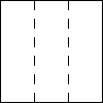
A square is cut into three rectangles along two lines parallel to a side, as shown. If the perimeter of each of the three rectangles is then the area of the original square is
Answer: D
Small hint:
Equal perimeters force the three rectangle widths to be equal
Big hint:
Express one rectangle’s perimeter using the square’s side length
Solution:
Let the square have side Since every rectangle has length and the same perimeter, their three widths are equal and are each Thus so and the square’s area is
Thus the correct answer is D.
4.
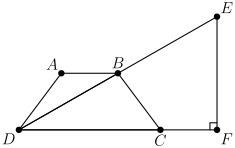
In the figure, is an isosceles trapezoid with side lengths and The point is on and is the midpoint of hypotenuse in the right triangle Then
Answer: D
Small hint:
Drop perpendiculars from and to
Big hint:
The segment through midpoint parallel to reaches the midpoint of
Solution:
Drop perpendiculars and to In the isosceles trapezoid, and Since is the midpoint of and the midpoint theorem makes the midpoint of Hence so and
Thus the correct answer is D.
5.
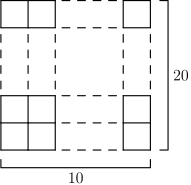
Toothpicks of equal length are used to build a rectangular grid as shown. If the grid is toothpicks high and toothpicks wide, then the number of toothpicks used is
Answer: E
Small hint:
Count horizontal and vertical toothpicks separately
Big hint:
A grid toothpicks wide has vertical grid lines
Solution:
There are vertical grid lines with toothpicks each, and horizontal grid lines with toothpicks each. The total is
Thus the correct answer is E.
6.
If and the triangle in the first quadrant bounded by the coordinate axes and the graph of has area then
Answer: A
Small hint:
Find the intercepts of the line on the two axes
Big hint:
Use those intercepts as the base and height of the triangle
Solution:
The intercepts are and Therefore the triangle’s area is which gives
Thus the correct answer is A.
7.
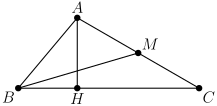
In is an altitude, and is a median. Then
Answer: C
Small hint:
Compare the horizontal and vertical changes from to midpoint
Big hint:
Both changes are half the corresponding legs of right triangle
Solution:
Because is the midpoint of the horizontal change from to is while the vertical change is Thus Hence
Thus the correct answer is C.
8.
For how many integers between and does factor into the product of two linear factors with integer coefficients?
Answer: D
Small hint:
Write the factors as with positive integers
Big hint:
The coefficient of forces the two integer parameters to differ by
Solution:
An integer factorization must have the form for some positive integer Expanding gives so The values give while There are values.
Thus the correct answer is D.
9.
Mr. and Mrs. Zeta want to name their baby Zeta so that its monogram (first, middle, and last initials) will be in alphabetical order with no letters repeated. How many such monograms are possible?
Answer: B
Small hint:
The last initial is already fixed as
Big hint:
Choosing the other two distinct letters determines their alphabetical order
Solution:
The first two initials must be two distinct letters chosen from through Once chosen, their order is forced. Therefore the number of monograms is
Thus the correct answer is B.
10.
Consider the sequence defined recursively by (any positive number), and For which of the following values of must
Answer: C
Small hint:
Compute and symbolically
Big hint:
Look for the period of the transformation
Solution:
Direct substitution gives The sequence therefore repeats every terms, so whenever Among the choices, only has that form.
Thus the correct answer is C.
11.
Let and be integers with and If the largest possible value for is
Answer: A
Small hint:
Maximize the integers from backward to
Big hint:
Each strict inequality lowers the greatest allowable integer by
Solution:
The largest possible values are and finally Each value satisfies its strict inequality, so this maximum is attainable.
Thus the correct answer is A.
12.
The traffic on a certain east-west highway moves at a constant speed of miles per hour in both directions. An eastbound driver passes westbound vehicles in a five-minute interval. Assume vehicles in the westbound lane are equally spaced. Which of the following is closest to the number of westbound vehicles present in a -mile section of highway?
Answer: C
Small hint:
The cars approach one another at the sum of their speeds
Big hint:
Use the distance covered at relative speed to find the spacing between westbound vehicles
Solution:
The relative speed is miles per hour, so in five minutes the driver covers relative miles. Passing equally spaced vehicles in that distance means the spacing is about mile. Thus a -mile section contains about vehicles.
Thus the correct answer is C.
13.
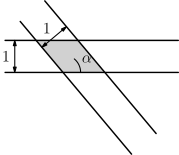
Two strips of width overlap at an angle of as shown. The area of the overlap (shown shaded) is
Answer: B
Small hint:
The overlap is a parallelogram with altitude
Big hint:
If its slanted side has length then
Solution:
The overlap is a parallelogram. Taking a slanted side as its base, the perpendicular height is the width of the slanted strip. If that base has length its vertical component is the width of the horizontal strip, so Hence and the area is
Thus the correct answer is B.
14.
Answer: B
Small hint:
Rewrite both terms using sine and cosine
Big hint:
Use and
Solution:
Using Combining the fractions gives numerator Since this numerator is and the expression is
Thus the correct answer is B.
15.
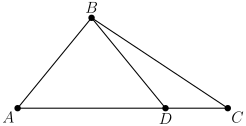
In and is on with Find the ratio
Answer: E
Small hint:
Let and
Big hint:
Apply Stewart’s Theorem to cevian
Solution:
Let and Stewart’s Theorem gives Simplifying yields so Then and
Thus the correct answer is E.
16.
A lattice point is a point in the plane with integer coordinates. How many lattice points are on the line segment whose endpoints are and (Include both endpoints of the segment in your count.)
Answer: B
Small hint:
Compute the horizontal and vertical coordinate differences
Big hint:
A segment with differences contains lattice points
Solution:
The coordinate differences are and whose greatest common divisor is The number of lattice points, including both endpoints, is therefore
Thus the correct answer is B.
17.
The perimeter of an equilateral triangle exceeds the perimeter of a square by cm. The length of each side of the triangle exceeds the length of each side of the square by cm. The square has perimeter greater than How many positive integers are not possible values for
infinitely many
Answer: D
Small hint:
Let the square’s side length be
Big hint:
Translate the positive-perimeter condition into a strict inequality for
Solution:
If the square has side the triangle has side The perimeter condition gives so The condition is equivalent to Thus the positive integers through are precisely the impossible values.
Thus the correct answer is D.
18.
The set of all real numbers for which is a rational number is the set of all
integers
rational
real
for which is rational
for which is rational
Answer: B
Small hint:
Rationalize the reciprocal term
Big hint:
The conjugate is the reciprocal of the denominator
Solution:
Rationalizing gives The entire expression is therefore It is rational exactly when is rational.
Thus the correct answer is B.
19.
A triangle is inscribed in a circle. The vertices of the triangle divide the circle into three arcs of lengths and What is the area of the triangle?
Answer: E
Small hint:
The circumference is so first find the radius and the three central angles
Big hint:
Split the triangle into three triangles having the circle’s center as a common vertex
Solution:
The radius is The arc lengths give central angles Their sines sum to Splitting the triangle at the center, its area is
Thus the correct answer is E.
20.
Let be a real number selected uniformly at random between and If find the probability that ( means the greatest integer less than or equal to )
Answer: B
Small hint:
Convert each floor condition into an interval for
Big hint:
The conditional probability is the ratio of the two relevant interval lengths
Solution:
The given condition is an interval of length The desired condition is or Its length is so the conditional probability is
Thus the correct answer is B.
21.
A square flag has a red cross of uniform width with a blue square in the center on a white background as shown. (The cross is symmetric with respect to each of the diagonals of the square.) If the entire cross (both the red arms and the blue center) takes up of the area of the flag, what percent of the area of the flag is blue?

Answer: C
Small hint:
Let be half a diagonal of the central blue square after scaling the flag side to
Big hint:
The four white corner triangles together have area
Solution:
Scale the flag to a unit square, and let be the horizontal distance from its center to a vertex of the blue square. The four congruent white corner triangles have total area Since the cross occupies With this gives The blue square has perpendicular diagonals and so its area is or of the flag.
Thus the correct answer is C.
22.
A child has a set of distinct blocks. Each block is one of materials (plastic, wood), sizes (small, medium, large), colors (blue, green, red, yellow), and shapes (circle, hexagon, square, triangle). How many blocks in the set are different from the “plastic medium red circle” in exactly two ways? (The “wood medium red square” is such a block.)
Answer: A
Small hint:
For each attribute, count the alternatives different from the specified block
Big hint:
Choose a pair of attributes to change, then multiply their alternative counts
Solution:
The numbers of alternatives for material, size, color, and shape are Changing exactly two attributes gives
Thus the correct answer is A.
23.
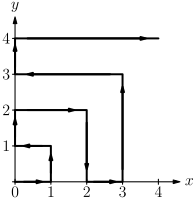
A particle moves through the first quadrant as follows. During the first minute it moves from the origin to Thereafter, it continues to follow the directions indicated in the figure, going back and forth between the positive and axes, moving one unit of distance parallel to an axis in each minute. At which point will the particle be after exactly minutes?
Answer: D
Small hint:
Record the particle’s location at times
Big hint:
Compare with the consecutive squares and
Solution:
At time the particle is at for odd and at for even Thus at time it is at It then moves units right, reaching at time and moves downward for the next minutes. At time it is therefore at
Thus the correct answer is D.
24.
Five people are sitting at a round table. Let be the number of people sitting next to at least one female and be the number of people sitting next to at least one male. The number of possible ordered pairs is
Answer: B
Small hint:
Classify arrangements by the number of females
Big hint:
With two females, separate the adjacent and nonadjacent cases; obtain three-female cases by symmetry
Solution:
For females, the possible pairs are respectively where the two-female cases distinguish adjacent from nonadjacent females. Swapping the sexes gives These are distinct ordered pairs.
Thus the correct answer is B.
25.
In a certain cross-country meet between two teams of five runners each, a runner who finishes in the th position contributes to his team’s score. The team with the lower score wins. If there are no ties among the runners, how many different winning scores are possible?
Answer: B
Small hint:
The two team scores add to
Big hint:
Determine the minimum winning score and verify that every integer below half the total is attainable
Solution:
The two scores sum to so the winning score is at most Its minimum is Every score from through is obtained by for Scores through use for and use and Thus all integers from through are possible.
Thus the correct answer is B.
26.
A regular octahedron is formed by joining the centers of adjoining faces of a cube. The ratio of the volume of the octahedron to the volume of the cube is
Answer: C
Small hint:
Scale the cube to side length and place its center at the origin
Big hint:
The octahedron has vertices
Solution:
Take a cube of side so its volume is The face centers are In each octant, the octahedron cuts out a tetrahedron with three perpendicular unit edges and volume Thus its volume is and the ratio is
Thus the correct answer is C.
27.
Let be a positive integer. If the equation has solutions in positive integers and then must be either
or
or
or
or
or
Answer: D
Small hint:
Group solutions according to
Big hint:
For fixed count the positive ordered pairs and require
Solution:
For there are positive ordered pairs and is positive when Writing the number of solutions is Setting this equal to gives Hence so or
Thus the correct answer is D.
28.
Find the sum of the roots of that are between and radians.
Answer: D
Small hint:
Let the two positive roots in be and
Big hint:
Use to relate then include the period of tangent
Solution:
The two roots of are positive and satisfy Therefore their acute arctangents add to Each tangent value occurs twice between and with the second occurrence shifted by The sum of all four roots is
Thus the correct answer is D.
29.
Find where
Answer: B
Small hint:
Recognize as
Big hint:
Take the real part of the binomial expansion of
Solution:
The sum is the real part of Since its real part is
Thus the correct answer is B.
30.
Suppose that boys and girls line up in a row. Let be the number of places in the row where a boy and a girl are standing next to each other. For example, for the row we have The average value of (if all possible orders of these people are considered) is closest to
Answer: A
Small hint:
Use an indicator for each of the adjacent pairs
Big hint:
For a fixed adjacent pair, compute the probability of seeing or
Solution:
For each of the adjacent position pairs, the probability of mixed sexes is By linearity of expectation, which is closest to
Thus the correct answer is A.