
1990 AMC 12 Problems
30 problems · 75 minutes
Scroll down and press Start to try the exam! Or, go to the printable PDF, answer key, or professional solutions curated by LIVE by Po-Shen Loh.
Or jump straight to a single problem with its solution: 1 · 2 · 3 · 4 · 5 · 6 · 7 · 8 · 9 · 10 · 11 · 12 · 13 · 14 · 15 · 16 · 17 · 18 · 19 · 20 · 21 · 22 · 23 · 24 · 25 · 26 · 27 · 28 · 29 · 30
All problems are used with official legal permission of the Mathematical Association of America (MAA).
Want to learn professionally through interactive video classes?
Learn LIVETimed
1:15:00
1.
If then
Answer: E
Small hint:
Simplify both complex fractions first
Big hint:
After clearing denominators, solve the resulting equation in
Solution:
The equation simplifies to Since multiplying by gives so
Thus the correct answer is E.
2.
Answer: E
Small hint:
A negative exponent takes the reciprocal
Big hint:
Rewrite as a power of
Solution:
Taking the reciprocal gives
Thus the correct answer is E.
3.
The consecutive angles of a trapezoid form an arithmetic sequence. If the smallest angle is then the largest angle is
Answer: C
Small hint:
Write the four angles as
Big hint:
Use the angle sum of a quadrilateral
Solution:
The four angles sum to so Thus and the largest angle is
Thus the correct answer is C.
4.
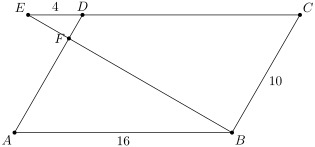
Let be a parallelogram with and Extend through to so that If intersects at then is closest to
Answer: B
Small hint:
Use that
Big hint:
Triangles and are similar
Solution:
Because triangles and are similar. Hence Since we get so
Thus the correct answer is B.
5.
Which of these numbers is largest?
Answer: B
Small hint:
Every choice is positive, so raise each one to the sixth power
Big hint:
Express each sixth power as
Solution:
Raising the five positive choices to the sixth power preserves their order and gives, respectively, The largest is the second.
Thus the correct answer is B.
6.
Points and are units apart. How many lines in a given plane containing and are units from and units from
more than
Answer: D
Small hint:
Replace the distance conditions by tangencies to two circles
Big hint:
The circles have radii and and are externally tangent
Solution:
A qualifying line is a common tangent to the circle centered at with radius and the circle centered at with radius Their center distance equals the sum of their radii, so they are externally tangent. They have two external common tangents and one common tangent at their point of contact, for a total of
Thus the correct answer is D.
7.
A triangle with integral sides has perimeter The area of the triangle is
Answer: A
Small hint:
List the unordered triples of positive integers summing to
Big hint:
Only one triple satisfies the strict triangle inequality
Solution:
The only unordered positive integral side lengths summing to and satisfying the triangle inequality are Their semiperimeter is so Heron’s formula gives
Thus the correct answer is A.
8.
The number of real solutions of the equation is
more than
Answer: E
Small hint:
Interpret the two absolute values as distances on a number line
Big hint:
Consider every between and
Solution:
For every Thus the entire interval consists of solutions, so there are more than
Thus the correct answer is E.
9.
Each edge of a cube is colored either red or black. Every face of the cube has at least one black edge. The smallest possible number of black edges is
Answer: B
Small hint:
Each edge belongs to exactly two faces
Big hint:
For the matching upper bound, choose three mutually nonadjacent edges
Solution:
Each black edge can cover only its two incident faces, so covering all faces requires at least black edges. Choose edges incident to the face-pairs top/front, bottom/left, and back/right. These three edges cover all six faces, so the minimum is
Thus the correct answer is B.
10.
An wooden cube is formed by gluing together unit cubes. What is the greatest number of unit cubes that can be seen from a single point?
Answer: D
Small hint:
At most three faces of a cube are visible from one point
Big hint:
Use inclusion-exclusion on three mutually adjacent faces
Solution:
From a suitable point one can see three mutually adjacent faces. They contain distinct unit cubes: subtract the three shared edges and restore the corner cube.
Thus the correct answer is D.
11.
How many positive integers less than have an odd number of positive integer divisors?
Answer: C
Small hint:
Divisors normally pair as and
Big hint:
An unpaired divisor occurs exactly for a perfect square
Solution:
A positive integer has an odd number of divisors exactly when it is a perfect square. The squares below are so there are
Thus the correct answer is C.
12.
Let be the function defined by for some positive If then
Answer: D
Small hint:
For positive when can equal
Big hint:
Set the inner value equal to zero
Solution:
Because the equation forces Hence so
Thus the correct answer is D.
13.
If the following instructions are carried out by a computer, which value of will be printed because of instruction
START AT AND AT
INCREASE THE VALUE OF BY
INCREASE THE VALUE OF BY THE VALUE OF
IF IS AT LEAST THEN GO TO INSTRUCTION OTHERWISE, GO TO INSTRUCTION AND PROCEED FROM THERE.
PRINT THE VALUE OF
STOP.
Answer: E
Small hint:
After passes through instructions and find and
Big hint:
The values added to are consecutive odd numbers beginning with
Solution:
After passes, and Now while Thus the loop stops at when
Thus the correct answer is E.
14.
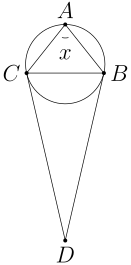
An acute isosceles triangle, is inscribed in a circle. Through and tangents to the circle are drawn, meeting at point If and is the radian measure of then
Answer: A
Small hint:
Express each base angle in terms of
Big hint:
The angle between the tangents is
Solution:
The two base angles are each The minor arc has central angle so the angle between the tangents is The given relation yields Therefore or
Thus the correct answer is A.
15.
Four whole numbers, when added three at a time, give the sums and What is the largest of the four numbers?
cannot be determined from the given information
Answer: C
Small hint:
Add the four given triple-sums
Big hint:
Each original number appears in exactly three of those sums
Solution:
If is the sum of the four numbers, adding the four triple-sums gives so The omitted numbers are and whose largest is
Thus the correct answer is C.
16.
At one of George Washington’s parties, each man shook hands with everyone except his spouse, and no handshakes took place between women. If married couples attended, how many handshakes were there among these people?
Answer: C
Small hint:
Begin with all unordered pairs of the guests
Big hint:
Remove spouse pairs and pairs consisting of two women
Solution:
There are possible pairs. Exclude the married pairs and the pairs of women. The number of handshakes is
Thus the correct answer is C.
17.
How many of the numbers have three different digits in increasing order or in decreasing order?
Answer: C
Small hint:
Choosing three distinct digits fixes their increasing or decreasing order
Big hint:
Treat the digit carefully in the increasing case
Solution:
An increasing three-digit number cannot use so there are increasing numbers. Any three digits chosen from through form a valid decreasing three-digit number, because the largest digit comes first; this gives The total is
Thus the correct answer is C.
18.
First is chosen at random from the set and then is chosen at random from the same set. The probability that the integer has units digit is
Answer: C
Small hint:
The units digits of both powers repeat with period
Big hint:
List the residue pairs that produce a units digit of
Solution:
The units digits of for are while those of are A sum ending in occurs for the residue pairs Each residue occurs times among so the probability is
Thus the correct answer is C.
19.
For how many integers between and is the improper fraction not in lowest terms?
Answer: B
Small hint:
Reduce modulo
Big hint:
The only possible common prime factor is a divisor of
Solution:
Modulo we have so Thus the fraction is reducible exactly when is divisible by or The values are a total of
Thus the correct answer is B.
20.
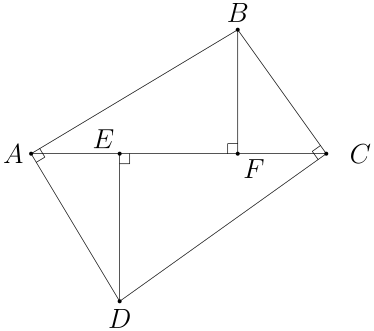
In the figure, is a quadrilateral with right angles at and Points and are on and and are perpendicular to If and then
Answer: C
Small hint:
Place on the -axis with
Big hint:
Use dot products for the right angles at and
Solution:
Set and where Since so Since so Substitution gives and
Thus the correct answer is C.
21.
Consider a pyramid whose base is square and whose vertex is equidistant from and If and then the volume of the pyramid is
Answer: E
Small hint:
In isosceles triangle express using the chord
Big hint:
Relate to the pyramid height and the center-to-vertex distance of the square
Solution:
Let In isosceles triangle so If is the pyramid height, the horizontal distance from the square’s center to is hence Thus and the volume is
Thus the correct answer is E.
22.
If the six solutions of are written in the form where and are real, then the product of those solutions with is
Answer: D
Small hint:
Write in polar form and list its six sixth roots
Big hint:
The roots with positive real part form a conjugate pair
Solution:
The roots have modulus and arguments The roots with positive real part have arguments and They are conjugates of modulus so their product is
Thus the correct answer is D.
23.
If and then
Answer: B
Small hint:
Let so that
Big hint:
The resulting values of show that one of is the cube of the other
Solution:
Let Then so giving or Thus one of is the cube of the other. Let the smaller be Then so and Therefore
Thus the correct answer is B.
24.
All students at Adams High School and at Baker High School take a certain exam. The average scores for boys, for girls, and for boys and girls combined, at Adams HS and Baker HS are shown in the table, as is the average for boys at the two schools combined. What is the average score for the girls at the two schools combined?
| Adams | Baker | Adams & Baker | |
|---|---|---|---|
| Boys: | |||
| Girls: | ? | ||
| Boys & Girls: |
Answer: D
Small hint:
Use each school’s combined average to find its ratio of girls to boys
Big hint:
Use the combined boys’ average to relate the numbers of boys at the two schools
Solution:
Let Adams have boys and girls. From its average, so If Baker has boys and girls, its average gives The combined boys’ average gives so and Hence the combined girls’ average is
Thus the correct answer is D.
25.
Nine congruent spheres are packed inside a unit cube in such a way that one of them has its center at the center of the cube and each of the others is tangent to the center sphere and to three faces of the cube. What is the radius of each sphere?
Answer: B
Small hint:
Place one corner sphere’s center at
Big hint:
Its distance from equals
Solution:
If the radius is a corner sphere has center and the central sphere has center Tangency gives Solving and rationalizing,
Thus the correct answer is B.
26.
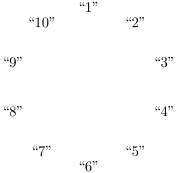
Ten people form a circle. Each picks a number and tells it to the two neighbors adjacent to him in the circle. Then each person computes and announces the average of the numbers of his two neighbors. The figure shows the average announced by each person (not the original number the person picked). The number picked by the person who announced the average was
not uniquely determined from the given information
Answer: A
Small hint:
If is a picked number and the displayed average, then
Big hint:
Start with two unknown adjacent picked numbers and propagate around the circle
Solution:
Index the displayed averages clockwise as and let be the corresponding picked numbers. Write From successive values are The two closing equations give and Hence
Thus the correct answer is A.
27.
Which of these triples could not be the lengths of the three altitudes of a triangle?
Answer: C
Small hint:
For fixed area a side corresponding to altitude equals
Big hint:
Test the triangle inequality on the reciprocals of each triple
Solution:
If the altitudes are then the corresponding sides are proportional to For so the reciprocals fail the triangle inequality. Direct checking shows that the reciprocals of each other listed triple satisfy all strict triangle inequalities.
Thus the correct answer is C.
28.
A quadrilateral that has consecutive sides of lengths and is inscribed in a circle and also has a circle inscribed in it. The point of tangency of the inscribed circle to the side of length divides that side into segments of lengths and Find
Answer: B
Small hint:
Assign one tangent length to each vertex, so adjacent pairs sum to the four side lengths
Big hint:
For supplementary opposite angles, the products of the tangent lengths at opposite vertices are equal
Solution:
Let the tangent lengths from the four consecutive vertices be Then Thus and If the inradius is a vertex with angle has tangent length Opposite angles are supplementary, so Therefore giving Hence the two segments of the -side are and whose difference is
Thus the correct answer is B.
29.
A subset of the integers has the property that none of its members is times another. What is the largest number of members such a subset can have?
Answer: D
Small hint:
Group integers into chains where is not a multiple of
Big hint:
Within each chain, alternating entries give a largest allowed selection
Solution:
Partition the integers into chains with not a multiple of In each chain, no two adjacent terms may both be selected, so a maximum selection takes alternating terms starting with Equivalently, select the integers whose exponent of is even. There are The chain argument also proves no larger selection is possible.
Thus the correct answer is D.
30.
If where and then is an integer. Its units digit is
Answer: E
Small hint:
Use and to obtain a recurrence for
Big hint:
Compute the recurrence modulo and look for a short period
Solution:
Because are roots of Starting with the units digits are with period Since the units digit is the same as that of namely
Thus the correct answer is E.