
Soluciones del 2004 AMC 10A
Desplázate hacia abajo para ver las soluciones preparadas profesionalmente de LIVE by Po-Shen Loh, imprime las soluciones en PDF, consulta la clave de respuestas, o haz el examen cronometrado completo.
Todos los problemas se usan con el permiso legal oficial de la Mathematical Association of America (MAA).
1.
Tú y cinco amigos necesitan recaudar $ en donaciones para una organización benéfica, repartiendo la recaudación por igual. ¿Cuántos dólares necesitará recaudar cada uno?
You and five friends need to raise $ in donations for a charity, dividing the fundraising equally. How many dollars will each of you need to raise?
Pista pequeña:
Incluyéndote a ti, cuenta el número total de personas que comparten el trabajo.
Including you, count the total number of people sharing the work
Pista grande:
Divide los $ por igual entre las personas.
Divide $ evenly among the people
Solución:
Incluyéndote a ti, hay personas que comparten la recaudación por igual. Cada uno debe recaudar dólares.
Por lo tanto, la respuesta correcta es A.
Including you, there are people sharing the fundraising equally. Each must raise dollars.
Thus, the correct answer is A.
2.
Para cualesquiera tres números reales y con la operación se define por ¿Cuál es el valor de ?
For any three real numbers and with the operation is defined by What is
Pista pequeña:
Calcula las tres expresiones internas antes de combinarlas.
Evaluate the three inner expressions before combining them
Pista grande:
y .
and
Solución:
Los valores internos son
Por lo tanto
Por lo tanto, la respuesta correcta es B.
The inner values are
Therefore
Thus, the correct answer is B.
3.
Alicia gana $ por hora, de los cuales se deduce el para pagar impuestos locales. ¿Cuántos centavos por hora del salario de Alicia se usan para pagar impuestos locales?
Alicia earns $ per hour, of which is deducted to pay local taxes. How many cents per hour of Alicia’s wages are used to pay local taxes?
Pista pequeña:
Convierte los $ a centavos antes de tomar el porcentaje.
Convert $ into cents before taking the percentage
Pista grande:
Calcula el de centavos.
Compute of cents
Solución:
Como $ equivale a centavos, el impuesto local es centavos por hora.
Por lo tanto, la respuesta correcta es E.
Since $ equals cents, the local tax is cents per hour.
Thus, the correct answer is E.
4.
¿Cuál es el valor de si ?
What is the value of if
Pista pequeña:
mide la distancia de a .
measures the distance from to
Pista grande:
El punto debe estar a la misma distancia de y de .
The point must be equally far from and
Solución:
Como y son las distancias de a y el punto es equidistante de y
Ese punto medio es
Por lo tanto, la respuesta correcta es D.
Since and are the distances from to and the point is equidistant from and
That midpoint is
Thus, the correct answer is D.
5.
Se elige al azar un conjunto de tres puntos de la cuadrícula que se muestra. Cada conjunto de tres puntos tiene la misma probabilidad de ser elegido. ¿Cuál es la probabilidad de que los puntos estén sobre una misma línea recta?

A set of three points is chosen randomly from the grid shown. Each three-point set has the same probability of being chosen. What is the probability that the points lie on the same straight line?
Pista pequeña:
Hay conjuntos de tres puntos igualmente probables.
There are equally likely three-point sets
Pista grande:
Cuenta las ternas colineales: filas, columnas y diagonales.
Count the collinear triples: rows, columns, and diagonals
Solución:
El número de conjuntos de tres puntos es
Las ternas colineales son las filas, las columnas y las diagonales principales, para un total de
Por lo tanto, la probabilidad es
Por lo tanto, la respuesta correcta es C.
The number of three-point sets is
The collinear triples are the rows, the columns, and the main diagonals, for a total of
The probability is therefore
Thus, the correct answer is C.
6.
Bertha tiene hijas y ningún hijo. Algunas de sus hijas tienen hijas cada una, y las demás no tienen ninguna. Bertha tiene en total hijas y nietas, y ninguna bisnieta. ¿Cuántas de las hijas y nietas de Bertha no tienen hijas?
Bertha has daughters and no sons. Some of her daughters have daughters, and the rest have none. Bertha has a total of daughters and granddaughters, and no great-granddaughters. How many of Bertha’s daughters and granddaughters have no daughters?
Pista pequeña:
Bertha tiene nietas, y ninguna de ellas tiene hijas.
Bertha has granddaughters, and none of them have daughters
Pista grande:
Las nietas vienen en grupos de así que averigua cuántas hijas son madres.
The granddaughters come in groups of so find how many daughters are mothers
Solución:
Bertha tiene nietas, ninguna de las cuales tiene hijas.
Estas nietas pertenecen a de las hijas de Bertha. Así que exactamente mujeres tienen hijas, y el número que no tiene hijas es
Por lo tanto, la respuesta correcta es E.
Bertha has granddaughters, none of whom have daughters.
These granddaughters belong to of Bertha’s daughters. So exactly women have daughters, and the number with no daughters is
Thus, the correct answer is E.
7.
Un tendero apila naranjas en una pila con forma de pirámide cuya base rectangular es de naranjas por naranjas. Cada naranja por encima del primer nivel descansa en un hueco formado por cuatro naranjas del nivel inferior. La pila se completa con una sola fila de naranjas. ¿Cuántas naranjas hay en la pila?
A grocer stacks oranges in a pyramid-like stack whose rectangular base is oranges by oranges. Each orange above the first level rests in a pocket formed by four oranges in the level below. The stack is completed by a single row of oranges. How many oranges are in the stack?
Pista pequeña:
Cada capa hacia arriba tiene una naranja menos en cada dimensión que la capa de abajo.
Each layer up has one fewer orange in each dimension than the layer below
Pista grande:
Suma .
Sum
Solución:
Hay cinco capas, cada una más corta y estrecha que la de abajo. El número total de naranjas es
Por lo tanto, la respuesta correcta es C.
There are five layers, each one shorter and narrower than the one below. The total number of oranges is
Thus, the correct answer is C.
8.
Se juega un juego con fichas según la siguiente regla. En cada ronda, el jugador con más fichas da una ficha a cada uno de los demás jugadores y además coloca una ficha en un montón de descarte. El juego termina cuando algún jugador se queda sin fichas. Los jugadores y empiezan con y fichas, respectivamente. ¿Cuántas rondas habrá en el juego?
A game is played with tokens according to the following rule. In each round, the player with the most tokens gives one token to each of the other players and also places one token into a discard pile. The game ends when some player runs out of tokens. Players and start with and tokens, respectively. How many rounds will there be in the game?
Pista pequeña:
Simula algunas rondas y busca un patrón que se repita.
Simulate a few rounds and look for a repeating pattern
Pista grande:
Cada tres rondas, el total de cada jugador disminuye exactamente en uno.
Every three rounds, each player’s total drops by exactly one
Solución:
Después de las tres primeras rondas los conteos pasan de a En general, cada tres rondas cada jugador pierde exactamente una ficha.
Después de rondas los conteos son En la ronda , el líder regala tres fichas y baja a terminando el juego.
Por lo tanto, la respuesta correcta es B.
After the first three rounds the counts go from to In general, every three rounds each player loses exactly one token.
After rounds the counts are On the th round the leader gives away three tokens and drops to ending the game.
Thus, the correct answer is B.
9.
En la figura, y son ángulos rectos, y y se cortan en ¿Cuál es la diferencia entre las áreas de y ?

In the figure, and are right angles, and and intersect at What is the difference between the areas of and
Pista pequeña:
Al sumar a cada uno de los dos triángulos se obtienen dos triángulos más grandes.
Adding to each of the two triangles produces two larger triangles
Pista grande:
Al restar el área compartida, es igual a .
Subtracting the shared area makes equal to
Solución:
Sea el área compartida por ambos triángulos grandes. Entonces y
Restando, Como y son ángulos rectos,
La diferencia es
Por lo tanto, la respuesta correcta es B.
Let be the area shared by both large triangles. Then and
Subtracting, Since and are right angles,
The difference is
Thus, the correct answer is B.
10.
La moneda se lanza tres veces y la moneda se lanza cuatro veces. ¿Cuál es la probabilidad de que el número de caras obtenido al lanzar las dos monedas justas sea el mismo?
Coin is flipped three times and coin is flipped four times. What is the probability that the number of heads obtained from flipping the two fair coins is the same?
Pista pequeña:
Suma sobre cada posible conteo común .
Add up over each possible common count
Pista grande:
Los conteos de tienen pesos y los de tienen .
The counts for are weighted and for are
Solución:
Las dos monedas coinciden cuando ambas muestran o caras. La moneda tiene pesos de un total de y la moneda tiene pesos de un total de
La probabilidad es
Por lo tanto, la respuesta correcta es D.
The two coins match when both show or heads. Coin has weights out of and coin has weights out of
The probability is
Thus, the correct answer is D.
11.
Una empresa vende mantequilla de maní en frascos cilíndricos. Una investigación de mercado sugiere que usar frascos más anchos aumentará las ventas. Si el diámetro de los frascos se aumenta en un sin alterar el volumen, ¿en qué porcentaje se debe disminuir la altura?
A company sells peanut butter in cylindrical jars. Marketing research suggests that using wider jars will increase sales. If the diameter of the jars is increased by without altering the volume, by what percent must the height be decreased?
Pista pequeña:
El volumen no cambia, así que permanece fijo.
The volume is unchanged, so stays fixed
Pista grande:
Multiplicar el radio por multiplica por .
Multiplying the radius by multiplies by
Solución:
Mantener constante mientras se multiplica el radio por exige que la altura se multiplique por
Así que la altura se vuelve el de la original, una disminución del
Por lo tanto, la respuesta correcta es C.
Keeping constant while multiplying the radius by requires the height to be multiplied by
So the height becomes of the original, a decrease of
Thus, the correct answer is C.
12.
Henry’s Hamburger Heaven ofrece sus hamburguesas con los siguientes ingredientes: kétchup, mostaza, mayonesa, tomate, lechuga, pepinillos, queso y cebolla. Un cliente puede elegir uno, dos o tres medallones de carne, y cualquier conjunto de ingredientes. ¿Cuántos tipos diferentes de hamburguesas se pueden pedir?
Henry’s Hamburger Heaven offers its hamburgers with the following condiments: ketchup, mustard, mayonnaise, tomato, lettuce, pickles, cheese, and onions. A customer can choose one, two, or three meat patties, and any collection of condiments. How many different kinds of hamburgers can be ordered?
Pista pequeña:
Cada uno de los ingredientes se incluye o se omite de forma independiente.
Each of the condiments is independently included or left out
Pista grande:
Multiplica las opciones de ingredientes por las opciones de cantidad de medallones.
Multiply the condiment choices by the choices of patty count
Solución:
Cada uno de los ingredientes está dentro o fuera de forma independiente, lo que da combinaciones de ingredientes.
Para cada una de estas hay opciones de cantidad de medallones, así que el número de hamburguesas es
Por lo tanto, la respuesta correcta es C.
Each of the condiments is independently in or out, giving condiment combinations.
For each of these there are choices of patty count, so the number of hamburgers is
Thus, the correct answer is C.
13.
En una fiesta, cada hombre bailó con exactamente tres mujeres y cada mujer bailó con exactamente dos hombres. Doce hombres asistieron a la fiesta. ¿Cuántas mujeres asistieron a la fiesta?
At a party, each man danced with exactly three women and each woman danced with exactly two men. Twelve men attended the party. How many women attended the party?
Pista pequeña:
Cuenta las parejas de baile hombre-mujer de dos maneras.
Count the man-woman dancing pairs in two ways
Pista grande:
Hay parejas, y cada mujer contribuye con de ellas.
There are pairs, and each woman accounts for of them
Solución:
El número de parejas de baile es contando desde el lado de los hombres. Cada mujer estuvo en exactamente parejas, así que el número de mujeres es
Por lo tanto, la respuesta correcta es D.
The number of dancing pairs is counting from the men’s side. Each woman was in exactly pairs, so the number of women is
Thus, the correct answer is D.
14.
El valor promedio de todos los centavos, monedas de cinco, de diez y de veinticinco centavos en el bolso de Paula es de centavos. Si tuviera una moneda de veinticinco más, el valor promedio sería de centavos. ¿Cuántas monedas de diez centavos tiene en su bolso?
The average value of all the pennies, nickels, dimes, and quarters in Paula’s purse is cents. If she had one more quarter, the average value would be cents. How many dimes does she have in her purse?
Pista pequeña:
Si tiene monedas, su valor total es centavos.
If she has coins, their total value is cents
Pista grande:
Agregar una moneda de veinticinco centavos da .
Adding a quarter gives
Solución:
Con monedas, el valor total es centavos. Al agregar una moneda de veinticinco centavos se obtiene así que
Si hubiera como máximo dos monedas de veinticinco centavos, las otras monedas valdrían como máximo centavos cada una, por lo que cuatro monedas sumarían a lo sumo centavos. Debe haber entonces tres monedas de veinticinco centavos, que dejan centavos para la cuarta moneda. El monedero contiene tres monedas de veinticinco y una de cinco centavos, así que tiene monedas de diez centavos.
Así, la respuesta correcta es A.
With coins the total value is cents. Adding a quarter gives so
If there were at most two quarters, the other coins would be worth at most cents each, so four coins would total at most cents. Thus there must be three quarters, leaving cents for the fourth coin. The purse contains three quarters and one nickel, so it has dimes.
Thus, the correct answer is A.
15.
Dado que y ¿cuál es el mayor valor posible de
Given that and what is the largest possible value of
Pista pequeña:
Reescribe .
Rewrite
Pista grande:
Como haz su valor absoluto lo más pequeño posible.
Since make its absolute value as small as possible
Solución:
Escribe Aquí así que la expresión es mayor cuando es menor.
Eso ocurre con y lo que da
Por lo tanto, la respuesta correcta es D.
Write Here so the expression is largest when is smallest.
That happens with and giving
Thus, the correct answer is D.
16.
La cuadrícula de que se muestra contiene una colección de cuadrados con tamaños desde hasta ¿Cuántos de estos cuadrados contienen el cuadrado central sombreado?

The grid shown contains a collection of squares with sizes from to How many of these squares contain the shaded center square?
Pista pequeña:
Todo cuadrado y contiene el centro.
Every and square contains the center
Pista grande:
Luego cuenta cuántos cuadrados y cubren la celda central.
Then count how many and squares cover the center cell
Solución:
Todo cuadrado y contiene la celda central, y hay de ellos.
Entre los cuadrados más pequeños, de los cuadrados y de los cuadrados cubren el centro, lo que da
Por lo tanto, la respuesta correcta es D.
Every and square contains the center cell, and there are of them.
Among the smaller squares, of the squares and of the squares cover the center, giving
Thus, the correct answer is D.
17.
Brenda y Sally corren en direcciones opuestas sobre una pista circular, partiendo de puntos diametralmente opuestos. Se encuentran por primera vez después de que Brenda ha corrido metros. Se vuelven a encontrar después de que Sally ha corrido metros más allá de su primer punto de encuentro. Cada chica corre a velocidad constante. ¿Cuál es la longitud de la pista en metros?
Brenda and Sally run in opposite directions on a circular track, starting at diametrically opposite points. They first meet after Brenda has run meters. They next meet after Sally has run meters past their first meeting point. Each girl runs at a constant speed. What is the length of the track in meters?
Pista pequeña:
Partiendo de puntos opuestos, juntas recorren la mitad de la pista antes de su primer encuentro.
Starting from opposite points, together they cover half the track before their first meeting
Pista grande:
Usa la razón constante de velocidades para comparar la distancia que Brenda recorrió antes del primer encuentro con la que recorrió entre encuentros.
Use the constant speed ratio to compare Brenda’s first-meeting distance with her distance between meetings
Solución:
Antes del primer encuentro, las dos juntas recorren la mitad de la pista. Entre el primer y el segundo encuentro recorren juntas una pista completa, que es el doble de distancia, así que Brenda corre metros en ese tramo.
Sally corre metros en el mismo tramo, así que la longitud total de la pista es
Por lo tanto, la respuesta correcta es C.
Before the first meeting the two together cover half the track. Between the first and second meetings they together cover a full track, which is twice as far, so Brenda runs meters in that stretch.
Sally runs meters in the same stretch, so the full track length is
Thus, the correct answer is C.
18.
Una sucesión de tres números reales forma una progresión aritmética con primer término Si se suma al segundo término y se suma al tercer término, los tres números resultantes forman una progresión geométrica. ¿Cuál es el menor valor posible para el tercer término de la progresión geométrica?
A sequence of three real numbers forms an arithmetic progression with a first term of If is added to the second term and is added to the third term, the three resulting numbers form a geometric progression. What is the smallest possible value for the third term of the geometric progression?
Pista pequeña:
Escribe la progresión como de modo que la geométrica es .
Write the progression as so the geometric one is
Pista grande:
Usa y toma el valor de que da el tercer término más pequeño.
Use and take the value of giving the smaller third term
Solución:
La progresión aritmética es así que la progresión geométrica es
La condición geométrica da que se simplifica a así que o
Los terceros términos son y El menor es
Por lo tanto, la respuesta correcta es A.
The arithmetic progression is so the geometric progression is
The geometric condition gives which simplifies to so or
The third terms are and The smallest is
Thus, the correct answer is A.
19.
Un silo cilíndrico blanco tiene un diámetro de pies y una altura de pies. Se pinta en el silo una franja roja con un ancho horizontal de pies, como se muestra, dando dos vueltas completas a su alrededor. ¿Cuál es el área de la franja en pies cuadrados?
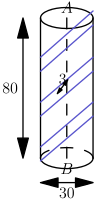
A white cylindrical silo has a diameter of feet and a height of feet. A red stripe with a horizontal width of feet is painted on the silo, as shown, making two complete revolutions around it. What is the area of the stripe in square feet?
Pista pequeña:
Imagina cortar la franja del silo y desenrollarla en un plano.
Imagine cutting the stripe from the silo and unrolling it flat
Pista grande:
Se convierte en un paralelogramo con ancho horizontal y altura .
It becomes a parallelogram with horizontal width and height
Solución:
Al desenrollar la franja se aplana en un paralelogramo. Su base (el ancho horizontal) es de pies y su altura abarca los pies completos del silo.
Por lo tanto, el área es pies cuadrados.
Por lo tanto, la respuesta correcta es C.
Unrolling the stripe flattens it into a parallelogram. Its base (the horizontal width) is feet and its height spans the full feet of the silo.
The area is therefore square feet.
Thus, the correct answer is C.
20.
Los puntos y se ubican en el cuadrado de modo que es equilátero. ¿Cuál es la razón entre el área de y la de ?
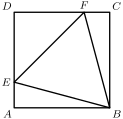
Points and are located on square so that is equilateral. What is the ratio of the area of to that of
Pista pequeña:
Supón que el cuadrado tiene lado y toma .
Let the square have side and set
Pista grande:
A partir de obtén .
From get
Solución:
Supón que el cuadrado tiene lado y por simetría toma así que
Como es equilátero, lo que da que se simplifica a
Los triángulos rectángulos tienen áreas y así que
Por lo tanto, la respuesta correcta es D.
Let the square have side and by symmetry let so
Since is equilateral, giving which simplifies to
The right triangles have areas and so
Thus, the correct answer is D.
21.
Dos rectas distintas pasan por el centro de tres círculos concéntricos de radios y El área de la región sombreada en el diagrama es del área de la región no sombreada. ¿Cuál es la medida en radianes del ángulo agudo formado por las dos rectas? (Nota: radianes es grados.)
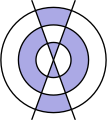
Two distinct lines pass through the center of three concentric circles of radii and The area of the shaded region in the diagram is of the area of the unshaded region. What is the radian measure of the acute angle formed by the two lines? (Note: radians is degrees.)
Pista pequeña:
Sea el ángulo agudo y expresa cada pieza sombreada como el área de un sector.
Let be the acute angle and express each shaded piece as a sector area
Pista grande:
Las piezas sombreadas suman de un área total de .
The shaded pieces total out of the whole area
Solución:
Sea el ángulo agudo. La región sombreada tiene tres partes: dos sectores agudos del disco unitario con área total dos sectores obtusos de la corona circular entre los radios y con área total y dos sectores agudos de la corona circular entre los radios y con área total
Sumando estas se obtiene un área sombreada de
La región sombreada es de la región no sombreada, así que es del área total Entonces lo que da
Por lo tanto, la respuesta correcta es B.
Let be the acute angle. The shaded region has three parts: two acute sectors of the unit disk with total area two obtuse sectors of the ring between radii and with total area and two acute sectors of the ring between radii and with total area
Adding these gives a shaded area of
The shaded region is of the unshaded region, so it is of the total area Then which gives
Thus, the correct answer is B.
22.
El cuadrado tiene lado Se construye dentro del cuadrado un semicírculo con diámetro , y la tangente al semicírculo desde corta al lado en ¿Cuál es la longitud de ?
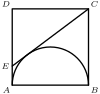
Square has side length A semicircle with diameter is constructed inside the square, and the tangent to the semicircle from intersects side at What is the length of
Pista pequeña:
Las tangentes desde un punto tienen la misma longitud: y .
Tangents from a point have equal length: and
Pista grande:
Con aplica el teorema de Pitágoras al .
With apply the Pythagorean theorem to
Solución:
Sea el punto donde toca el semicírculo y sea Como las tangentes desde un punto son iguales, y así que
En el triángulo rectángulo tenemos y así que Esto da por lo que
Por lo tanto, la respuesta correcta es D.
Let be the point where touches the semicircle and let Since tangents from a point are equal, and so
In right triangle we have and so This gives hence
Thus, the correct answer is D.
23.
Los círculos y son tangentes exteriores entre sí y tangentes interiores al círculo Los círculos y son congruentes. El círculo tiene radio y pasa por el centro de ¿Cuál es el radio del círculo ?
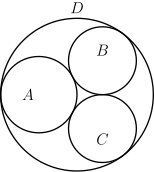
Circles and are externally tangent to each other and internally tangent to circle Circles and are congruent. Circle has radius and passes through the center of What is the radius of circle
Pista pequeña:
Como pasa por el centro de y es tangente interior, el círculo tiene radio .
Since passes through ’s center and is internally tangent, circle has radius
Pista grande:
Coloca los centros en coordenadas; el círculo de radio tiene su centro a distancia de y de .
Place the centers on coordinates; circle of radius has center at distance from and from
Solución:
Como el círculo pasa por el centro de y es tangente interior a el círculo tiene radio Coloca el centro de en el origen y el centro de en
Sea el círculo de radio y centro usando la simetría de y respecto al eje horizontal. La tangencia da
Restando se obtiene Sustituyendo en la segunda ecuación da así que
Por lo tanto, la respuesta correcta es D.
Because circle passes through ’s center and is internally tangent to circle has radius Place ’s center at the origin and ’s center at
Let circle have radius and center using the symmetry of and about the horizontal axis. Tangency gives
Subtracting yields Substituting into the second equation gives so
Thus, the correct answer is D.
24.
Sea una sucesión con las siguientes propiedades: y para cualquier entero positivo ¿Cuál es el valor de ?
Let be a sequence with the following properties: and for any positive integer What is the value of
Pista pequeña:
Calcula y sigue el exponente de .
Compute and track the exponent of
Pista grande:
Los exponentes son
The exponents are
Solución:
Aplicando la regla repetidamente, así que en general
Para el exponente es así que
Por lo tanto, la respuesta correcta es D.
Applying the rule repeatedly, so in general
For the exponent is so
Thus, the correct answer is D.
25.
Tres esferas mutuamente tangentes de radio descansan sobre un plano horizontal. Una esfera de radio descansa sobre ellas. ¿Cuál es la distancia del plano a la parte superior de la esfera más grande?
Three mutually tangent spheres of radius rest on a horizontal plane. A sphere of radius rests on them. What is the distance from the plane to the top of the larger sphere?
Pista pequeña:
Los tres centros pequeños forman un triángulo equilátero de lado a una altura de .
The three small centers form an equilateral triangle of side at height
Pista grande:
El centro de la esfera grande está sobre el baricentro del triángulo; el baricentro está a de cada centro pequeño, y la distancia entre los centros de dos esferas tangentes es .
The big center sits above the triangle’s centroid; the centroid is from each small center, and the slant distance between centers is
Solución:
Los tres centros pequeños forman un triángulo equilátero de lado cada uno a unidad sobre el plano. Su baricentro está a distancia de cada vértice.
El centro de la esfera grande está directamente sobre y la distancia entre y un centro pequeño es Por lo tanto
Sumar la unidad del plano a y las unidades de a la parte superior de la esfera grande da
Por lo tanto, la respuesta correcta es B.
The three small centers form an equilateral triangle of side each unit above the plane. Its centroid is at distance from each vertex.
The large sphere’s center sits directly above and the distance between and a small center is Thus
Adding the unit from the plane to and the units from to the top of the large sphere gives
Thus, the correct answer is B.