
1968 AMC 12 Problem 31
Attempt Problem 31 of the 1968 AMC 12 below, then check your answer against the professionally curated solution from LIVE by Po-Shen Loh. You can also try the full timed exam, view all 1968 AMC 12 solutions, or check the answer key.
All problems are used with official legal permission of the Mathematical Association of America (MAA).
31.
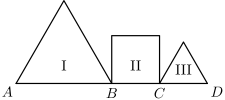
In this diagram, not drawn to scale, figures and are equilateral triangular regions with respective areas of and square inches. Figure is a square region with area square inches. Let the length of segment be decreased by of itself, while the lengths of and remain unchanged. The percent decrease in the area of the square is:
Answer: D
Small hint:
Convert the three given areas into the side lengths
Big hint:
The decrease in is absorbed entirely by the square’s side
Solution:
From The square has and the smaller equilateral triangle also has Thus Decreasing it by removes from whose new length is The square’s area falls from to a decrease.
Therefore, the correct answer is D.