
Soluciones del 1979 AMC 12
Desplázate hacia abajo para ver las soluciones preparadas profesionalmente de LIVE by Po-Shen Loh, imprime las soluciones en PDF, consulta la clave de respuestas, o haz el examen cronometrado completo.
Todos los problemas se usan con el permiso legal oficial de la Mathematical Association of America (MAA).
1.
Si el rectángulo tiene un área de metros cuadrados y y son los puntos medios de los lados y respectivamente, entonces el área del rectángulo , en metros cuadrados, es
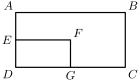
If rectangle has area square meters and and are the midpoints of sides and respectively, then the area of rectangle in square meters is
Pista pequeña:
Las dos condiciones de punto medio reducen a la mitad las longitudes de los lados correspondientes
The two midpoint conditions halve the relevant side lengths
Pista grande:
Compara el factor de escala de las áreas de y
Compare the area scale factor of with that of
Solución:
Las longitudes de los lados de son la mitad de las longitudes correspondientes de Por lo tanto, su área es de es decir,
Por lo tanto, la respuesta correcta es D.
The side lengths of are one half the corresponding side lengths of Its area is therefore of which is
Therefore, the correct answer is D.
2.
Para todos los números reales no nulos y tales que el valor de es
For all nonzero real numbers and such that equals
Pista pequeña:
Combina los dos recíprocos usando el denominador
Combine the two reciprocals over the denominator
Pista grande:
Usa la ecuación dada para sustituir
Use the given equation to replace
Solución:
Tenemos porque
Por lo tanto, la respuesta correcta es D.
We have because
Therefore, the correct answer is D.
3.
En la figura adjunta, es un cuadrado, es un triángulo equilátero y el punto está fuera del cuadrado ¿Cuál es la medida de en grados?
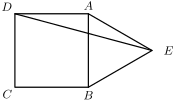
In the adjoining figure, is a square, is an equilateral triangle and point is outside square What is the measure of in degrees?
Pista pequeña:
Compara y
Compare and
Pista grande:
Halla y luego usa los ángulos de la base del triángulo isósceles
Find , then use the base angles of isosceles
Solución:
El cuadrado y el triángulo equilátero dan Además, Así, es isósceles y cada ángulo de la base mide
Por lo tanto, la respuesta correcta es C.
The square and equilateral triangle give Also Thus is isosceles, and each base angle is
Therefore, the correct answer is C.
4.
Para todo número real la expresión es igual a
For all real numbers equals
Pista pequeña:
Desarrolla desde los paréntesis más internos hacia afuera
Expand from the innermost parentheses outward
Pista grande:
Lleva la cuenta por separado de los dos factores externos
Track the outer two factors of separately
Solución:
Al desarrollar desde adentro hacia afuera se obtiene
Por lo tanto, la respuesta correcta es E.
Expanding from the inside gives
Therefore, the correct answer is E.
5.
Halla la suma de los dígitos del mayor número par de tres cifras (en representación de base diez) que no cambia cuando se intercambian sus cifras de unidades y centenas.
Find the sum of the digits of the largest even three digit number (in base ten representation) which is not changed when its units and hundreds digits are interchanged.
Pista pequeña:
Las cifras de centenas y unidades deben ser iguales
The hundreds and units digits must be equal
Pista grande:
Maximiza las cifras exteriores iguales bajo la condición de que el número sea par y luego maximiza la cifra de las decenas
Maximize the equal outer digits subject to the number being even, then maximize the tens digit
Solución:
La cifra común de centenas y unidades debe ser par. La mayor cifra no nula posible es y la cifra de las decenas puede ser Por lo tanto, el mayor número es y la suma de sus cifras es
Por lo tanto, la respuesta correcta es D.
The equal hundreds and units digit must be even. The largest possible nonzero such digit is and the tens digit can be Thus the largest number is whose digit sum is
Therefore, the correct answer is D.
6.
Pista pequeña:
Escribe cada fracción como más el recíproco de una potencia de
Write each fraction as plus a reciprocal power of
Pista grande:
Suma como una serie geométrica finita
Sum as a finite geometric series
Solución:
Cada numerador es una unidad mayor que su denominador, así que la expresión es La suma geométrica entre paréntesis es Por lo tanto, el valor es
Por lo tanto, la respuesta correcta es A.
Each numerator is one more than its denominator, so the expression is The parenthesized geometric sum is Therefore the value is
Therefore, the correct answer is A.
7.
El cuadrado de un entero se llama cuadrado perfecto. Si es un cuadrado perfecto, el siguiente cuadrado perfecto mayor es
The square of an integer is called a perfect square. If is a perfect square, the next larger perfect square is
Pista pequeña:
Escribe para algún entero no negativo
Write for a nonnegative integer
Pista grande:
Desarrolla el siguiente cuadrado y sustituye por
Expand the next square and replace by
Solución:
Sea con El siguiente cuadrado perfecto mayor es
Por lo tanto, la respuesta correcta es E.
Let with The next larger perfect square is
Therefore, the correct answer is E.
8.
Halla el área de la región más pequeña limitada por las gráficas de y
Find the area of the smallest region bounded by the graphs of and
Pista pequeña:
Los dos rayos de se encuentran en el centro del círculo
The two rays of meet at the center of the circle
Pista grande:
Halla el menor ángulo central entre los rayos y
Find the smaller central angle between the rays and
Solución:
Los dos rayos llegan al círculo en las direcciones angulares y de modo que la región limitada más pequeña es un sector de del círculo de radio . Su área es
Por lo tanto, la respuesta correcta es C.
The two rays meet the circle at angles and so the smallest bounded region is a sector of the radius- circle. Its area is
Therefore, the correct answer is C.
9.
El producto de y es igual a
The product of and equals
Pista pequeña:
Escribe ambos radicandos como potencias de
Rewrite both radicands as powers of
Pista grande:
Suma los exponentes y , y luego separa la parte entera
Add the exponents and , then separate the integer part
Solución:
Al escribir ambos radicales como potencias de , obtenemos
Por lo tanto, la respuesta correcta es E.
Writing both radicals as powers of gives
Therefore, the correct answer is E.
10.
Si es un hexágono regular cuya apotema (distancia del centro al punto medio de un lado) es y es el punto medio del lado para y entonces el área del cuadrilátero es
If is a regular hexagon whose apothem (distance from the center to the midpoint of a side) is and is the midpoint of side for then the area of quadrilateral is
Pista pequeña:
Los puntos están sobre un círculo cuyo radio es igual a la apotema
The points lie on a circle of radius equal to the apothem
Pista grande:
Une el centro con los cuatro puntos medios consecutivos y descompón el cuadrilátero
Join the center to the four consecutive side midpoints and decompose the quadrilateral
Solución:
Sea el centro. Las apotemas consecutivas y tienen longitud y forman un ángulo de , por lo que cada es equilátero de lado El cuadrilátero es la unión de tres de estos triángulos y, por tanto, tiene área
Por lo tanto, la respuesta correcta es D.
Let be the center. Consecutive apothems and have length and form a angle, so each is equilateral of side The quadrilateral is the union of three such triangles, and hence has area
Therefore, the correct answer is D.
11.
Halla una solución entera positiva de la ecuación
Find a positive integral solution to the equation
La ecuación no tiene soluciones enteras positivas.
The equation has no positive integral solutions.
Pista pequeña:
Usa las sumas de los primeros enteros positivos impares y de los primeros enteros positivos pares
Use the sums of the first odd and first even positive integers
Pista grande:
La fracción se simplifica a
The fraction simplifies to
Solución:
El numerador es y el denominador es Por tanto, lo que da y así
Por lo tanto, la respuesta correcta es B.
The numerator is and the denominator is Thus which gives so
Therefore, the correct answer is B.
12.
En la figura adjunta, es el diámetro de un semicírculo con centro El punto está en la prolongación de más allá de el punto está en el semicírculo, y es el punto de intersección (distinto de ) del segmento con el semicírculo. Si la longitud es igual a la longitud y la medida de es entonces la medida de es
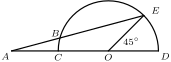
In the adjoining figure, is the diameter of a semicircle with center Point lies on the extension of past point lies on the semicircle, and is the point of intersection (distinct from ) of line segment with the semicircle. If length equals length and the measure of is then the measure of is
Pista pequeña:
Sea y usa
Let and use
Pista grande:
Expresa de dos maneras usando los triángulos isósceles y el ángulo central de
Express in two ways using the isosceles triangles and the central angle
Solución:
Sea Como se tiene y por ello Además, así que y Por otra parte, de modo que Por tanto, lo que da
Por lo tanto, la respuesta correcta es B.
Let Since so Also hence and On the other hand, so Therefore giving
Therefore, the correct answer is B.
13.
La desigualdad se satisface si y solo si
The inequality is satisfied if and only if
o (o se cumplen ambas
desigualdades)
or (or both inequalities
hold)
o (o se cumplen ambas desigualdades)
or (or both inequalities hold)
y
and
Pista pequeña:
Sustituye por
Replace by
Pista grande:
Separa los casos y , y luego combina las regiones obtenidas
Separate the cases and , then combine the resulting regions
Solución:
Si la desigualdad se convierte en o bien Si se convierte en o bien Al combinar los dos casos se obtiene exactamente o permitiendo que ambos se cumplan.
Por lo tanto, la respuesta correcta es A.
If the inequality becomes or If it becomes or Combining the two cases gives exactly or with overlap allowed.
Therefore, the correct answer is A.
14.
En cierta sucesión de números, el primer número es y, para todo el producto de los primeros números de la sucesión es La suma del tercer y el quinto número de la sucesión es
In a certain sequence of numbers, the first number is and, for all the product of the first numbers in the sequence is The sum of the third and the fifth numbers in the sequence is
Pista pequeña:
Divide el producto de los primeros términos entre el producto de los primeros términos
Divide the product of the first terms by the product of the first terms
Pista grande:
Esto da directamente el término -ésimo como un cociente de dos cuadrados
This gives the th term directly as a ratio of two squares
Solución:
Para el término -ésimo es Por lo tanto, y cuya suma es
Por lo tanto, la respuesta correcta es C.
For the th term is Therefore and whose sum is
Therefore, the correct answer is C.
15.
Dos frascos idénticos se llenan con soluciones de alcohol; en uno, la razón del volumen de alcohol al volumen de agua es , y en el otro es . Si se mezcla todo el contenido de los dos frascos, la razón del volumen de alcohol al volumen de agua en la mezcla es
Two identical jars are filled with alcohol solutions, the ratio of the volume of alcohol to the volume of water being in one jar and in the other jar. If the entire contents of the two jars are mixed together, the ratio of the volume of alcohol to the volume of water in the mixture is
Pista pequeña:
Asigna el mismo volumen total a cada frasco y convierte cada razón en fracciones de alcohol y de agua
Assign the same total volume to each jar and convert each ratio to alcohol and water fractions
Pista grande:
Suma las dos cantidades de alcohol y las dos cantidades de agua antes de formar su razón
Add the two alcohol amounts and the two water amounts before forming their ratio
Solución:
Para volúmenes totales iguales, las fracciones de alcohol son y mientras que las fracciones de agua son y Su razón es
Por lo tanto, la respuesta correcta es E.
For equal total volumes, the alcohol fractions are and while the water fractions are and Their ratio is
Therefore, the correct answer is E.
16.
Un círculo de área está contenido en el interior de un círculo mayor de área Si el radio del círculo mayor es y y forman una progresión aritmética, entonces el radio del círculo menor es
A circle with area is contained in the interior of a larger circle with area If the radius of the larger circle is and if is an arithmetic progression, then the radius of the smaller circle is
Pista pequeña:
Usa la condición del término medio para las tres áreas en progresión aritmética
Use the middle-term condition for the three areas in arithmetic progression
Pista grande:
Expresa el área del círculo mayor como un múltiplo de
Express the larger circle’s area as a multiple of
Solución:
La condición de progresión da por lo que Así, el área mayor es y Si el radio menor es entonces y por ello
Por lo tanto, la respuesta correcta es E.
The progression condition gives so Hence the larger area is and If the smaller radius is then so
Therefore, the correct answer is E.
17.
Los puntos y son distintos y están, en ese orden, sobre una recta. Los segmentos y tienen longitudes y respectivamente. Si los segmentos y pueden girarse alrededor de los puntos y respectivamente, de modo que los puntos y coincidan para formar un triángulo de área positiva, ¿cuáles de las siguientes tres desigualdades deben satisfacerse?
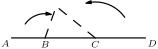
Points and are distinct and lie, in the given order, on a straight line. Line segments and have lengths and respectively. If line segments and may be rotated about points and respectively, so that points and coincide, to form a triangle with positive area, then which of the following three inequalities must be satisfied?
solo
only
solo
only
solo y
and only
solo y
and only
y
and
Pista pequeña:
Después de los giros, identifica las longitudes de los tres lados del nuevo triángulo
After the rotations, identify the three side lengths of the new triangle
Pista grande:
Aplica las tres desigualdades estrictas del triángulo a y
Apply all three strict triangle inequalities to and
Solución:
El nuevo triángulo tiene lados de longitudes y Sus desigualdades del triángulo dan Por tanto, I y II deben cumplirse, mientras que III debe fallar.
Por lo tanto, la respuesta correcta es C.
The new triangle has side lengths and Its triangle inequalities give Thus I and II must hold, while III must fail.
Therefore, the correct answer is C.
18.
Redondeados a la milésima más cercana, es y es ¿Cuál de los siguientes valores es la mejor aproximación de ?
To the nearest thousandth, is and is Which of the following is the best approximation of
Pista pequeña:
Usa
Use
Pista grande:
Aplica el cambio de base y luego compara el resultado decimal con las cinco fracciones
Apply change of base, then compare the decimal result with the five fractions
Solución:
Tenemos Por lo tanto, Entre las opciones, es la más cercana.
Por lo tanto, la respuesta correcta es C.
We have Therefore Of the choices, is closest.
Therefore, the correct answer is C.
19.
Halla la suma de los cuadrados de todos los números reales que satisfacen la ecuación
Find the sum of the squares of all real numbers satisfying the equation
Pista pequeña:
Reescribe como una sola potencia con exponente
Rewrite as a single power with exponent
Pista grande:
Determina los dos valores reales cuyas potencias -ésimas son
Determine the two real values whose th powers equal
Solución:
Como se tiene Así, Las soluciones reales son y y la suma de sus cuadrados es
Por lo tanto, la respuesta correcta es A.
Since Thus The real solutions are and and the sum of their squares is
Therefore, the correct answer is A.
20.
Si y entonces la medida en radianes de es
If and then the radian measure of equals
Pista pequeña:
Primero despeja en la ecuación de producto dada
First solve the given product equation for
Pista grande:
Usa la fórmula de adición de tangentes para los dos ángulos positivos de tangente inversa
Use the tangent addition formula on the two positive inverse-tangent angles
Solución:
Al sustituir , se obtiene Si y entonces Ambos ángulos son positivos y su suma es menor que de modo que
Por lo tanto, la respuesta correcta es C.
Substituting gives If and then Both angles are positive and their sum is less than so
Therefore, the correct answer is C.
21.
La hipotenusa de un triángulo rectángulo tiene longitud y el radio de su círculo inscrito es La razón entre el área del círculo y el área del triángulo es
The length of the hypotenuse of a right triangle is and the radius of the inscribed circle is The ratio of the area of the circle to the area of the triangle is
ninguna de estas
none of these
Pista pequeña:
Usa la fórmula para el área de un triángulo
Use the formula for a triangle’s area
Pista grande:
Para un triángulo rectángulo, relaciona la suma de los catetos con y
For a right triangle, relate the sum of the legs to and
Solución:
Si los catetos son y la identidad del inradio de un triángulo rectángulo es Por ello, el semiperímetro es El área del triángulo es mientras que el área del círculo es Su razón es
Por lo tanto, la respuesta correcta es B.
If the legs are and then the right-triangle inradius identity is Hence the semiperimeter is The triangle’s area is while the circle’s area is Their ratio is
Therefore, the correct answer is B.
22.
Halla el número de pares de enteros que satisfacen la ecuación
Find the number of pairs of integers which satisfy the equation
infinitos
infinitely many
Pista pequeña:
Factoriza el lado izquierdo como
Factor the left side as
Pista grande:
Compara ambos lados módulo
Compare the two sides modulo
Solución:
El lado izquierdo es que es divisible por para todo entero El lado derecho es que es congruente con Por tanto, ningún par de enteros satisface la ecuación.
Por lo tanto, la respuesta correcta es A.
The left side is which is divisible by for every integer The right side is which is congruent to Therefore no integer pair satisfies the equation.
Therefore, the correct answer is A.
23.
Las aristas de un tetraedro regular con vértices y tienen longitud uno. Halla la menor distancia posible entre un par de puntos y donde está en la arista y está en la arista
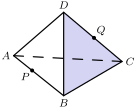
The edges of a regular tetrahedron with vertices and each have length one. Find the least possible distance between a pair of points and where is on edge and is on edge
Pista pequeña:
Usa coordenadas simétricas para un tetraedro regular con vértices
Use symmetric coordinates for a regular tetrahedron with vertices
Pista grande:
Parametriza puntos de las dos aristas opuestas y minimiza la distancia al cuadrado
Parameterize points on the two opposite edges and minimize the squared distance
Solución:
Antes de escalar, toma Estas aristas tienen longitud así que se escala por Los puntos de y tienen las formas y Antes de escalar, que se minimiza en Después de escalar, la distancia mínima al cuadrado es por lo que la distancia es
Por lo tanto, la respuesta correcta es C.
Before scaling, take These edges have length so scale by Points on and have forms and Before scaling, minimized at After scaling, the minimum squared distance is so the distance is
Therefore, the correct answer is C.
24.
Un polígono se llama «simple» si no se interseca consigo mismo. Los lados y del cuadrilátero simple tienen longitudes y respectivamente. Si los ángulos en los vértices y son obtusos y ¿cuál es la longitud del lado ?
A polygon is called “simple” if it is not self-intersecting. Sides and of simple quadrilateral have lengths and respectively. If vertex angles and are obtuse and then side has length
Pista pequeña:
Coloca y , y luego usa los signos determinados por los ángulos obtusos
Place and , then use the signs forced by the obtuse angles
Pista grande:
Determina las coordenadas de y a partir de las razones --
Determine coordinates for and from the -- ratios
Solución:
Coloca y Como es obtuso y podemos tomar La configuración simple y el ángulo obtuso en dan Así,
Por lo tanto, la respuesta correcta es E.
Put and Since is obtuse and we may take The simple configuration and the obtuse angle at give Thus
Therefore, the correct answer is E.
25.
Si y son, respectivamente, el cociente y el residuo al dividir el polinomio entre y y son, respectivamente, el cociente y el residuo al dividir entre entonces es igual a
If and are the quotient and remainder, respectively, when the polynomial is divided by and if and are the quotient and remainder, respectively, when is divided by then equals
Pista pequeña:
Sea y expresa el primer cociente usando
Let and express the first quotient using
Pista grande:
Aplica el teorema del residuo a en
Apply the remainder theorem to at
Solución:
Sea Como el primer residuo es Por tanto, el segundo residuo es
Por lo tanto, la respuesta correcta es B.
Let Since the first remainder is Therefore the second remainder is
Therefore, the correct answer is B.
26.
La función satisface la ecuación funcional para todo par de números reales. Si entonces el número de enteros para los cuales es
The function satisfies the functional equation for every pair of real numbers. If then the number of integers for which is
infinitos
infinite
Pista pequeña:
Iguala una variable a para obtener una recurrencia para entradas enteras consecutivas
Set one variable equal to to get a recurrence for consecutive integer inputs
Pista grande:
Halla , resuelve la recurrencia para todos los enteros y luego impón
Find , solve the recurrence for all integers, and then impose
Solución:
Al tomar , se obtiene Al tomar , se obtiene Al extender la recurrencia en ambas direcciones se obtiene, para todo entero Así, equivale a Las soluciones enteras son y y, después de excluir , queda exactamente una.
Por lo tanto, la respuesta correcta es B.
Setting gives Setting gives Extending the recurrence in both directions yields, for every integer Thus is equivalent to The integer solutions are and and after excluding exactly one remains.
Therefore, the correct answer is B.
27.
Se elige al azar un par ordenado de enteros, cada uno con valor absoluto menor o igual que cinco, y todos esos pares ordenados tienen la misma probabilidad de ser elegidos. ¿Cuál es la probabilidad de que la ecuación no tenga raíces reales positivas distintas?
An ordered pair of integers, each of which has absolute value less than or equal to five, is chosen at random, with each such ordered pair having an equal likelihood of being chosen. What is the probability that the equation will not have distinct positive real roots?
ninguna de estas
none of these
Pista pequeña:
Tener raíces positivas distintas exige y
Distinct positive roots require and
Pista grande:
Cuenta los valores admisibles de para y luego toma el complemento entre los pares
Count the qualifying values for each then take the complement among pairs
Solución:
Hay pares ordenados. Tener raíces positivas distintas exige y Para y no hay opciones; para y hay, respectivamente, y opciones de Así, solo pares producen raíces positivas distintas, por lo que la probabilidad pedida es que no aparece entre las opciones.
Por lo tanto, la respuesta correcta es E.
There are ordered pairs. Distinct positive roots require and For and there are no choices; for and there are respectively and choices of Thus only pairs produce distinct positive roots, so the requested probability is which is not listed.
Therefore, the correct answer is E.
28.
Los círculos con centros y tienen radio donde La distancia entre cada par de centros es Si es el punto de intersección de los círculos con centros y que está fuera del círculo con centro y es el punto de intersección de los círculos con centros y que está fuera del círculo con centro entonces la longitud es
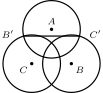
Circles with centers and each have radius where The distance between each pair of centers is If is the point of intersection of circle and circle which is outside circle and if is the point of intersection of circle and circle which is outside circle then length equals
ninguna de estas
none of these
Pista pequeña:
Introduce el punto análogo , exterior al círculo con centro ; por simetría, es equilátero
Introduce the analogous point outside circle ; symmetry makes equilateral
Pista grande:
Usa el centroide común y la altura de un triángulo isósceles de lados y
Use the common centroid and the altitude of an isosceles triangle with sides and
Solución:
Sea la intersección exterior análoga de los círculos con centros y Entonces y son triángulos equiláteros concéntricos. Si es su centroide común y es el punto medio de entonces La semejanza da Por tanto,
Por lo tanto, la respuesta correcta es D.
Let be the analogous outer intersection of the circles centered at and Then and are concentric equilateral triangles. If is their common centroid and is the midpoint of then Similarity gives Hence
Therefore, the correct answer is D.
29.
Para cada número positivo sea El valor mínimo de es
For each positive number let The minimum value of is
Pista pequeña:
Sea y escribe en términos de
Set and write in terms of
Pista grande:
Factoriza el numerador como una diferencia de cuadrados y luego usa
Factor the numerator as a difference of squares, then use
Solución:
Sean y Como el numerador es El denominador es así que Para se tiene con igualdad en Por tanto, el mínimo es
Por lo tanto, la respuesta correcta es E.
Let and Since the numerator is The denominator is so For with equality at Thus the minimum is
Therefore, the correct answer is E.
30.
En es el punto medio del lado y está sobre el lado Si la longitud de es y y entonces el área de más el doble del área de es
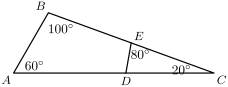
In is the midpoint of side and is on side If the length of is and and then the area of plus twice the area of equals
Pista pequeña:
Prolonga hasta de modo que , formando un triángulo equilátero
Extend to so that , creating an equilateral triangle
Pista grande:
Elige en con ; compara con
Choose on with ; compare with
Solución:
Prolonga más allá de hasta con Entonces es equilátero. Elige en de modo que Las condiciones angulares dan mientras que Como es el punto medio de el factor de semejanza es así que Al descomponer el triángulo equilátero se obtiene Al dividir entre , resulta
Por lo tanto, la respuesta correcta es B.
Extend through to with Then is equilateral. Choose on so that The angle conditions give while Since is the midpoint of the similarity scale is so Decomposing the equilateral triangle gives Dividing by yields
Therefore, the correct answer is B.