
Soluciones del 1988 AMC 12
Desplázate hacia abajo para ver las soluciones preparadas profesionalmente de LIVE by Po-Shen Loh, imprime las soluciones en PDF, consulta la clave de respuestas, o haz el examen cronometrado completo.
Todos los problemas se usan con el permiso legal oficial de la Mathematical Association of America (MAA).
1.
Pista pequeña:
Extrae el mayor factor cuadrado de cada radicando
Extract the largest square factor from each radicand
Pista grande:
Después de simplificar, los dos radicales son términos semejantes
After simplifying, the two radicals are like terms
Solución:
Tenemos y Su suma es
Por lo tanto, la respuesta correcta es D.
We have and Their sum is
Thus the correct answer is D.
2.
Los triángulos y son semejantes; corresponde a y a Si y entonces es
Triangles and are similar, with corresponding to and to If and then is
Pista pequeña:
Empareja con y con
Match with and with
Pista grande:
Usa el factor de escala del primer triángulo al segundo
Use the scale factor from the first triangle to the second
Solución:
El factor de escala es Por tanto, y
Por lo tanto, la respuesta correcta es D.
The scale factor is Therefore and
Thus the correct answer is D.
3.
Cuatro tiras rectangulares de papel de longitud y ancho se colocan planas sobre una mesa y se superponen perpendicularmente como se muestra. ¿Qué área de la mesa queda cubierta?
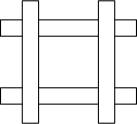
Four rectangular paper strips of length and width are put flat on a table and overlap perpendicularly as shown. How much area of the table is covered?
Pista pequeña:
Suma primero las áreas de las cuatro tiras
First add the areas of the four strips
Pista grande:
Cada cruce perpendicular es un cuadrado unitario contado dos veces
Each perpendicular crossing is a unit square counted twice
Solución:
Las tiras tienen un área total de Hay cuatro superposiciones de por cada una contada dos veces, por lo que el área cubierta es
Por lo tanto, la respuesta correcta es A.
The strips have total area There are four -by- overlaps, each counted twice, so the covered area is
Thus the correct answer is A.
4.
La pendiente de la recta es
The slope of the line is
Pista pequeña:
Despeja en la ecuación
Solve the equation for
Pista grande:
En el coeficiente es la pendiente
In the coefficient is the slope
Solución:
Al multiplicar por y luego aislar se obtiene La pendiente es
Por lo tanto, la respuesta correcta es B.
Multiplying by after isolating gives The slope is
Thus the correct answer is B.
5.
Si y son constantes y entonces es
If and are constants and then is
Pista pequeña:
Desarrolla el producto de la izquierda
Expand the product on the left
Pista grande:
Compara el término constante antes de comparar el coeficiente de
Compare the constant term before comparing the coefficient of
Solución:
Al desarrollar se obtiene Por tanto, así que y
Por lo tanto, la respuesta correcta es E.
Expansion gives Thus so and
Thus the correct answer is E.
6.
Una figura es un paralelogramo equiángulo si y solo si es un
A figure is an equiangular parallelogram if and only if it is a
rectángulo
rectangle
polígono regular
regular polygon
rombo
rhombus
cuadrado
square
trapecio
trapezoid
Pista pequeña:
Los cuatro ángulos interiores iguales deben sumar
The four equal interior angles must add to
Pista grande:
Ninguna condición obliga a que los lados adyacentes tengan la misma longitud
No condition here forces adjacent sides to have equal lengths
Solución:
Cuatro ángulos iguales que suman son todos rectos. Un paralelogramo con cuatro ángulos rectos es exactamente un rectángulo.
Por lo tanto, la respuesta correcta es A.
Four equal angles summing to are all right angles. A parallelogram with four right angles is exactly a rectangle.
Thus the correct answer is A.
7.
Estima el tiempo necesario para enviar bloques de datos por un canal de comunicaciones si cada bloque consta de “fragmentos” y el canal puede transmitir fragmentos por segundo.
Estimate the time it takes to send blocks of data over a communications channel if each block consists of “chunks” and the channel can transmit chunks per second.
segundos
seconds
segundos
seconds
segundos
seconds
minutos
minutes
horas
hours
Pista pequeña:
Calcula primero el número total de fragmentos
Compute the total number of chunks first
Pista grande:
Convierte a minutos el número de segundos obtenido
Convert the resulting number of seconds to minutes
Solución:
La transmisión tarda segundos, un poco más de minutos.
Por lo tanto, la respuesta correcta es D.
The transmission takes seconds, which is a little over minutes.
Thus the correct answer is D.
8.
Si y ¿cuál es la razón de a ?
If and what is the ratio of to
Pista pequeña:
Escribe y como múltiplos de
Write both and as multiples of
Pista grande:
Sustituye esas expresiones en
Substitute those expressions into
Solución:
Tenemos y Por tanto,
Por lo tanto, la respuesta correcta es B.
We have and Therefore
Thus the correct answer is B.
9.
Una mesa de está en la esquina de una habitación cuadrada, como en la Figura de abajo. Los dueños desean moverla a la posición de la Figura El lado de la habitación mide pies. ¿Cuál es el menor valor entero de para el que la mesa puede moverse como se desea sin inclinarla ni desmontarla?
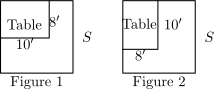
An table sits in the corner of a square room, as in Figure below. The owners desire to move the table to the position shown in Figure The side of the room is feet. What is the smallest integer value of for which the table can be moved as desired without tilting it or taking it apart?
Pista pequeña:
Durante un cuarto de vuelta, una diagonal queda perpendicular a dos paredes opuestas
During a quarter-turn, a diagonal becomes perpendicular to a pair of opposite walls
Pista grande:
Compara el lado de la habitación con la diagonal de la mesa
Compare the room side with the table’s diagonal
Solución:
La diagonal de la mesa es que está entre y Durante el giro, esta diagonal debe caber en la habitación, así que Recíprocamente, un rectángulo puede girar dentro de un círculo cuyo diámetro es su diagonal, por lo que esa cota es suficiente. El menor entero es
Por lo tanto, la respuesta correcta es C.
The table diagonal is which is between and During the turn this diagonal must fit across the room, so Conversely, a rectangle can rotate inside a circle whose diameter is its diagonal, so that bound is sufficient. The least integer is
Thus the correct answer is C.
10.
En un experimento, se determina que una constante científica vale con un error máximo de El experimentador desea anunciar un valor de en el que cada cifra sea significativa. Es decir, sea cual sea el valor anunciado debe ser el resultado correcto al redondear a ese número de cifras. El valor más preciso que puede anunciar para es
In an experiment, a scientific constant is determined to be with an error of at most The experimenter wishes to announce a value for in which every digit is significant. That is, whatever is, the announced value must be the correct result when is rounded to that number of digits. The most accurate value the experimenter can announce for is
Pista pequeña:
Halla los valores mínimo y máximo posibles de
Find the smallest and largest possible values of
Pista grande:
Redondea ambos extremos a cantidades crecientes de cifras significativas
Round both endpoints to increasing numbers of significant digits
Solución:
El intervalo posible es Todos sus números se redondean a con tres cifras significativas, pero los extremos se redondean de manera diferente con cuatro. Por tanto, es el anuncio más preciso garantizado.
Por lo tanto, la respuesta correcta es D.
The possible interval is Every number in it rounds to at three significant digits, but the endpoints round differently at four significant digits. Hence is the most accurate guaranteed announcement.
Thus the correct answer is D.
11.
En cada línea horizontal de la figura, los cinco puntos grandes indican las poblaciones de las ciudades y en el año señalado. ¿Qué ciudad tuvo el mayor aumento porcentual de población entre y ?

On each horizontal line in the figure below, the five large dots indicate the populations of cities and in the year indicated. Which city had the greatest percentage increase in population from to
Pista pequeña:
Lee en la escala los dos valores de población de cada ciudad
Read each city’s two population values from the scale
Pista grande:
Compara el aumento dividido entre la población de no solo el aumento absoluto
Compare increase divided by the population, not just absolute increase
Solución:
Los aumentos porcentuales de son, respectivamente, y Estos son y por lo que la ciudad tuvo el mayor aumento porcentual.
Por lo tanto, la respuesta correcta es C.
The percentage increases for are respectively and These are and so city has the greatest percentage increase.
Thus the correct answer is C.
12.
Cada entero del al se escribe en una hoja distinta y las nueve hojas se colocan en un sombrero. Jack extrae una al azar y la devuelve. Luego Jill extrae una hoja al azar. ¿Qué dígito tiene mayor probabilidad de ser la cifra de las unidades de la suma de los enteros de Jack y Jill?
Each integer through is written on a separate slip of paper and all nine slips are put into a hat. Jack picks one of these slips at random and puts it back. Then Jill picks a slip at random. Which digit is most likely to be the units digit of the sum of Jack’s integer and Jill’s integer?
cada dígito es igualmente probable
each digit is equally likely
Pista pequeña:
Hay pares ordenados equiprobables
There are equally likely ordered pairs
Pista grande:
Cuenta los pares cuya suma tiene cada residuo módulo
Count pairs whose sum has each residue modulo
Solución:
Para obtener una cifra de unidades los pares ordenados son lo que da pares. Cada otra cifra aparece veces entre los pares ordenados. Por tanto, es la más probable.
Por lo tanto, la respuesta correcta es A.
For a units digit of the ordered pairs are giving pairs. Each other units digit occurs times among the ordered pairs. Therefore is most likely.
Thus the correct answer is A.
13.
Si ¿cuánto vale ?
If then what is
Pista pequeña:
Eleva al cuadrado la relación dada y usa
Square the given relation and use
Pista grande:
La relación dada también determina el signo del producto
The given relation also determines the sign of the product
Solución:
Al elevar al cuadrado obtenemos Por tanto, Al multiplicar por obtenemos
Por lo tanto, la respuesta correcta es E.
Squaring gives Hence Multiplying by gives
Thus the correct answer is E.
14.
Para cualquier número real y entero positivo define ¿Cuánto vale
For any real number and positive integer define What is
Pista pequeña:
Cancela el denominador común
Cancel the identical denominator
Pista grande:
Escribe los factores restantes como enteros impares consecutivos y busca una cancelación telescópica
Write the remaining factors as consecutive odd integers and look for telescoping cancellation
Solución:
Después de cancelar las magnitudes de los factores del numerador son mientras que las del denominador son Todos los factores impares comunes se cancelan y queda magnitud El numerador tiene factores negativos y el denominador así que el cociente es
Por lo tanto, la respuesta correcta es A.
After canceling the numerator factors have magnitudes while the denominator factors have magnitudes All common odd factors cancel, leaving magnitude The numerator has negative factors and the denominator has so the quotient is
Thus the correct answer is A.
15.
Si y son enteros tales que es un factor de entonces es
If and are integers such that is a factor of then is
Pista pequeña:
Reduce las potencias usando
Reduce powers using
Pista grande:
Un polinomio de grado menor que divisible por el cuadrático debe ser cero
A polynomial of degree below divisible by the quadratic must be zero
Solución:
Módulo tenemos y Así, el polinomio es congruente con Ambos coeficientes deben anularse, de modo que y Por tanto, y
Por lo tanto, la respuesta correcta es A.
Modulo we have and Thus the polynomial is congruent to Both coefficients must vanish, so and Hence and
Thus the correct answer is A.
16.
y son triángulos equiláteros con lados paralelos y el mismo centro, como en la figura. La distancia entre el lado y el lado es de la altura de La razón entre el área de y la de es
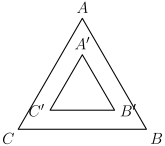
and are equilateral triangles with parallel sides and the same center, as in the figure. The distance between side and side is the altitude of The ratio of the area of to the area of is
Pista pequeña:
Un centroide se encuentra a un tercio de la altura sobre la base
A centroid lies one-third of the altitude above the base
Pista grande:
Relaciona las dos alturas usando la distancia entre sus bases paralelas
Relate the two altitudes using the distance between their parallel bases
Solución:
Sean y las alturas exterior e interior. Su centro común está a sobre y a sobre Por tanto, así que Las áreas varían como el cuadrado de las longitudes correspondientes, lo que da
Por lo tanto, la respuesta correcta es C.
Let the outer and inner altitudes be and Their common center is above and above Hence so Areas scale as the square of corresponding lengths, giving
Thus the correct answer is C.
17.
Si y halla
If and find
Pista pequeña:
Usa cada ecuación para descartar una posibilidad de signo
Use each equation to rule out one sign possibility
Pista grande:
Después de determinar los signos de y resuelve un sistema lineal
After determining the signs of and solve a linear system
Solución:
Si la primera ecuación da lo que contradice la segunda; por tanto, Si la segunda da lo que contradice la primera; por tanto, Las ecuaciones se convierten en y Así, y
Por lo tanto, la respuesta correcta es C.
If the first equation gives contradicting the second; hence If the second gives contradicting the first; hence The equations become and Thus and
Thus the correct answer is C.
18.
Al final de un torneo profesional de bolos, los mejores jugadores disputan una eliminatoria. Primero, el número juega contra el número El perdedor recibe el premio número y el ganador juega contra el número . El perdedor de este juego recibe el premio número y el ganador juega contra el número . El perdedor recibe el premio número y el ganador juega contra el número . El ganador de este último juego recibe el premio número y el perdedor el número . ¿En cuántos órdenes pueden recibir los premios los jugadores del número al número ?
At the end of a professional bowling tournament, the top bowlers have a play-off. First # bowls # The loser receives th prize and the winner bowls # in another game. The loser of this game receives th prize and the winner bowls # The loser of this game receives rd prize and the winner bowls # The winner of this game gets st prize and the loser gets nd prize. In how many orders can bowlers # through # receive the prizes?
ninguna de estas
none of these
Pista pequeña:
Se juegan exactamente cuatro partidas
Exactly four games are played
Pista grande:
Cada secuencia de ganadores determina un orden de premios diferente
Each sequence of winners determines a different prize order
Solución:
Cada una de las cuatro partidas tiene dos posibles ganadores. Una secuencia de cuatro resultados determina de manera única los cinco puestos, así que hay órdenes.
Por lo tanto, la respuesta correcta es B.
Each of the four games has two possible winners. A sequence of four outcomes uniquely determines the five prize positions, so there are orders.
Thus the correct answer is B.
19.
Simplifica
Simplify
Pista pequeña:
Separa los términos y
Separate the and terms
Pista grande:
Intenta factorizar primero el numerador por
Try to factor the numerator first by
Solución:
Al reagrupar el numerador obtenemos Al dividir entre se obtiene
Por lo tanto, la respuesta correcta es B.
Regrouping the numerator gives Dividing by yields
Thus the correct answer is B.
20.
En una de las figuras adjuntas, un cuadrado de lado se divide en cuatro piezas de modo que y sean los puntos medios de lados opuestos y sea perpendicular a Las cuatro piezas pueden rearmarse en un rectángulo como muestra la segunda figura. La razón de la altura a la base, en este rectángulo es
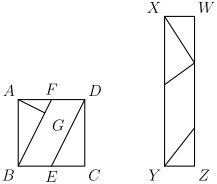
In one of the adjoining figures a square of side is dissected into four pieces so that and are the midpoints of opposite sides and is perpendicular to These four pieces can then be reassembled into a rectangle as shown in the second figure. The ratio of height to base, in this rectangle is
Pista pequeña:
Halla y a partir del lado y de las condiciones de punto medio
Find and from the side length and midpoint conditions
Pista grande:
Usa el área invariable para determinar la base del rectángulo
Use the unchanged area to determine the rectangle’s base
Solución:
Tanto como tienen cambios horizontal y vertical de y así que cada uno mide Por tanto, El rectángulo tiene área así que Por tanto,
Por lo tanto, la respuesta correcta es E.
Both and have horizontal and vertical changes and so each has length Thus The rectangle has area so Therefore
Thus the correct answer is E.
21.
El número complejo satisface ¿Cuál es ? Nota: si entonces
The complex number satisfies What is Note: if then
Pista pequeña:
Escribe y compara las partes imaginarias
Write and compare imaginary parts
Pista grande:
Usa la parte real para relacionar con
Use the real part to relate to
Solución:
Al escribir , se obtiene y Por tanto, Al elevar al cuadrado se obtiene En consecuencia,
Por tanto, la respuesta correcta es E.
Writing gives and Thus Squaring yields Therefore
Thus the correct answer is E.
22.
¿Para cuántos enteros un triángulo con lados de longitudes y tiene todos sus ángulos agudos?
For how many integers does a triangle with side lengths and have all its angles acute?
más de
more than
Pista pequeña:
Aplica la desigualdad pitagórica estricta al lado mayor en cada orden posible
Apply the strict Pythagorean inequality to the largest side in each possible ordering
Pista grande:
El ángulo opuesto a y el ángulo opuesto a dan las cotas restrictivas
The angle opposite and the angle opposite give the restrictive bounds
Solución:
Para que el triángulo sea acutángulo, se requiere y de modo que y Para entero, esto da Los cuatro valores también satisfacen la desigualdad triangular, por lo que hay valores.
Por tanto, la respuesta correcta es A.
Acuteness requires and so and For integer this gives All four values also satisfy the triangle inequality, so there are values.
Thus the correct answer is A.
23.
Las seis aristas del tetraedro miden y unidades. Si la arista mide entonces la longitud de la arista es
The six edges of tetrahedron measure and units. If the length of edge is then the length of edge is
Pista pequeña:
La arista de longitud pertenece a dos caras triangulares
The edge of length belongs to two triangular faces
Pista grande:
En cualquiera de las caras que contiene esa arista, las longitudes de las otras dos aristas deben diferir en menos de
In either face containing that edge, the other two edge lengths must differ by less than
Solución:
En una cara que contiene la arista de longitud sus otros dos lados deben diferir en menos de Entre las longitudes restantes, los únicos pares disjuntos con esta propiedad son y por lo que la arista de longitud es opuesta a la de longitud Dado que se pueden comprobar mediante las desigualdades triangulares las dos ubicaciones posibles de estos pares; la ubicación en la que la arista opuesta a mide no es válida, mientras que en la ubicación válida se tiene
Por tanto, la respuesta correcta es B.
For a face containing the edge its other two sides must differ by less than Among the remaining lengths, the only disjoint pairs with this property are and so edge is opposite edge With the two possible placements of these pairs can be checked by the triangle inequalities; the placement making the edge opposite equal to fails, while the valid placement has
Thus the correct answer is B.
24.
Un trapecio isósceles está circunscrito a una circunferencia. La base mayor del trapecio mide y uno de los ángulos de la base es Halla el área del trapecio.
An isosceles trapezoid is circumscribed around a circle. The longer base of the trapezoid is and one of the base angles is Find the area of the trapezoid.
no se puede determinar de manera única
not uniquely determined
Pista pequeña:
En un cuadrilátero circunscrito, las sumas de las longitudes de los lados opuestos son iguales
For a circumscribed quadrilateral, the sums of opposite side lengths are equal
Pista grande:
Usa y para relacionar el lado no paralelo, la altura y la diferencia de las bases
Use and to relate the leg, height, and difference of the bases
Solución:
Sea la base menor y sea la longitud de cada lado no paralelo. La tangencia da Si el ángulo de la base es entonces y Al resolver, se obtiene y la altura es El área es
Por tanto, la respuesta correcta es C.
Let the shorter base be and each leg be Tangency gives If the base angle is then and Solving gives and height The area is
Thus the correct answer is C.
25.
y son conjuntos de personas disjuntos dos a dos. Las edades promedio de las personas en los conjuntos y se muestran en la tabla siguiente.
Halla la edad promedio de las personas del conjunto
| Conjunto | ||||||
|---|---|---|---|---|---|---|
| Edad promedio de las personas del conjunto |
and are pairwise disjoint sets of people. The average ages of people in the sets and are given in the table below.
Find the average age of the people in the set
| Set | ||||||
|---|---|---|---|---|---|---|
| Average age of people in the set |
Pista pequeña:
Sean los tamaños de los tres conjuntos
Let be the sizes of the three sets
Pista grande:
Cada promedio de una unión proporciona una relación lineal entre
Each union average gives a linear relation among
Solución:
Sean los tamaños de los conjuntos. Los tres promedios de las uniones dan y Por tanto, y El promedio total es
Por tanto, la respuesta correcta es E.
Let the set sizes be The three union averages give and Thus and The total average is
Thus the correct answer is E.
26.
Supón que y son números positivos tales que ¿Cuál es el valor de ?
Suppose that and are positive numbers for which What is the value of
Pista pequeña:
Llama al valor común de los logaritmos
Call the common logarithm value
Pista grande:
Si compara con
If compare with
Solución:
Sea el valor común. Entonces y Sea Al dividir la última ecuación entre , se obtiene Como se tiene
Por tanto, la respuesta correcta es D.
Let the common value be Then and Put Dividing the last equation by gives Since
Thus the correct answer is D.
27.
En la figura, y es tangente a la circunferencia de centro y diámetro ¿En cuál de los casos siguientes el área de es un entero?
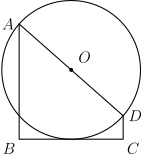
In the figure, and is tangent to the circle with center and diameter In which one of the following cases is the area of an integer?
Pista pequeña:
Sea el punto de tangencia y usa el diámetro para formar un rectángulo dentro del trapecio
Let the tangent point be and use the diameter to form a rectangle inside the trapezoid
Pista grande:
La potencia del punto relaciona la mitad de con y
Power of point relates half of to and
Solución:
El punto de tangencia es el punto medio de y la relación entre tangente y secante da Por tanto, y el área del trapecio es Solo hace que el producto bajo el radical sea un cuadrado; el área es
Por tanto, la respuesta correcta es D.
The tangent point is the midpoint of and the tangent-secant relation gives Thus and the trapezoid area is Only makes the product under the radical a square; the area is
Thus the correct answer is D.
28.
Una moneda sesgada tiene probabilidad de caer cara en un solo lanzamiento. Sea la probabilidad de que, en lanzamientos independientes de esta moneda, se obtengan exactamente caras. Si entonces
An unfair coin has probability of coming up heads on a single toss. Let be the probability that, in independent tosses of this coin, heads come up exactly times. If then
debe ser
must be
debe ser
must be
debe ser mayor que
must be greater than
no está determinado de manera única
is not uniquely determined
no existe ningún valor de para el cual
there is no value of for which
Pista pequeña:
Escribe como función de mediante el coeficiente binomial
Write as a function of using the binomial coefficient
Pista grande:
Comprueba un valor sencillo y luego compara la función en y
Check one simple value, then compare the function at and
Solución:
Aquí, Para Además, mientras que Por continuidad, hay otra solución entre y Por tanto, no es único.
Por tanto, la respuesta correcta es D.
Here At Also while By continuity there is another solution between and Hence is not unique.
Thus the correct answer is D.
29.
Representas el peso en función de la estatura de tres amigos y obtienes los puntos Si ¿cuál de las siguientes expresiones es necesariamente la pendiente de la recta que mejor se ajusta a los datos? «Mejor se ajusta» significa que la suma de los cuadrados de las distancias verticales de los puntos a la recta es menor que para cualquier otra recta.
You plot weight against height for three of your friends and obtain the points If which of the following is necessarily the slope of the line which best fits the data? “Best fits” means that the sum of the squares of the vertical distances from the data points to the line is smaller than for any other line.
ninguna de las anteriores
none of these
Pista pequeña:
Traslada y escala las coordenadas para obtener
Translate and scale the -coordinates to
Pista grande:
Para una recta de mínimos cuadrados con valores de simétricos, calcula la pendiente a partir del numerador de la covarianza
For a least-squares line through symmetric -values, compute the slope from the covariance numerator
Solución:
Traslada y escala de modo que las coordenadas sean Su promedio es por lo que la pendiente de la recta de mínimos cuadrados es
Por tanto, la respuesta correcta es A.
Translate and scale so the -coordinates are Their mean is so the least-squares slope is
Thus the correct answer is A.
30.
Sea Dado considera la sucesión definida por para todo ¿Para cuántos números reales la sucesión toma solo un número finito de valores diferentes?
Let Given consider the sequence defined by for all For how many real numbers will the sequence take on only a finite number of different values?
o
or
o
or
más de , pero una cantidad finita
more than but finitely many
infinitos
infinitely many
Pista pequeña:
Empieza con y luego busca números que se apliquen sucesivamente a
Start with then find numbers mapping successively to
Pista grande:
Para todo resuelve y elige una nueva preimagen real
For every solve and choose a new real preimage
Solución:
Los valores iniciales producen las órbitas finitas , y En general, si inicia una cadena finita que termina en resuelve Sus soluciones reales son Elegir una preimagen que aún no esté en la cadena la extiende con un valor nuevo. Al repetir este proceso, se obtienen infinitos valores iniciales distintos con órbitas finitas.
Por tanto, la respuesta correcta es E.
The starting values give finite orbits , , and More generally, if begins a finite chain ending at solve Its real solutions are Choosing a preimage not already in the chain extends it by one new value. Repeating produces infinitely many distinct starting values with finite orbits.
Thus the correct answer is E.