
1973 AMC 12 Problem 35
Attempt Problem 35 of the 1973 AMC 12 below, then check your answer against the professionally curated solution from LIVE by Po-Shen Loh. You can also try the full timed exam, view all 1973 AMC 12 solutions, or check the answer key.
All problems are used with official legal permission of the Mathematical Association of America (MAA).
35.
In the unit circle shown in the figure, chords and are parallel to the unit radius of the circle with center at Chords and are each units long and chord is units long.
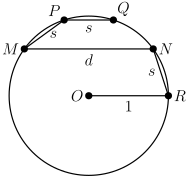
Of the three equations those which are necessarily true are
only
only
only
and only
and
Answer: E
Small hint:
Use symmetry across the vertical diameter to see that the upper semicircle is divided into five equal chords
Big hint:
Write and then relate each to the square of the other
Solution:
Let be the left endpoint of the horizontal diameter. Reflection across the vertical diameter shows that and Together with the given equal chords, the upper semicircle is split into five equal arcs. Each subtends at Thus
Using the double-angle identities, Adding these equations gives Since it follows that Substituting into yields Therefore and All three equations are necessarily true.
Therefore, the correct answer is E.