
Problemas del 2006 AMC 10B
¡Desplázate hacia abajo y presiona Iniciar para intentar el examen! O ve al PDF imprimible, la clave de respuestas, o las soluciones profesionales preparadas por LIVE by Po-Shen Loh.
Todos los problemas se usan con el permiso legal oficial de la Mathematical Association of America (MAA).
O salta directamente a un solo problema con su solución: 1 · 2 · 3 · 4 · 5 · 6 · 7 · 8 · 9 · 10 · 11 · 12 · 13 · 14 · 15 · 16 · 17 · 18 · 19 · 20 · 21 · 22 · 23 · 24 · 25
¿Quieres aprender de forma profesional con clases interactivas en video?
Con tiempo
1:15:00
1.
¿Cuál es el valor de ?
What is
Respuesta: C
Pista pequeña:
Agrupa los términos en parejas consecutivas.
Group the terms in consecutive pairs
Pista grande:
En cada pareja, compara los signos del término con exponente impar y del término con exponente par.
In each pair, compare the signs of the odd-power and even-power terms
Solución:
Hay términos. Al emparejar términos consecutivos se obtiene Como es par, cada término se empareja y la suma es
Por lo tanto, la respuesta correcta es C.
There are terms. Pairing consecutive terms gives Since is even, every term pairs off and the sum is
Thus, the correct answer is C.
2.
Para los números reales y se define ¿Cuál es el valor de ?
For real numbers and define What is
Respuesta: A
Pista pequeña:
Primero evalúa la operación interior .
Evaluate the inner operation first
Pista grande:
Se cumple que .
Solución:
Como se tiene
Entonces
Por lo tanto, la respuesta correcta es A.
Since we have
Then
Thus, the correct answer is A.
3.
Se jugó un partido de fútbol americano entre dos equipos, los Cougars y los Panthers. Los dos equipos anotaron un total de puntos, y los Cougars ganaron por un margen de puntos. ¿Cuántos puntos anotaron los Panthers?
A football game was played between two teams, the Cougars and the Panthers. The two teams scored a total of points, and the Cougars won by a margin of points. How many points did the Panthers score?
Respuesta: A
Pista pequeña:
Sean y las dos puntuaciones, con .
Let the two scores be and with
Pista grande:
El margen de victoria da .
The winning margin gives
Solución:
Sean y las puntuaciones de los Cougars y los Panthers. Entonces y Restando se obtiene así que
Por lo tanto, la respuesta correcta es A.
Let and be the Cougars’ and Panthers’ scores. Then and Subtracting gives so
Thus, the correct answer is A.
4.
Dos círculos de diámetro pulgada y pulgadas tienen el mismo centro. El círculo menor se pinta de rojo, y la porción que está fuera del círculo menor y dentro del círculo mayor se pinta de azul. ¿Cuál es la razón entre el área pintada de azul y el área pintada de rojo?
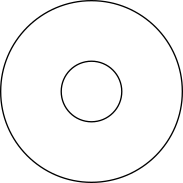
Circles of diameter inch and inches have the same center. The smaller circle is painted red, and the portion outside the smaller circle and inside the larger circle is painted blue. What is the ratio of the blue-painted area to the red-painted area?
Respuesta: D
Pista pequeña:
Los radios son y .
The radii are and
Pista grande:
El azul es el anillo ; el rojo es .
Blue is the ring ; red is
Solución:
El círculo rojo tiene área y el círculo grande tiene área El anillo azul es
La razón es
Por lo tanto, la respuesta correcta es D.
The red circle has area and the large circle has area The blue ring is
The ratio is
Thus, the correct answer is D.
5.
Un rectángulo de y un rectángulo de están contenidos dentro de un cuadrado sin superponerse en ningún punto interior, y los lados del cuadrado son paralelos a los lados de los dos rectángulos dados. ¿Cuál es la menor área posible del cuadrado?
A rectangle and a rectangle are contained within a square without overlapping at any interior point, and the sides of the square are parallel to the sides of the two given rectangles. What is the smallest possible area of the square?
Respuesta: B
Pista pequeña:
Intenta apilar los rectángulos de modo que sus lados de longitud queden alineados.
Try stacking the rectangles so their sides of length line up
Pista grande:
El lado del cuadrado debe ser al menos la suma de las dimensiones menores, .
The square’s side must be at least the sum of the smaller dimensions,
Solución:
Coloquemos los rectángulos uno junto al otro con sus lados de longitud en posición vertical. Sus anchos suman y las alturas y caben ambas dentro de
Como los rectángulos están alineados con los ejes y sus interiores no se superponen, sus proyecciones horizontales o sus proyecciones verticales deben ser disjuntas. En cualquiera de las dos direcciones, el primer rectángulo abarca al menos y el segundo al menos así que el lado del cuadrado mide al menos Por tanto, la menor área es
Así, la respuesta correcta es B.
Place the rectangles side by side with their -length sides vertical. Their widths add to and the heights and both fit within
Because the rectangles are axis-aligned and their interiors do not overlap, their horizontal projections or their vertical projections must be disjoint. In either direction, the first rectangle spans at least and the second spans at least so the square’s side is at least The smallest area is therefore
Thus, the correct answer is B.
6.
Una región está limitada por arcos semicirculares construidos sobre los lados de un cuadrado cuyos lados miden como se muestra. ¿Cuál es el perímetro de esta región?
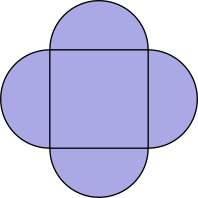
A region is bounded by semicircular arcs constructed on the sides of a square whose sides measure as shown. What is the perimeter of this region?
Respuesta: D
Pista pequeña:
Cada lado del cuadrado es el diámetro de un arco semicircular.
Each side of the square is the diameter of one semicircular arc
Pista grande:
Un semicírculo sobre un diámetro tiene longitud de arco .
A semicircle on diameter has arc length
Solución:
Cada lado tiene longitud el diámetro de un arco semicircular, así que cada arco tiene longitud
La frontera consta de cuatro arcos así, por lo que el perímetro es
Por lo tanto, la respuesta correcta es D.
Each side has length the diameter of a semicircular arc, so each arc has length
The boundary consists of four such arcs, so the perimeter is
Thus, the correct answer is D.
7.
¿Cuál de las siguientes expresiones es equivalente a
cuando ?
Which of the following is equivalent to
when
Respuesta: A
Pista pequeña:
Combina el denominador en una sola fracción.
Combine the denominator into a single fraction
Pista grande:
Se tiene y cuando .
and when
Solución:
El denominador se simplifica:
Así que la expresión es Como esto es igual a
Por lo tanto, la respuesta correcta es A.
The denominator simplifies:
So the expression is Since this equals
Thus, the correct answer is A.
8.
Un cuadrado de área está inscrito en un semicírculo como se muestra. ¿Cuál es el área del semicírculo?
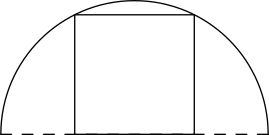
A square of area is inscribed in a semicircle as shown. What is the area of the semicircle?
Respuesta: B
Pista pequeña:
Sea el lado del cuadrado con y la base centrada sobre el diámetro.
Let the square have side with base centered on the diameter
Pista grande:
El radio cumple .
The radius satisfies
Solución:
Sea el lado del cuadrado de modo que Su base queda centrada sobre el diámetro, y un vértice superior en está sobre la circunferencia.
Entonces El área del semicírculo es
Por lo tanto, la respuesta correcta es B.
Let the square have side so Its base lies centered on the diameter, and a top corner at lies on the circle.
Then The semicircle area is
Thus, the correct answer is B.
9.
Francesca usa gramos de jugo de limón, gramos de azúcar y gramos de agua para hacer limonada. Hay calorías en gramos de jugo de limón y calorías en gramos de azúcar. El agua no contiene calorías. ¿Cuántas calorías hay en gramos de su limonada?
Francesca uses grams of lemon juice, grams of sugar, and grams of water to make lemonade. There are calories in grams of lemon juice and calories in grams of sugar. Water contains no calories. How many calories are in grams of her lemonade?
Respuesta: B
Pista pequeña:
Todo el lote pesa gramos y contiene calorías.
The whole batch weighs grams and holds calories
Pista grande:
Escala el total de calorías por .
Scale the total calories by
Solución:
La limonada suma gramos que contienen calorías.
En gramos hay calorías.
Por lo tanto, la respuesta correcta es B.
The lemonade totals grams containing calories.
In grams there are calories.
Thus, the correct answer is B.
10.
En un triángulo con longitudes de lado enteras, un lado es tres veces más largo que un segundo lado, y la longitud del tercer lado es ¿Cuál es el mayor perímetro posible del triángulo?
In a triangle with integer side lengths, one side is three times as long as a second side, and the length of the third side is What is the greatest possible perimeter of the triangle?
Respuesta: A
Pista pequeña:
Sean los lados y .
Let the sides be and
Pista grande:
La desigualdad triangular determinante es .
The binding triangle inequality is
Solución:
Sean los lados y La desigualdad triangular da
El mayor entero es que da los lados y perímetro
Por lo tanto, la respuesta correcta es A.
Let the sides be and The triangle inequality gives
The largest integer is giving sides and perimeter
Thus, the correct answer is A.
11.
¿Cuál es la cifra de las decenas en la suma ?
What is the tens digit in the sum
Respuesta: C
Pista pequeña:
Para termina en al menos dos ceros.
For ends in at least two zeros
Pista grande:
Solo afecta las dos últimas cifras.
Only affects the last two digits
Solución:
Para es divisible por así que no afecta las dos últimas cifras.
La cifra de las decenas proviene de cuya cifra de las decenas es
Por lo tanto, la respuesta correcta es C.
For is divisible by so it does not affect the last two digits.
The tens digit comes from whose tens digit is
Thus, the correct answer is C.
12.
Las rectas y se cortan en el punto ¿Cuánto vale ?
The lines and intersect at the point What is
Respuesta: E
Pista pequeña:
Sustituye en ambas ecuaciones.
Substitute into both equations
Pista grande:
Suma las dos ecuaciones resultantes para obtener directamente.
Add the two resulting equations to get directly
Solución:
Sustituyendo : de obtenemos y de obtenemos
Entonces
Por lo tanto, la respuesta correcta es E.
Substituting : from we get and from we get
Then
Thus, the correct answer is E.
13.
Joe y JoAnn compraron cada uno onzas de café en una taza de onzas. Joe bebió onzas de su café y luego añadió onzas de crema. JoAnn añadió onzas de crema, revolvió bien el café y luego bebió onzas. ¿Cuál es la razón resultante entre la cantidad de crema en el café de Joe y la del café de JoAnn?
Joe and JoAnn each bought ounces of coffee in a -ounce cup. Joe drank ounces of his coffee and then added ounces of cream. JoAnn added ounces of cream, stirred the coffee well, and then drank ounces. What is the resulting ratio of the amount of cream in Joe’s coffee to that in JoAnn’s coffee?
Respuesta: E
Pista pequeña:
Joe conserva onzas de crema.
Joe simply has ounces of cream
Pista grande:
JoAnn bebe de onzas de una bebida bien mezclada que contiene onzas de crema.
JoAnn drinks of ounces of a well-mixed drink holding ounces of cream
Solución:
Joe añade onzas de crema y no bebe nada después, así que tiene onzas de crema.
JoAnn tiene onzas de café más onzas de crema, formando onzas de mezcla uniforme. Después de beber onzas conserva de su crema, que son onzas.
La razón es
Por lo tanto, la respuesta correcta es E.
Joe adds ounces of cream and drinks nothing afterward, so he has ounces of cream.
JoAnn has ounces of coffee plus ounces of cream, making ounces of uniform mixture. After drinking ounces she keeps of her cream, which is ounces.
The ratio is
Thus, the correct answer is E.
14.
Sean y las raíces de la ecuación Supongamos que y son las raíces de la ecuación ¿Cuánto vale ?
Let and be the roots of the equation Suppose that and are the roots of the equation What is
Respuesta: D
Pista pequeña:
Por las fórmulas de Vieta, .
By Vieta’s formulas,
Pista grande:
es el producto .
is the product
Solución:
Como y son raíces de se tiene
El valor es el producto de las nuevas raíces:
Por lo tanto, la respuesta correcta es D.
Since and are roots of we have
The value is the product of the new roots:
Thus, the correct answer is D.
15.
El rombo es semejante al rombo El área del rombo es y ¿Cuál es el área del rombo ?
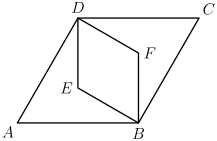
Rhombus is similar to rhombus The area of rhombus is and What is the area of rhombus
Respuesta: C
Pista pequeña:
Como y el triángulo es equilátero.
Since and triangle is equilateral
Pista grande:
y dividen en seis triángulos congruentes.
and split into six congruent triangles
Solución:
Como y el triángulo es equilátero, y también lo es el triángulo
Los puntos y dividen el rombo en seis triángulos congruentes, cada uno de área
El rombo es la unión de los triángulos y así que su área es
Por lo tanto, la respuesta correcta es C.
Because and triangle is equilateral, and so is triangle
Points and split the rhombus into six congruent triangles, each of area
Rhombus is the union of triangles and so its area is
Thus, the correct answer is C.
16.
El día bisiesto, de febrero de cayó en domingo. ¿En qué día de la semana caerá el día bisiesto, de febrero de ?
Leap Day, February occurred on a Sunday. On what day of the week will Leap Day, February occur?
martes
Tuesday
miércoles
Wednesday
jueves
Thursday
viernes
Friday
sábado
Saturday
Respuesta: E
Pista pequeña:
Cuenta los días de un día bisiesto al siguiente: .
Count the days from one Leap Day to the next:
Pista grande:
Ese total es así que cada ciclo de años adelanta el día de la semana en .
That total is so each -year cycle advances the weekday by
Solución:
De un día bisiesto al siguiente hay días, y
A lo largo de los cuatro ciclos de a el día de la semana adelanta es decir, días hacia adelante, lo que equivale a un día antes del domingo.
Por lo tanto, el día bisiesto de cae en sábado.
Por lo tanto, la respuesta correcta es E.
From one Leap Day to the next is days, and
Over the four cycles from to the weekday advances that is, days forward, which is one day back from Sunday.
So Leap Day falls on a Saturday.
Thus, the correct answer is E.
17.
Bob y Alice tienen cada uno una bolsa que contiene una bola de cada uno de los colores azul, verde, naranja, rojo y violeta. Alice selecciona al azar una bola de su bolsa y la pone en la bolsa de Bob. Luego Bob selecciona al azar una bola de su bolsa y la pone en la bolsa de Alice. ¿Cuál es la probabilidad de que, después de este proceso, el contenido de las dos bolsas sea el mismo?
Bob and Alice each have a bag that contains one ball of each of the colors blue, green, orange, red, and violet. Alice randomly selects one ball from her bag and puts it into Bob’s bag. Bob then randomly selects one ball from his bag and puts it into Alice’s bag. What is the probability that after this process the contents of the two bags are the same?
Respuesta: D
Pista pequeña:
Después del movimiento de Alice, la bolsa de Bob tiene bolas con un color duplicado.
After Alice’s move, Bob’s bag has balls with one color doubled
Pista grande:
Las bolsas coinciden solo si Bob devuelve una bola de ese color duplicado.
The bags match only if Bob returns a ball of that doubled color
Solución:
Alice mueve una bola a Bob, así que la bolsa de Bob contiene bolas con exactamente un color que aparece dos veces.
Las dos bolsas quedan idénticas exactamente cuando Bob devuelve una de ese par duplicado. Dos de las seis bolas cumplen la condición, así que la probabilidad es
Por lo tanto, la respuesta correcta es D.
Alice moves one ball to Bob, so Bob’s bag holds balls with exactly one color appearing twice.
The two bags end up identical exactly when Bob returns one of that duplicated pair. Two of the six balls qualify, so the probability is
Thus, the correct answer is D.
18.
Sea una sucesión para la cual y para cada entero positivo ¿Cuánto vale ?
Let be a sequence for which and for each positive integer What is
Respuesta: E
Pista pequeña:
Calcula los primeros términos para detectar un ciclo que se repite.
Compute the first several terms to detect a repeating cycle
Pista grande:
La sucesión se repite cada términos; reduce módulo .
The sequence repeats every terms; reduce modulo
Solución:
Los términos son luego un ciclo de longitud
Como se tiene
Por lo tanto, la respuesta correcta es E.
The terms are then a cycle of length
Since we have
Thus, the correct answer is E.
19.
Un círculo de radio está centrado en El cuadrado tiene lado Los lados y se prolongan más allá de hasta cortar el círculo en y respectivamente. ¿Cuál es el área de la región sombreada de la figura, que está limitada por y el arco menor que une y ?
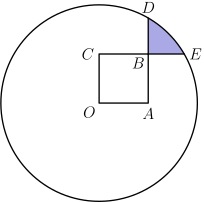
A circle of radius is centered at Square has side length Sides and are extended past to meet the circle at and respectively. What is the area of the shaded region in the figure, which is bounded by and the minor arc connecting and
Respuesta: A
Pista pequeña:
Usa y para hallar .
Use and to find
Pista grande:
El área sombreada es igual al sector menos los dos triángulos rectángulos y .
Shaded area equals sector minus the two right triangles and
Solución:
Como y con sobre la recta obtenemos e igualmente así que
El sector tiene área
La región es este sector menos los triángulos y Con cada triángulo tiene área que suman
Así que el área sombreada es
Por lo tanto, la respuesta correcta es A.
Since and with on the line we get and likewise so
The sector has area
The region is this sector minus triangles and With each triangle has area totaling
So the shaded area is
Thus, the correct answer is A.
20.
En el rectángulo tenemos y para algún entero ¿Cuál es el área del rectángulo ?
In rectangle we have and for some integer What is the area of rectangle
Respuesta: E
Pista pequeña:
Se tiene por lo que sus pendientes se multiplican dando .
so their slopes multiply to
Pista grande:
El área es .
The area is
Solución:
La pendiente de es Como su pendiente es así que da
Entonces y
El área es
Por lo tanto, la respuesta correcta es E.
The slope of is Since its slope is so gives
Then and
The area is
Thus, the correct answer is E.
21.
Para cierto par de dados peculiares, las probabilidades de sacar y en cada dado están en la razón ¿Cuál es la probabilidad de sacar un total de con los dos dados?
For a particular peculiar pair of dice, the probabilities of rolling and on each die are in the ratio What is the probability of rolling a total of on the two dice?
Respuesta: C
Pista pequeña:
La probabilidad de sacar es .
The probability of rolling is
Pista grande:
Suma sobre los seis pares ordenados con .
Sum over the six ordered pairs with
Solución:
Cada dado muestra con probabilidad
Para un total de los pares ordenados contribuyen
Por lo tanto, la respuesta correcta es C.
Each die shows with probability
For a total of the ordered pairs contribute
Thus, the correct answer is C.
22.
Elmo hace sándwiches para una recaudación de fondos. Para cada sándwich usa porciones de mantequilla de maní a ¢ por porción y porciones de mermelada a ¢ por porción. El costo de la mantequilla de maní y la mermelada para hacer todos los sándwiches es Supón que y son enteros positivos con ¿Cuál es el costo de la mermelada que Elmo usa para hacer los sándwiches?
Elmo makes sandwiches for a fundraiser. For each sandwich he uses globs of peanut butter at ¢ per glob and blobs of jam at ¢ per blob. The cost of the peanut butter and jam to make all the sandwiches is Assume that and are positive integers with What is the cost of the jam Elmo uses to make the sandwiches?
Respuesta: D
Pista pequeña:
El costo total en centavos es .
The total cost in cents is
Pista grande:
Como y prueba cada factor.
and so test each factor
Solución:
El costo total es centavos Como
Si o entonces es igual a u imposible para enteros positivos.
Así que y cuya única solución positiva es La mermelada cuesta centavos, o
Por lo tanto, la respuesta correcta es D.
The total cost is cents Since
If or then equals or impossible for positive integers.
So and whose only positive solution is The jam costs cents, or
Thus, the correct answer is D.
23.
Un triángulo se divide en tres triángulos y un cuadrilátero trazando dos líneas desde vértices hacia sus lados opuestos. Las áreas de los tres triángulos son y como se muestra. ¿Cuál es el área del cuadrilátero sombreado?
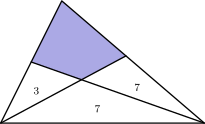
A triangle is partitioned into three triangles and a quadrilateral by drawing two lines from vertices to their opposite sides. The areas of the three triangles are and as shown. What is the area of the shaded quadrilateral?
Respuesta: D
Pista pequeña:
Divide el cuadrilátero en dos triángulos con áreas y .
Split the quadrilateral into two triangles with areas and
Pista grande:
Los triángulos que comparten una altura tienen áreas proporcionales a sus bases.
Triangles sharing an altitude have areas proportional to their bases
Solución:
Divide el cuadrilátero en dos triángulos de áreas y de modo que el área sombreada es
Comparando triángulos que comparten una altura, las razones de las bases dan y
Entonces así que lo que da
Por lo tanto, la respuesta correcta es D.
Split the quadrilateral into two triangles of areas and so the shaded area is
Comparing triangles that share an altitude, base ratios give and
Then so giving
Thus, the correct answer is D.
24.
Los círculos con centros en y tienen radios y respectivamente, y son tangentes exteriormente. Los puntos y en el círculo de centro y los puntos y en el círculo de centro son tales que y son tangentes exteriores comunes a los círculos. ¿Cuál es el área del hexágono cóncavo ?
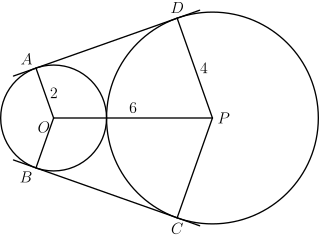
Circles with centers at and have radii and respectively, and are externally tangent. Points and on the circle with center and points and on the circle with center are such that and are common external tangents to the circles. What is the area of the concave hexagon
Respuesta: B
Pista pequeña:
Traza que corta a en para formar un rectángulo y un triángulo rectángulo.
Draw meeting at to form a rectangle and a right triangle
Pista grande:
Entonces y con .
Then and with
Solución:
El hexágono es simétrico respecto a así que su área es el doble de la del trapecio
Traza con sobre Entonces es un rectángulo, así que y
Como los círculos son tangentes exteriormente, así que en el triángulo rectángulo
El trapecio tiene lados paralelos y con altura lo que da un área de El área del hexágono es
Por lo tanto, la respuesta correcta es B.
The hexagon is symmetric about so its area is twice that of trapezoid
Draw with on Then is a rectangle, so and
Since the circles are externally tangent, so in right triangle
Trapezoid has parallel sides and with height giving area The hexagon area is
Thus, the correct answer is B.
25.
El señor Jones tiene ocho hijos de edades distintas. En un viaje familiar, su hija mayor, que tiene ve una placa con un número de cifras en el que cada uno de dos dígitos aparece dos veces. «¡Mira, papá! ¡Ese número es divisible por la edad de cada uno de nosotros!», exclama. «Así es», responde el señor Jones, «y las dos últimas cifras resultan ser justo mi edad». ¿Cuál de las siguientes no es la edad de uno de los hijos del señor Jones?
Mr. Jones has eight children of different ages. On a family trip his oldest child, who is spots a license plate with a -digit number in which each of two digits appears two times. “Look, daddy!” she exclaims. “That number is evenly divisible by the age of each of us kids!” “That’s right,” replies Mr. Jones, “and the last two digits just happen to be my age.” Which of the following is not the age of one of Mr. Jones’s children?
Respuesta: B
Pista pequeña:
El hijo mayor tiene así que el número es divisible por .
The oldest child is so the number is divisible by
Pista grande:
Con dos dígitos que aparecen dos veces cada uno, la suma de las cifras es un múltiplo de lo que fuerza .
With two digits each appearing twice, the digit sum is a multiple of forcing
Solución:
Como uno de los hijos tiene años, el número es divisible por de modo que su suma de cifras es múltiplo de lo que obliga a
Las ocho edades distintas son ocho de los nueve enteros de a así que por lo menos una de y es una edad. Por tanto, el número de la placa es divisible por Salvo intercambiar las dos cifras, su patrón es o Al combinar estos patrones con y la divisibilidad por , quedan
El último candidato haría que la edad del señor Jones fuera así que es imposible. Ninguno de los otros seis candidatos es divisible por por lo que no puede ser una de las edades. Las condiciones sí pueden cumplirse: es divisible por cada edad de , y sus dos últimas cifras dan la edad del señor Jones,
Por lo tanto, la respuesta correcta es B.
Since a child is the number is divisible by so its digit sum is a multiple of which forces
The eight distinct ages are eight of the nine integers from through so at least one of and is an age. Hence the plate number is divisible by Up to interchanging the two digits, its pattern is or Combining these patterns with and divisibility by leaves
The last candidate would make Mr. Jones’s age so it is impossible. None of the other six candidates is divisible by so cannot be one of the children’s ages. The conditions are attainable: is divisible by each age in and its last two digits give Mr. Jones’s age as
Thus, the correct answer is B.