
Problemas del 2017 AMC 10A
¡Desplázate hacia abajo y presiona Iniciar para intentar el examen! O ve al PDF imprimible, la clave de respuestas, o las soluciones profesionales preparadas por LIVE by Po-Shen Loh.
Todos los problemas se usan con el permiso legal oficial de la Mathematical Association of America (MAA).
O salta directamente a un solo problema con su solución: 1 · 2 · 3 · 4 · 5 · 6 · 7 · 8 · 9 · 10 · 11 · 12 · 13 · 14 · 15 · 16 · 17 · 18 · 19 · 20 · 21 · 22 · 23 · 24 · 25
¿Quieres aprender de forma profesional con clases interactivas en video?
Con tiempo
1:15:00
1.
¿Cuál es el valor de la siguiente expresión?
What is the value of the following expression?
Respuesta: C
Pista pequeña:
Trabaja desde los paréntesis más internos hacia afuera.
Work from the innermost parentheses outward
Pista grande:
Observa que los valores intermedios son uno menos que potencias de dos.
Notice the intermediate values are one less than powers of two
Solución:
Comenzando con el más interno, cada nueva capa duplica el valor actual y suma Los valores sucesivos son
Por lo tanto, C es la respuesta correcta.
Starting with the innermost each new layer doubles the current value and adds The successive values are
Thus, C is the correct answer.
2.
Pablo compra paletas heladas para sus amigos. La tienda vende paletas individuales a cada una, cajas de paletas a cada una y cajas de paletas a ¿Cuál es el mayor número de paletas que Pablo puede comprar con ?
Pablo buys popsicles for his friends. The store sells single popsicles for each, -popsicle boxes for each, and -popsicle boxes for What is the greatest number of popsicles that Pablo can buy with
Respuesta: D
Pista pequeña:
Compara las paletas por dólar en las tres opciones de compra.
Compare popsicles per dollar for the three buying options
Pista grande:
Primero decide el mejor uso de , luego gasta los restantes.
First decide the best use of , then spend the remaining
Solución:
Las cajas de dan la mayor cantidad de paletas por dólar, así que queremos comprar tantas de esas como sea posible.
Podemos comprar dos de esas, obteniendo paletas y quedándonos con .
Las paletas individuales de son la peor oferta, así que Pablo debería gastar el resto de su dinero en la caja de paletas.
Así termina con paletas.
Por lo tanto, D es la respuesta correcta.
The boxes give us the most popsicles per dollar, so we want to buy as many of those as possible.
We can buy two of those, getting popsicles with remaining.
The single popsicles are the worst deal, so Pablo should spend the rest of his money on the -popsicle box.
He then ends up with popsicles.
Thus, D is the correct answer.
3.
Tamara tiene tres filas de dos canteros de flores de pies por pies en su jardín. Los canteros están separados y también rodeados por caminos de pie de ancho, como se muestra en el diagrama. ¿Cuál es el área total de los caminos, en pies cuadrados?
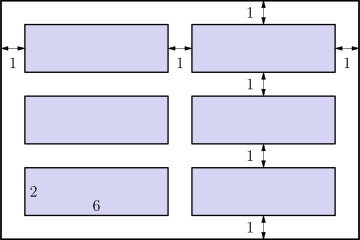
Tamara has three rows of two -feet by -feet flower beds in her garden. The beds are separated and also surrounded by -foot-wide walkways, as shown on the diagram. What is the total area of the walkways, in square feet?
Respuesta: B
Pista pequeña:
Primero halla las dimensiones de todo el jardín rectangular incluyendo los caminos.
Find the dimensions of the whole rectangular garden including walkways
Pista grande:
Resta el área total de los seis canteros al rectángulo exterior.
Subtract the total area of the six flower beds from the outside rectangle
Solución:
El ancho del jardín es Su altura es Por lo tanto, el área total del jardín es El área de todos los canteros es Al restarla del área del jardín se obtiene el área de los caminos.
Por lo tanto, B es la respuesta correcta.
We can see that the width of the garden is We can also see that the height is The total area of the garden is therefore The area of all the flower beds is Subtracting this from the area of the garden yields which is the area of the walkways.
Thus, B is the correct answer.
4.
Mia está “ayudando” a su mamá a recoger juguetes esparcidos por el suelo. La mamá de Mia logra poner juguetes en la caja de juguetes cada segundos, pero cada vez, inmediatamente después de que transcurren esos segundos, Mia saca juguetes de la caja. ¿Cuánto tiempo, en minutos, les tomará a Mia y a su mamá poner los juguetes en la caja por primera vez?
Mia is “helping” her mom pick up toys that are strewn on the floor. Mia’s mom manages to put toys into the toy box every seconds, but each time immediately after those seconds have elapsed, Mia takes toys out of the box. How much time, in minutes, will it take Mia and her mom to put all toys into the box for the first time?
Respuesta: B
Pista pequeña:
Sigue el cambio neto durante un ciclo normal de medio minuto.
Track the net change during a normal half-minute cycle
Pista grande:
Al final, detente cuando la caja alcance por primera vez antes de otra extracción.
At the end, stop when the box first reaches before another removal
Solución:
Observa que después de segundos se agregan juguetes y se quitan , dejando un total neto de juguetes en la caja.
Sin embargo, debemos tener cuidado hacia el final, ya que es posible que la caja tenga juguetes justo después de que la mamá de Mia los agrega y antes de que Mia los quite.
Cuando hay juguetes en la caja, la mamá de Mia puede agregar dejando juguetes en la caja.
Tomará segundos, más otros segundos, lo que da minutos para tener por primera vez juguetes en la caja.
Por lo tanto, B es la respuesta correcta.
Note that after seconds, there are toys added and removed, leaving a net total of toys in the box.
We have to be careful towards the end, however, since it is possible for the box to have toys right after Mia’s mom adds the toys and before Mia removes them.
After there are toys in the box, Mia’s mom can add leaving toys in the box.
It will take seconds, plus another seconds, which gives us minutes to get toys in the box.
Thus, B is the correct answer.
5.
La suma de dos números reales distintos de cero es veces su producto. ¿Cuál es la suma de los recíprocos de los dos números?
The sum of two nonzero real numbers is times their product. What is the sum of the reciprocals of the two numbers?
Respuesta: C
Pista pequeña:
Nombra los dos números y .
Name the two numbers and
Pista grande:
Divide la ecuación dada entre .
Divide the given equation by
Solución:
Sean y los dos números. Se nos da que
Observa que
Por lo tanto, C es la respuesta correcta.
Let and be the two numbers. We are given that
Note that
Thus, C is the correct answer.
6.
La Sra. Carroll prometió que cualquiera que respondiera correctamente todas las preguntas de opción múltiple en el próximo examen recibiría una A en el examen. ¿Cuál de estos enunciados se deduce necesariamente de forma lógica?
Ms. Carroll promised that anyone who got all the multiple choice questions right on the upcoming exam would receive an A on the exam. Which one of these statements necessarily follows logically?
Si Lewis no recibió una A, entonces respondió mal todas las preguntas de opción múltiple.
If Lewis did not receive an A, then he got all of the multiple choice questions wrong.
Si Lewis no recibió una A, entonces respondió mal al menos una de las preguntas de opción múltiple.
If Lewis did not receive an A, then he got at least one of the multiple choice questions wrong.
Si Lewis respondió mal al menos una de las preguntas de opción múltiple, entonces no recibió una A.
If Lewis got at least one of the multiple choice questions wrong, then he did not receive an A.
Si Lewis recibió una A, entonces respondió correctamente todas las preguntas de opción múltiple.
If Lewis received an A, then he got all of the multiple choice questions right.
Si Lewis recibió una A, entonces respondió correctamente al menos una de las preguntas de opción múltiple.
If Lewis received an A, then he got at least one of the multiple choice questions right.
Respuesta: B
Pista pequeña:
Traduce la promesa como una implicación.
Translate the promise as an implication
Pista grande:
Usa el contrarrecíproco del enunciado.
Use the contrapositive of the statement
Solución:
La promesa dice que responder correctamente todas las preguntas de opción múltiple garantiza una A. Su contrarrecíproco es que quien no recibió una A no pudo haber respondido correctamente todas las preguntas de opción múltiple. En otras palabras, esa persona respondió mal al menos una pregunta de opción múltiple.
Por lo tanto, B es la respuesta correcta.
The promise says that getting every multiple choice question right guarantees an A. Its contrapositive is that anyone who did not receive an A must not have gotten every multiple choice question right. In other words, that person got at least one multiple choice question wrong.
Thus, B is the correct answer.
7.
Jerry y Silvia querían ir desde la esquina suroeste de un campo cuadrado hasta la esquina noreste. Jerry caminó hacia el este y luego hacia el norte para llegar a la meta, pero Silvia se dirigió al noreste y llegó a la meta caminando en línea recta. ¿Cuál de las siguientes opciones es la más cercana a cuánto más corto fue el trayecto de Silvia, comparado con el trayecto de Jerry?
Jerry and Silvia wanted to go from the southwest corner of a square field to the northeast corner. Jerry walked due east and then due north to reach the goal, but Silvia headed northeast and reached the goal walking in a straight line. Which of the following is closest to how much shorter Silvia’s trip was, compared to Jerry’s trip?
Respuesta: A
Pista pequeña:
Sea la longitud del lado del cuadrado.
Let the square side length be
Pista grande:
Compara con como porcentaje del trayecto de Jerry.
Compare with as a percent of Jerry’s trip
Solución:
Sea la longitud del lado del campo. Entonces Jerry recorrió y Silvia recorrió por el teorema de Pitágoras.
El valor buscado es
Por lo tanto, A es la respuesta correcta.
Let be the side length of the field. Then Jerry traveled and Silvia traveled from the Pythagorean theorem.
The desired value is
Thus, A is the correct answer.
8.
En una reunión de personas, hay personas que se conocen todas entre sí y personas que no conocen a nadie. Las personas que se conocen se abrazan, y las que no se conocen se dan la mano. ¿Cuántos apretones de manos ocurren dentro del grupo?
At a gathering of people, there are people who all know each other and people who know no one. People who know each other hug, and people who do not know each other shake hands. How many handshakes occur?
Respuesta: B
Pista pequeña:
Cuenta los apretones de manos que involucran a las diez personas que no conocen a nadie.
Count handshakes involving the ten people who know no one
Pista grande:
Evita contar dos veces pensando en parejas.
Avoid double-counting by thinking in pairs
Solución:
Cada una de las personas se da la mano con cada una de las personas. Esto resulta en apretones de manos.
También hay apretones de manos entre las personas (cada par de personas se da la mano).
Por lo tanto, el número total de apretones de manos es
Por lo tanto, B es la respuesta correcta.
Each of the people shake hands with each of the people. This results in handshakes.
There are also handshakes within the people (every pair of people shake hands).
Therefore, the total number of handshakes is
Thus, B is the correct answer.
9.
Minnie viaja en carretera plana a kilómetros por hora (kph), cuesta abajo a kph y cuesta arriba a kph. Penny viaja en carretera plana a kph, cuesta abajo a kph y cuesta arriba a kph. Minnie va del pueblo al pueblo una distancia de km toda cuesta arriba, luego del pueblo al pueblo una distancia de km toda cuesta abajo, y luego de regreso al pueblo una distancia de km en llano. Penny va en sentido contrario usando la misma ruta. ¿Cuántos minutos más le toma a Minnie completar el recorrido de km que a Penny?
Minnie rides on a flat road at kilometers per hour (kph), downhill at kph, and uphill at kph. Penny rides on a flat road at kph, downhill at kph, and uphill at kph. Minnie goes from town to town a distance of km all uphill, then from town to town a distance of km all downhill, and then back to town a distance of km on the flat. Penny goes the other way around using the same route. How many more minutes does it take Minnie to complete the -km ride than it takes Penny?
Respuesta: C
Pista pequeña:
Calcula los tiempos de los tres tramos de Minnie en horas.
Compute Minnie’s three segment times in hours
Pista grande:
Calcula los tiempos de los tres tramos de Penny en la misma ruta en sentido contrario.
Compute Penny’s three segment times on the same route in the opposite direction
Solución:
A Minnie le tomará horas recorrer la distancia cuesta arriba. Le tomará horas recorrer la distancia cuesta abajo.
Finalmente, le tomará hora recorrer el llano. Su tiempo total es minutos.
A Penny le tomará horas recorrer el llano. Le tomará otras horas recorrer la cuesta arriba.
Finalmente, le tomará horas recorrer la cuesta abajo. Su tiempo total es minutos. El recorrido le toma a Minnie minutos más que a Penny.
Por lo tanto, C es la respuesta correcta.
It will take Minnie hours to travel the uphill distance. It will take her hours to travel the downhill distance.
Finally, it will take her hour to travel the flat. This will take her a total of minutes.
It will take Penny hours to travel the flat. It will take her another hours to travel the uphill.
Finally, it will take her hours to travel the downhill. This is a total of minutes. The trip takes Minnie more minutes to travel than Penny.
Thus, C is the correct answer.
10.
Joy tiene varillas delgadas, una de cada longitud entera desde cm hasta cm. Coloca sobre una mesa las varillas de longitudes cm, cm y cm. Luego quiere elegir una cuarta varilla que pueda juntar con estas tres para formar un cuadrilátero de área positiva. ¿Cuántas de las varillas restantes puede elegir como la cuarta varilla?
Joy has thin rods, one each of every integer length from cm through cm. She places the rods with lengths cm, cm, and cm on a table. She then wants to choose a fourth rod that she can put with these three to form a quadrilateral with positive area. How many of the remaining rods can she choose as the fourth rod?
Respuesta: B
Pista pequeña:
Usa la desigualdad del cuadrilátero para el lado más largo.
Use the quadrilateral inequality for the longest side
Pista grande:
Después de hallar las longitudes enteras posibles, elimina las varillas que ya están en la mesa.
After finding the possible integer lengths, remove rods already on the table
Solución:
Observa que ningún lado puede ser mayor o igual que la suma de las longitudes de los otros lados.
Sea la longitud de la cuarta varilla. Debemos tener y, cuando la varilla originalmente más larga sigue siendo el lado más largo, . Al simplificar, Hay valores enteros posibles para
Sin embargo, las varillas de longitud y ya están en uso, así que no puede ser igual a estos valores.
Esto deja soluciones viables para
Por lo tanto, B es la respuesta correcta.
Note that no one side can be greater than or equal to the sum of the other side lengths.
Let be the length fourth rod. Then we have that and Simplifying, we know that Counting the number of integers in this range, we are left with values for
The rods with length and are already being used, however, so cannot equal these.
This leaves viable solutions for
Thus, B is the correct answer.
11.
La región formada por todos los puntos del espacio tridimensional que están a no más de unidades del segmento tiene volumen ¿Cuál es la longitud ?
The region consisting of all points in three-dimensional space within units of line segment has volume What is the length
Pista pequeña:
El sólido es un cilindro con dos casquetes hemisféricos.
The solid is a cylinder with two hemispherical caps
Pista grande:
Resta el volumen de los dos hemisferios antes de despejar .
Subtract the volume of the two hemispheres before solving for
Solución:
Recuerda que todos los puntos que están a lo sumo a una distancia fija de un punto forman una esfera.
En los extremos de este segmento, podemos visualizar que se forma un hemisferio en cada extremo.
Todos los puntos del medio también tienen esferas formándose a su alrededor, pero se fusionan con las de al lado.
Esto significa que la sección central forma un cilindro de radio Los dos hemisferios forman una esfera de radio cuyo volumen es Por lo tanto, el cilindro tiene volumen El área de su base es así que, si es la longitud de
Por lo tanto, D es la respuesta correcta.
Recall that all the points at most a fixed distance away from a point form a sphere.
At the end points of this line segment, we can visualize two hemispheres being formed at each end.
All the points in the middle also have spheres forming around them, but they get merged into the ones right next to them.
This means that the middle section forms a cylinder with radius The two hemispheres form a sphere with radius and therefore a volume of This means that the cylinder has a volume of We know the base area is so if is then the volume is
Thus, D is the correct answer.
12.
Sea el conjunto de puntos en el plano coordenado tal que dos de las tres cantidades y sean iguales y la tercera de las tres cantidades no sea mayor que este valor común. ¿Cuál de las siguientes es una descripción correcta de ?
Let be the set of points in the coordinate plane such that two of the three quantities and are equal and the third of the three quantities is no greater than this common value. Which of the following is a correct description of
un solo punto
a single point
dos rectas que se intersecan
two intersecting lines
tres rectas cuyas intersecciones por pares son tres puntos distintos
three lines whose pairwise intersections are three distinct points
un triángulo
a triangle
tres rayos con un extremo común
three rays with a common endpoint
Respuesta: E
Pista pequeña:
Divide en casos según cuáles dos cantidades sean iguales.
Split into cases according to which two quantities are equal
Pista grande:
Cada igualdad da un rayo una vez que la tercera cantidad queda acotada superiormente.
Each equality gives a ray once the third quantity is bounded above
Solución:
Analicemos por casos cuáles de los valores son iguales. Si entonces Esto también implica Esto describe un rayo que parte de y se extiende en la dirección negativa del eje .
De manera análoga, si entonces y Esto describe otro rayo que parte de , ahora en la dirección negativa del eje .
Finalmente, si obtenemos la recta Además, y Por la ecuación de la recta, cualquiera de estas dos condiciones implica la otra.
Si entonces Los demás puntos de este rayo cumplen y
Esto describe otro rayo que parte de y se aleja en una tercera dirección.
Los tres casos producen rayos con origen en y direcciones distintas.
Por tanto, E es la respuesta correcta.
Let us case on which of the values are equal. If then This also tells us that This describes a ray starting at and extending in the negative direction.
Similarly, if then and This also describes a ray starting at but instead extending in the negative direction.
Finally, if then we have the line Furthermore, we have that and Note that if one of these conditions is met, the other is also necessarily true due to the equation of the line.
If then The other points are along the line, where and
This describes another ray that starts at and goes off in some third direction.
All three cases result in rays originating from that all go in different directions.
Thus, E is the correct answer.
13.
Define una sucesión recursivamente mediante y haciendo que el residuo de dividir entre para todo Así, la sucesión comienza ¿Cuál es el valor de
Define a sequence recursively by and the remainder when is divided by for all Thus the sequence starts What is
Respuesta: D
Pista pequeña:
Escribe suficientes términos para ver el periodo módulo .
Write out enough terms to see the period modulo
Pista grande:
Los ocho términos pedidos cubren un periodo completo.
The requested eight terms cover one complete period
Solución:
Enumeremos los primeros valores para buscar un patrón en la sucesión.
El par Como cada término posterior queda determinado por los dos términos anteriores, la sucesión se repite cada términos.
La expresión pedida es la suma de términos consecutivos, que es constante. Esta suma es Así, la respuesta correcta es D.
Let us list out the first few values to see if we can find a pattern in this sequence.
The pair Because each later term is determined by the preceding two terms, the sequence therefore repeats every terms.
The desired answer is the sum of consecutive numbers, which is fixed. This sum is Thus, D is the correct answer.
14.
Cada semana Roger paga una entrada de cine y un refresco con su mesada. La semana pasada, la mesada de Roger fue dólares. El costo de su entrada de cine fue de la diferencia entre y el costo de su refresco, mientras que el costo de su refresco fue de la diferencia entre y el costo de su entrada de cine. Al entero de porcentaje más cercano, ¿qué fracción de pagó Roger por su entrada de cine y su refresco?
Every week Roger pays for a movie ticket and a soda out of his allowance. Last week, Roger’s allowance was dollars. The cost of his movie ticket was of the difference between and the cost of his soda, while the cost of his soda was of the difference between and the cost of his movie ticket. To the nearest whole percent, what fraction of did Roger pay for his movie ticket and soda?
Respuesta: D
Pista pequeña:
Toma los costos de la entrada y del refresco como variables.
Let the ticket and soda costs be variables
Pista grande:
Convierte los dos enunciados de porcentaje en un sistema lineal de dos ecuaciones.
Turn the two percent statements into a two-equation linear system
Solución:
Sea el costo de la entrada y el costo del refresco. Entonces obtenemos las siguientes ecuaciones.
Multiplicar en cruz la primera ecuación nos da Sustituyendo la expresión de se obtiene Al resolver,
Esto también nos da
Sumando los costos se obtiene
Por lo tanto, D es la respuesta correcta.
Let be the cost of the ticket and be the cost of the soda. Then we get the following equations.
Cross-multiplying the first equation gives us Substituting in the expression for yields Solving yields
This also gives us
Adding together the costs gives us
Thus, D is the correct answer.
15.
Chloe elige un número real de manera uniforme al azar del intervalo
De forma independiente, Laurent elige un número real de manera uniforme al azar del intervalo
¿Cuál es la probabilidad de que el número de Laurent sea mayor que el número de Chloe?
Chloé chooses a real number uniformly at random from the interval
Independently, Laurent chooses a real number uniformly at random from the interval
What is the probability that Laurent’s number is greater than Chloé’s number?
Respuesta: C
Pista pequeña:
Divide el intervalo de Laurent en la mitad inferior y la mitad superior.
Break Laurent’s interval into the lower half and upper half
Pista grande:
En la mitad inferior, la simetría decide cuál de los números elegidos es mayor.
In the lower half, symmetry decides which chosen number is larger
Solución:
Si Laurent elige un número en el intervalo entonces no hay forma de que Chloe tenga el número mayor.
Esto significa que Laurent tiene una probabilidad de de ganar automáticamente.
De lo contrario, Laurent elige un número en el intervalo La probabilidad de que obtenga un número mayor que Chloe es la misma que la de que Chloe obtenga un número mayor que Laurent.
Esto significa que Laurent tiene una probabilidad de de obtener un número mayor (al trabajar con intervalos reales, la probabilidad de un empate es esencialmente debido al tamaño infinito de los intervalos).
La probabilidad total de que Laurent obtenga un número mayor es
Por lo tanto, C es la respuesta correcta.
If Laurent chooses a number in the interval then there is no way that Chloé can have the greater number.
This means that Laurent has a chance of automatically winning.
Otherwise, Laurent chooses a number in the interval The probability that he gets a greater number than Chloé is the same as Chloé getting a greater number than Laurent.
This means that Laurent has a chance of getting a greater number (when working with real intervals, the probability of a tie is essentially due to the infinite size of the intervals).
Laurent’s total chance of getting a greater number is
Thus, C is the correct answer.
16.
Hay caballos, llamados Caballo Caballo y así sucesivamente hasta Caballo Reciben sus nombres según cuántos minutos les toma dar una vuelta a una pista de carreras circular: el Caballo da una vuelta en exactamente minutos. En el tiempo todos los caballos están juntos en el punto de partida de la pista. Los caballos empiezan a correr en la misma dirección y siguen corriendo alrededor de la pista circular a sus velocidades constantes.
El menor tiempo en minutos, en el que los caballos vuelven a estar simultáneamente en el punto de partida es Sea el menor tiempo, en minutos, tal que al menos de los caballos vuelvan a estar en el punto de partida. ¿Cuánto vale la suma de los dígitos de ?
There are horses, named Horse Horse and so on through Horse They get their names from how many minutes it takes them to run one lap around a circular race track: Horse runs one lap in exactly minutes. At time all the horses are together at the starting point on the track. The horses start running in the same direction, and they keep running around the circular track at their constant speeds.
The least time in minutes, at which all horses will again simultaneously be at the starting point is Let be the least time, in minutes, such that at least of the horses are again at the starting point. What is the sum of the digits of
Respuesta: B
Pista pequeña:
Un caballo está en la salida exactamente cuando su número divide al tiempo transcurrido.
A horse is at the start exactly when its name divides the elapsed time
Pista grande:
Encuentra el menor tiempo divisible por al menos cinco números del al .
Find the least time divisible by at least five numbers from through
Solución:
El Caballo vuelve al punto de partida después de minutos exactamente cuando es divisible por . Por lo tanto, necesitamos el menor positivo que sea divisible por al menos cinco de los enteros .
Revisando hacia arriba, ningún número menor que tiene cinco divisores de esta lista: por ejemplo, tiene , tiene , tiene , y tiene .
El número es divisible por y , así que el menor tiempo posible es . La suma de sus dígitos es .
Por lo tanto, B es la respuesta correcta.
Horse is back at the starting point after minutes exactly when is divisible by . Thus we need the least positive that is divisible by at least five of the integers .
Checking upward, no number below has five divisors from this list: for example, has , has , has , and has .
The number is divisible by and , so the least possible time is . The sum of its digits is .
Thus, B is the correct answer.
17.
Los puntos distintos están sobre la circunferencia y tienen coordenadas enteras. Las distancias y son números irracionales.
¿Cuál es el mayor valor posible de la razón ?
Distinct points lie on the circle and have integer coordinates. The distances and are irrational numbers.
What is the greatest possible value of the ratio
Respuesta: D
Pista pequeña:
Enumera los puntos reticulares sobre la circunferencia.
List the lattice points on the circle
Pista grande:
Maximiza una distancia irracional y minimiza otra distancia irracional.
Maximize one irrational distance and minimize another irrational distance
Solución:
Los puntos de coordenadas enteras sobre son , , y .
Para que y sean irracionales, la distancia al cuadrado no debe ser un cuadrado perfecto. Para maximizar la razón, haz que sea lo más grande posible y lo más pequeño posible bajo esa condición.
La mayor distancia irracional posible es entre y , lo que da . La menor distancia irracional posible es entre y , lo que da .
La mayor razón posible es . Por lo tanto, D es la respuesta correcta.
The integer-coordinate points on are , , , and .
For and to be irrational, the squared distance must not be a perfect square. To maximize the ratio, make as large as possible and as small as possible under that condition.
The largest possible irrational distance is between and , giving . The smallest possible irrational distance is between and , giving .
The greatest possible ratio is . Thus, D is the correct answer.
18.
Amelia tiene una moneda que cae cara con probabilidad y Blaine tiene una moneda que cae cara con probabilidad Amelia y Blaine lanzan sus monedas alternadamente hasta que alguien obtiene cara; el primero en obtener cara gana. Todos los lanzamientos son independientes. Amelia empieza. La probabilidad de que Amelia gane es donde y son enteros positivos primos entre sí. ¿Cuánto vale ?
Amelia has a coin that lands heads with probability and Blaine has a coin that lands on heads with probability Amelia and Blaine alternately toss their coins until someone gets a head; the first one to get a head wins. All coin tosses are independent. Amelia goes first. The probability that Amelia wins is where and are relatively prime positive integers. What is
Respuesta: D
Pista pequeña:
Sea la probabilidad de que Amelia gane desde el inicio de su turno.
Let be Amelia’s chance to win from the start of her turn
Pista grande:
Después de que ambos jugadores lancen cruz, la misma situación se repite.
After both players toss tails, the same situation repeats
Solución:
Sea la probabilidad de que Amelia gane.
Hay una probabilidad de de que Amelia gane en su primer lanzamiento.
Si ella obtiene cruz, Blaine también debe obtener cruz para que el juego vuelva al mismo estado; esto ocurre con probabilidad
La probabilidad total de este caso es
El juego vuelve entonces a Amelia, quien de nuevo tiene una probabilidad de ganar.
Por lo tanto, obtenemos la siguiente ecuación.
La diferencia entre el denominador y el numerador es
Por lo tanto, D es la respuesta correcta.
Let be the probability that Amelia wins.
There is a chance Amelia wins off her first flip.
If she gets tails, Blaine must also get tails for the game to return to the same state; this happens with probability
The total probability of this case is
The game then goes back to Amelia, who then again has a chance of winning.
Therefore, we get the following equation.
The difference between the denominator and numerator is
Thus, D is the correct answer.
19.
Alice se niega a sentarse junto a Bob o Carla. Derek se niega a sentarse junto a Eric. ¿De cuántas maneras pueden sentarse los cinco en una fila de sillas bajo estas condiciones?
Alice refuses to sit next to either Bob or Carla. Derek refuses to sit next to Eric. How many ways are there for the five of them to sit in a row of chairs under these conditions?
Respuesta: C
Pista pequeña:
Analiza por casos la posición del asiento de Alice.
Case on Alice’s seat position
Pista grande:
Cuando Alice no está en un extremo, Derek y Eric deben ocupar los asientos vecinos a ella.
When Alice is not on an end, Derek and Eric must occupy her neighboring seats
Solución:
Si Alice se sienta en un extremo, entonces la persona a su lado no puede ser Bob ni Carla. Esto significa que debe ser Derek o Eric.
Sin pérdida de generalidad, supongamos que esa persona es Eric. Entonces la persona junto a Eric tiene que ser Bob o Carla. Después de eso no hay más restricciones.
Esto nos da un total de
El primer es por los dos extremos. El segundo es por Derek o Eric. El tercer es por Bob o Carla. El último es por las personas restantes.
De lo contrario, supongamos que Alice está en uno de los tres asientos que no son extremos. Entonces las dos personas a su lado tienen que ser Derek y Eric. Bob y Carla quedan obligados a ocupar los últimos asientos.
Hay opciones para el asiento de Alice. El lado en el que se sienta Derek tiene opciones, y luego hay opciones para dónde van Bob y Carla.
Esto nos da configuraciones.
Por lo tanto, hay un total de disposiciones de asientos.
Por lo tanto, C es la respuesta correcta.
If Alice sits on an end, then the person next to her cannot be Bob or Carla. This means that it must be Derek or Eric.
WLOG, let the person be Eric. Then the person next to Eric has to be Bob or Carla. After that there are no more restrictions.
This gives us a total of
The first is for both edges. The second is for Derek or Eric. The third is for Bob or Carla. The final is just for the people that are remaining.
Otherwise, let Alice be in one of the three non-end seats. Then the two people next to her have to be Derek and Eric. Bob and Carla are forced to be in the last seats.
There are choices for Alice’s seat. The side on which Derek sits has options, and then there are options for where Bob and Carla go.
This gives us configurations.
Therefore, there are a total of total seating arrangements.
Thus, C is the correct answer.
20.
Sea la suma de los dígitos del entero positivo Por ejemplo, Para cierto entero positivo
¿Cuál de los siguientes podría ser el valor de ?
Let equal the sum of the digits of positive integer For example, For a particular positive integer
Which of the following could be the value of
Respuesta: D
Pista pequeña:
Usa las sumas de dígitos módulo .
Use digit sums modulo
Pista grande:
Como es uno más que , compara las posibles opciones de respuesta módulo .
Since is one more than , compare possible answer choices modulo
Solución:
Recordemos que un número es divisible por si y solo si la suma de sus dígitos también es divisible por
Esto significa que mirar módulo también nos da módulo
Probémoslo. Si sumamos a sin llevar, la suma de los dígitos aumenta claramente en , y mismo también aumenta en
Esto aumenta ambos valores módulo en
Si hay una llevada, restamos de algún dígito y sumamos al siguiente.
Eso mantiene constante el valor módulo . Sin embargo, también sumamos , así que el valor módulo todavía aumenta en
Estos son los únicos casos, y en ambos hemos mostrado que los valores módulo de y aumentan en
Por tanto,
De aquí,
La única opción que deja residuo al dividirse entre es
Este valor es alcanzable. Tomemos formado por dígitos seguidos de un dígito y luego cuatro dígitos Entonces Al sumar , los cuatro finales se vuelven y el se vuelve por lo que
Por lo tanto, D es la respuesta correcta.
Recall that a number is divisible by if and only if the sum of its digits is also divisible by
This means that looking at mod would also give us mod
Let us prove this. If we add to without carrying, it is clear that the sum of the digits increases by and that itself increases by
This would increase both their values mod by
Now, if it does carry, we would be subtracting from some digit and adding on to the next digit.
This would keep the value mod constant. We did, however, add in there, so the value mod still increased by
These are the only two cases, and in both we have shown that the value mod for both and increased by
Therefore, we have that
From this, we can see that
The only answer choice that leaves a remainder of when divided by is
This value is attainable. Take to consist of digits followed by a digit followed by four more digits Then Adding changes the final four s to s and changes the to so
Thus, D is the correct answer.
21.
Un cuadrado de lado está inscrito en un triángulo rectángulo de lados y de modo que un vértice del cuadrado coincide con el vértice del ángulo recto del triángulo. Un cuadrado de lado está inscrito en otro triángulo rectángulo de lados y de modo que un lado del cuadrado queda sobre la hipotenusa del triángulo. ¿Cuánto vale ?
A square with side length is inscribed in a right triangle with sides of length and so that one vertex of the square coincides with the right-angle vertex of the triangle. A square with side length is inscribed in another right triangle with sides of length and so that one side of the square lies on the hypotenuse of the triangle. What is
Respuesta: D
Pista pequeña:
Usa triángulos semejantes en la primera colocación del cuadrado.
Use similar triangles in the first square placement
Pista grande:
En la segunda colocación, expresa los dos segmentos sobrantes del lado en términos de .
In the second placement, express the two leftover side pieces in terms of
Solución:
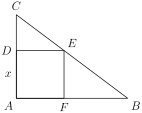
Podemos ver que y son semejantes (ángulo-ángulo). Esto nos da
Multiplicar en cruz da
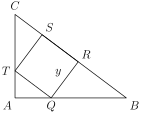
Aquí tenemos que y son semejantes (ángulo-ángulo).
Esto significa que y Esto nos da la ecuación
Finalmente, obtenemos que La razón buscada es
Por lo tanto, D es la respuesta correcta.
We can see that and are similar (angle-angle). This gives us
Cross-multiplying yields
Here, we have that and are similar (angle-angle).
This means that and This gives us the equation
Finally, we get that The desired ratio is
Thus, D is the correct answer.
22.
Los lados y del triángulo equilátero son tangentes a una circunferencia en los puntos y respectivamente. ¿Qué fracción del área de queda fuera de la circunferencia?
Sides and of equilateral triangle are tangent to a circle at points and respectively. What fraction of the area of lies outside the circle?
Respuesta: E
Pista pequeña:
Sea el radio de la circunferencia.
Let the circle radius be
Pista grande:
Compara el segmento circular dentro del triángulo con el área completa de .
Compare the circular segment inside the triangle with the full area of
Solución:
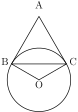
Sea el radio de la circunferencia.
Para hallar el área del triángulo que queda fuera de la circunferencia, podemos hallar el área del triángulo que queda dentro y restarla.
Como y son ángulos rectos, se tiene .
Por lo tanto, el área del sector es
Ahora hallamos el área de Usando la fórmula del área de un triángulo con el seno, obtenemos
Entonces el área del triángulo que queda dentro de la circunferencia es
El área de es
La fracción del triángulo que queda dentro de la circunferencia es que se simplifica a
La fracción buscada es entonces
Por lo tanto, E es la respuesta correcta.
Let the radius of the circle be
To find the area of the triangle outside of the circle, we can find the area of the triangle inside the circle and subtract it.
We get that since and are right angles.
This means that the area of sector is
Now, we need to find the area of Using the formula for the area of a triangle with sine, we get the area to be
Then the area of the triangle inside the circle is
The area of is
The fraction of the triangle lying inside the circle is which simplifies to
Hence the desired fraction is
Thus, E is the correct answer.
23.
¿Cuántos triángulos con área positiva tienen todos sus vértices en puntos del plano coordenado, donde y son enteros entre y inclusive?
How many triangles with positive area have all their vertices at points in the coordinate plane, where and are integers between and inclusive?
Respuesta: B
Pista pequeña:
Empieza con todos los tríos de puntos reticulares.
Start with all triples of lattice points
Pista grande:
Resta los tríos colineales según la longitud de la recta y la pendiente.
Subtract collinear triples by line length and slope
Solución:
Podemos usar conteo complementario para hallar el número total de triángulos y restar los que no sirven.
Hay un total de puntos, así que hay triángulos posibles.
Observa que la única forma de que un triángulo no sirva es que los puntos estén en línea recta.
Hay filas, columnas y diagonales largas. Cada una de estas rectas tiene puntos, por lo que aportan triángulos degenerados.
También están las rectas diagonales con puntos, como la que va de a Hay de estas rectas, así que aportan triángulos degenerados.
De forma similar, hay rectas diagonales con puntos. Estas nos dan triángulos extra que no sirven.
Ahora, tenemos que fijarnos en las rectas con pendientes y
Hay de estas rectas por cada pendiente, y todas tienen puntos. Por lo tanto, hay que descontar otros triángulos degenerados.
El número total de triángulos de área positiva es Por lo tanto, B es la respuesta correcta.
We can use complementary counting to find the total number of triangles and subtract out the ones that don’t work.
There are a total of points, so there are possible triangles.
Note that the only way a triangle doesn’t work is if all the points are in a straight line.
There are rows, columns, and long diagonals. Each of these lines have points, which means they contribute degenerate triangles.
There are also the diagonal lines with points, such as the line from to There are of these lines, so they have degenerate triangles.
Similarly, there are diagonal lines with points. These give us extra triangles that don’t work.
Now, we have to look at the lines with slopes of and
There are such lines for each slope, and they all have points on them. Therefore, they contribute more triangles to discount.
The total number of working triangles is then Thus, B is the correct answer.
24.
Para ciertos números reales y el polinomio tiene tres raíces distintas, y cada raíz de también es raíz del polinomio ¿Cuánto vale ?
For certain real numbers and the polynomial has three distinct roots, and each root of is also a root of the polynomial What is
Respuesta: C
Pista pequeña:
Como las raíces de son raíces de , factoriza usando .
Because the roots of are roots of , factor by
Pista grande:
Compara los coeficientes de y para hallar la raíz adicional y .
Compare the and coefficients to find the extra root and
Solución:
Como las tres raíces distintas del polinomio cúbico también son raíces del polinomio mónico de cuarto grado podemos escribir para algún número real
El coeficiente de en este producto es así que y El coeficiente de es así que y
Por tanto,
Por lo tanto, C es la respuesta correcta.
Because the three distinct roots of the cubic are also roots of the monic quartic we can write for some real number
The coefficient of in this product is so and The coefficient of is so and
Therefore,
Thus, C is the correct answer.
25.
¿Cuántos enteros entre y inclusive, tienen la propiedad de que alguna permutación de sus dígitos es un múltiplo de entre y ? Por ejemplo, tanto como tienen esta propiedad.
How many integers between and inclusive, have the property that some permutation of its digits is a multiple of between and For example, both and have this property.
Respuesta: A
Pista pequeña:
Usa la regla de divisibilidad para .
Use the divisibility rule for
Pista grande:
Agrupa los múltiplos de de tres dígitos según los dígitos repetidos y según si algún dígito es .
Group three-digit multiples of by repeated digits and whether a digit is
Solución:
Podemos analizar todos los múltiplos de y ver cuántas permutaciones aporta cada uno. Podemos hacer esto según el número de dígitos distintos del número.
Caso todos los dígitos son iguales
Esto no puede ocurrir. Lo vemos por la regla de divisibilidad para que dice que la suma del primer y el último dígito menos el dígito del medio debe ser divisible por
Si todos los dígitos son iguales, entonces la expresión anterior es igual a ese dígito, que no puede ser divisible por
Caso dos de los dígitos son iguales
Podemos dividir esto en los números que tienen el dígito y los que no.
Hay múltiplos de que no tienen el dígito y
Cada uno de estos números aporta permutaciones, así que este escenario tiene números.
Hay múltiplos de que tienen el dígito y
Para estos números, no puede ser el dígito de las centenas, así que cada uno solo aporta permutaciones, para un total de
Caso todos los dígitos son diferentes
Hay un total de múltiplos de entre y El número de estos con todos los dígitos diferentes es Como en el caso tenemos que considerar por separado los números que contienen el dígito Hay y
Cada uno de estos nos da permutaciones, pero contamos de más por un factor de ya que intercambiar el primer y el último dígito crea otro número que ya está en el conjunto.
Por lo tanto, estos números aportan un total de permutaciones distintas.
Ahora quedan múltiplos de que debemos contar.
Sabemos que cada uno de estos aporta permutaciones. Sin embargo, como antes, observa que intercambiar el primer y el último dígito de cualquier número de este conjunto produce otro número de este conjunto.
Lo vemos usando la regla de divisibilidad para Si es divisible por entonces tenemos que es divisible por
Esto significa que es divisible por lo que significa que también es divisible por
Por lo tanto, estos números aportan permutaciones más.
En total, entre todos los casos hay números.
Por lo tanto, A es la respuesta correcta.
We can analyze all the multiples of and see how many permutations each of them contribute. We can do this by casing on the number of unique digits in the number.
Case all the digits are the same
This cannot happen. We can see this by the divisibility rule for which says that the sum of the first and last digit minus the middle digit must be divisible by
If all the digits are the same, then the above expression evaluates to that digit, which cannot be divisible by
Case two of the digits are the same
We can split this up into the numbers that have the digit and those that don’t.
There are multiples of that do not have the digit and
Each of these numbers contributes permutations, so this scenario has numbers.
There are multiples of that have the digit and
For these numbers, cannot be the hundreds digit, so each of them only contributes permutations, for a total of
Case all the digits are different
There are a total of multiples of between and The number of these with all different digits is As in case we have to specially account for the numbers with as a digit. There are and
Each of these gives us permutations, but we overcount by a factor of since flipping the first and last digits creates another number already in the set.
Therefore, these numbers provide a total of unique permutations.
There are now multiples of that we need to account for.
We know that each of these provides permutations. As above, however, note that flipping the first and last digit of any number in this set produces another number in this set.
We can see this by using the divisibility rule for If is divisible by then we have that is divisible by
This means that is divisible by which means that is also divisible by
Therefore, these numbers contribute more permutations.
Over all the cases, we have a total of numbers.
Thus, A is the correct answer.