
Soluciones del 1958 AMC 12
Desplázate hacia abajo para ver las soluciones preparadas profesionalmente de LIVE by Po-Shen Loh, imprime las soluciones en PDF, consulta la clave de respuestas, o haz el examen cronometrado completo.
Todos los problemas se usan con el permiso legal oficial de la Mathematical Association of America (MAA).
1.
El valor de es:
The value of is:
Pista pequeña:
Evalúa la diferencia más interna antes de aplicar el exponente
Evaluate the innermost difference before using the exponent
Pista grande:
Un exponente de indica que se toma el recíproco
An exponent of means to take a reciprocal
Solución:
Como su recíproco también es Por lo tanto,
Por lo tanto, la respuesta correcta es C.
Since its reciprocal is also Therefore
Thus, the correct answer is C.
2.
Si entonces es igual a:
If then equals:
Pista pequeña:
Combina usando un denominador común
Combine over a common denominator
Pista grande:
Después de hallar toma el recíproco para obtener
After finding take the reciprocal to obtain
Solución:
Al combinar las fracciones, Al tomar recíprocos se obtiene
Por lo tanto, la respuesta correcta es D.
Combining the fractions, Taking reciprocals gives
Therefore, the correct answer is D.
3.
De las siguientes expresiones, la que es igual a es:
Of the following expressions, the one equal to is:
Pista pequeña:
Reescribe cada potencia negativa como un recíproco
Rewrite every negative power as a reciprocal
Pista grande:
Expresa con el denominador común
Express over the common denominator
Solución:
Tenemos Por consiguiente,
Por lo tanto, la respuesta correcta es B.
We have Hence
Thus, the correct answer is B.
4.
En la expresión se reemplaza cada por La expresión resultante, evaluada en es igual a:
In the expression each is replaced by The resulting expression, evaluated for equals:
ninguna de las anteriores
none of these
Pista pequeña:
Sea y simplifica
Let and simplify
Pista grande:
Combina por separado el numerador y el denominador de la fracción compuesta
Combine the numerator and denominator of the composed fraction separately
Solución:
Sea Entonces Para el valor es que no aparece en la lista.
Por lo tanto, la respuesta correcta es E.
Let Then At the value is which is not listed.
Therefore, the correct answer is E.
5.
La expresión es igual a:
The expression equals:
Pista pequeña:
Racionaliza los dos términos recíprocos antes de sumarlos
Rationalize the two reciprocal terms before adding them
Pista grande:
Los dos recíprocos se simplifican a cantidades cuya suma es
The two reciprocals simplify to quantities whose sum is
Solución:
Al racionalizar se obtiene Su suma es Por lo tanto, la expresión completa es
Por lo tanto, la respuesta correcta es A.
Rationalizing gives Their sum is Therefore the whole expression is
Thus, the correct answer is A.
6.
La media aritmética de y cuando es:
The arithmetic mean between and when is:
si
if
solo si
only if
Pista pequeña:
Suma las dos expresiones dadas y divide entre
Add the two given expressions and divide by
Pista grande:
Los términos con se cancelan en el numerador
The -terms cancel in the numerator
Solución:
La media aritmética es
Por lo tanto, la respuesta correcta es B.
The arithmetic mean is
Therefore, the correct answer is B.
7.
Una recta pasa por los puntos y Su intersección con el eje es:
A straight line joins the points and Its -intercept is:
Pista pequeña:
Primero halla la pendiente de la recta que pasa por los dos puntos dados
First find the slope through the two given points
Pista grande:
Usa uno de los puntos para escribir la ecuación de la recta y luego toma
Use one point to write the line equation, then set
Solución:
La pendiente es Usando la recta es Al tomar se obtiene
Por lo tanto, la respuesta correcta es A.
The slope is Using the line is Setting gives
Thus, the correct answer is A.
8.
¿Cuáles de estos cuatro números, son racionales?
Which of these four numbers, is (are) rational?
ninguno
none
todos
all
el primero y el cuarto
the first and fourth
solo el cuarto
only the fourth
solo el primero
only the first
Pista pequeña:
Evalúa cada radical por separado y recuerda que es irracional
Evaluate each radical separately and remember that is irrational
Pista grande:
Para la última expresión, usa y
The last expression uses and
Solución:
El primer número es que es irracional. La raíz cúbica de es irracional. Además, es irracional. El cuarto número es que es racional.
Por lo tanto, solo el cuarto es racional y la respuesta correcta es D.
The first number is which is irrational. The cube root of is irrational. Also is irrational. The fourth number is which is rational.
Therefore, only the fourth is rational, and the correct answer is D.
9.
Un valor de que satisface la ecuación es:
A value of satisfying the equation is:
Pista pequeña:
Desarrolla
Expand
Pista grande:
Los términos se cancelan y queda una ecuación lineal en
The -terms cancel, leaving a linear equation in
Solución:
Al desarrollar el lado derecho, Al cancelar y resolver se obtiene
Por lo tanto, la respuesta correcta es C.
Expanding the right side, Cancelling and solving gives
Therefore, the correct answer is C.
10.
¿Para qué valores reales de distintos de tiene raíces reales la ecuación ?
For what real values of other than does the equation have real roots?
todos los valores de
all values of
ningún valor de
no values of
Pista pequeña:
Usa la condición del discriminante para que una cuadrática tenga raíces reales
Use the discriminant condition for a quadratic to have real roots
Pista grande:
Calcula y usa la restricción
Compute and use the restriction
Solución:
El discriminante es Para todo real no nulo, es negativo, por lo que la cuadrática no tiene raíces reales.
Por lo tanto, la respuesta correcta es E.
The discriminant is For every nonzero real this is negative, so the quadratic has no real roots.
Thus, the correct answer is E.
11.
El número de raíces que satisfacen la ecuación es:
The number of roots satisfying the equation is:
ilimitado
unlimited
Pista pequeña:
Lleva ambos lados a un mismo miembro y factoriza el radical común
Move both sides to one side and factor the common radical
Pista grande:
Examina por separado cuándo el radical es cero y cuándo el otro factor es cero
Check separately when the radical is zero and when its remaining factor is zero
Solución:
Al factorizar se obtiene Por lo tanto, o que da Ambos valores están en el dominio y satisfacen la ecuación original.
Así que hay dos raíces y la respuesta correcta es C.
Factoring gives Thus either or giving Both values lie in the domain and satisfy the original equation.
Therefore, there are two roots, and the correct answer is C.
12.
Si entonces es igual a:
If then equals:
Pista pequeña:
Toma logaritmos en ambos lados de la ecuación
Take logarithms of both sides of the equation
Pista grande:
Usa y despeja
Use and isolate
Solución:
Al tomar logaritmos, Por lo tanto,
Por lo tanto, la respuesta correcta es A.
Taking logarithms, Therefore
Thus, the correct answer is A.
13.
La suma de dos números es su producto es La suma de sus recíprocos es:
The sum of two numbers is their product is The sum of their reciprocals is:
Pista pequeña:
Llama y a los números, pero no los calcules por separado
Call the numbers and , but do not solve for them individually
Pista grande:
Usa
Use
Solución:
Si los números son y entonces
Por lo tanto, la respuesta correcta es B.
If the numbers are and then
Therefore, the correct answer is B.
14.
En una fiesta, un grupo de chicos y chicas baila de la siguiente manera: un chico baila con chicas, otro baila con chicas, y así sucesivamente, hasta que el último baila con todas las chicas. Si representa el número de chicos y el número de chicas, entonces:
At a dance party a group of boys and girls exchange dances as follows: one boy dances with girls, a second boy dances with girls, and so on, the last boy dancing with all the girls. If represents the number of boys and the number of girls, then:
Es imposible determinar una relación entre y sin
conocer
It is impossible to determine a relation between and
without knowing
Pista pequeña:
Los números de parejas forman la sucesión
The numbers of partners form the sequence
Pista grande:
Hay términos; expresa el último con la fórmula de una sucesión aritmética
There are terms, so express the last term using the arithmetic-sequence formula
Solución:
El último de los términos de la sucesión es Este último número es igual al total de chicas. Por eso, o
Por lo tanto, la respuesta correcta es C.
The last of the terms in the sequence is This last number equals the total number of girls. Hence or
Thus, the correct answer is C.
15.
Un cuadrilátero está inscrito en un círculo. Si se inscribe un ángulo en cada uno de los cuatro segmentos exteriores al cuadrilátero, la suma de estos cuatro ángulos, en grados, es:
A quadrilateral is inscribed in a circle. If an angle is inscribed into each of the four segments outside the quadrilateral, the sum of these four angles, expressed in degrees, is:
Pista pequeña:
Las medidas de los cuatro arcos determinados por los lados del cuadrilátero suman
Let the four arcs cut off by the quadrilateral’s sides have measures summing to
Pista grande:
Un ángulo en el segmento exterior de un lado subtiende el arco mayor complementario
An angle in the outside segment of a side subtends the complementary major arc
Solución:
Sean las medidas de los cuatro arcos menores determinados por los lados; su suma es El ángulo del segmento exterior correspondiente al arco subtiende el otro arco, por lo que mide Así, la suma de los cuatro ángulos es
Por lo tanto, la respuesta correcta es D.
Let the four minor arcs cut off by the sides have measures whose sum is The angle in the outside segment corresponding to arc subtends the other arc, so its measure is The sum of the four angles is therefore
Thus, the correct answer is D.
16.
El área de un círculo inscrito en un hexágono regular es El área del hexágono es:
The area of a circle inscribed in a regular hexagon is The area of the hexagon is:
Pista pequeña:
El radio del círculo es la apotema del hexágono regular
The circle’s radius is the apothem of the regular hexagon
Pista grande:
Si la apotema es el lado del hexágono es
For apothem the hexagon side is
Solución:
El círculo tiene radio que es la apotema del hexágono. Por tanto, el lado mide Usando la mitad del producto del perímetro por la apotema, el área del hexágono es
Por lo tanto, la respuesta correcta es D.
The circle has radius which is the hexagon’s apothem. Thus the side length is Using one-half the product of perimeter and apothem, the hexagon’s area is
Therefore, the correct answer is D.
17.
Si es positivo y entonces:
If is positive and then:
no tiene valor mínimo ni máximo
has no minimum or maximum value
el valor máximo de es
the maximum value of is
el valor mínimo de es
the minimum value of is
el valor máximo de es
the maximum value of is
el valor mínimo de es
the minimum value of is
Pista pequeña:
Resta de ambos lados
Subtract from both sides
Pista grande:
Multiplica por dos la desigualdad resultante y combina
Double the resulting inequality and combine
Solución:
La desigualdad da de modo que Por tanto, y el menor valor posible de es
Por lo tanto, la respuesta correcta es E.
The inequality gives so Hence and the minimum possible value of is
Therefore, the correct answer is E.
18.
El área de un círculo se duplica cuando su radio aumenta en Entonces es igual a:
The area of a circle is doubled when its radius is increased by Then equals:
Pista pequeña:
Expresa la condición de área duplicada como
Translate the doubled-area condition into
Pista grande:
Tras tomar las raíces cuadradas positivas, resuelve
After taking positive square roots, solve
Solución:
La condición de área duplicada es Como los radios son positivos, Entonces
Por lo tanto, la respuesta correcta es A.
The doubled-area condition is Since the radii are positive, Thus
Thus, the correct answer is A.
19.
Los catetos de un triángulo rectángulo son y y la hipotenusa es Una perpendicular trazada desde el vértice divide en segmentos y adyacentes respectivamente a y Si la razón de a es:
The sides of a right triangle are and and the hypotenuse is A perpendicular from the vertex divides into segments and adjacent respectively to and If then the ratio of to is:
Pista pequeña:
Usa las relaciones de proyección y
Use the projection relations and
Pista grande:
Divide las dos ecuaciones de proyección para expresar en función de
Divide the two projection equations to express in terms of
Solución:
La semejanza producida por la altura a la hipotenusa da Por lo tanto,
Por lo tanto, la respuesta correcta es B.
Similarity from the altitude-to-hypotenuse construction gives Therefore
Thus, the correct answer is B.
20.
Si entonces es igual a:
If then equals:
Pista pequeña:
Extrae el factor del lado izquierdo
Factor from the left side
Pista grande:
Una vez obtenido reescribe ambos lados como potencias de
Once rewrite both sides as powers of
Solución:
Tenemos por lo que Entonces de donde Por lo tanto,
Por lo tanto, la respuesta correcta es C.
We have so Thus giving Therefore
Therefore, the correct answer is C.
21.
En la figura, y son cuerdas iguales de un círculo con centro El arco es un cuarto de círculo. La razón entre el área del triángulo y la del triángulo es:
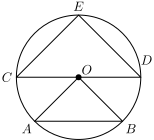
In the accompanying figure and are equal chords of a circle with center Arc is a quarter-circle. Then the ratio of the area of triangle to the area of triangle is:
Pista pequeña:
Las cuerdas iguales desde hacen que el triángulo sea simétrico respecto del diámetro perpendicular
The equal chords from make the pictured triangle symmetric about the perpendicular diameter
Pista grande:
Compara las áreas por base y altura en función del radio del círculo
Compare each triangle’s base-height area in terms of the circle radius
Solución:
Sea el radio. En la figura, es un diámetro y es el extremo del radio perpendicular, así que Como el arco es un cuarto de círculo, y La razón pedida es
Por lo tanto, la respuesta correcta es E.
Let the circle have radius In the pictured configuration, is a diameter and is the endpoint of the perpendicular radius, so Since arc is a quarter-circle, and The requested ratio is therefore
Thus, the correct answer is E.
22.
Una partícula se coloca en la parábola , en un punto cuya ordenada es Se deja rodar hasta el punto más cercano cuya ordenada es La distancia horizontal recorrida, es decir, el valor absoluto de la diferencia de las abscisas de y , es:
A particle is placed on the parabola at a point whose ordinate is It is allowed to roll along the parabola until it reaches the nearest point whose ordinate is The horizontal distance traveled by the particle (the numerical value of the difference in the abscissas of and ) is:
Pista pequeña:
Halla las dos coordenadas para la ordenada y las dos para la ordenada
Find the two -coordinates where the parabola has ordinate and the two where it has ordinate
Pista grande:
Empareja cada punto superior con el punto inferior más cercano de la misma rama
Pair each upper point with the nearer lower point on the same branch
Solución:
Para así que o Para así que o El punto inferior más cercano a es y el más cercano a es En ambos casos la distancia horizontal es
Por lo tanto, la respuesta correcta es C.
For so or For so or The nearest lower point to is and the nearest to is Either horizontal distance is
Therefore, the correct answer is C.
23.
Si en la expresión , aumenta o disminuye en una cantidad positiva el cambio de la expresión es:
If, in the expression increases or decreases by a positive amount the expression changes by an amount:
Pista pequeña:
Calcula y para
Compute and for
Pista grande:
El término constante se cancela en ambas diferencias
The constant term cancels in both differences
Solución:
Para un aumento, Para una disminución, En conjunto, los cambios son
Por lo tanto, la respuesta correcta es A.
For an increase, For a decrease, Together these changes are
Thus, the correct answer is A.
24.
Un hombre recorre pies hacia el norte a razón de minutos por milla. Regresa al punto de partida a millas por minuto. La rapidez media de todo el viaje, en millas por hora, es:
A man travels feet due north at minutes per mile. He returns due south to his starting point at miles per minute. The average rate in miles per hour for the entire trip is:
imposible de determinar sin conocer
impossible to determine without knowing the value of
Pista pequeña:
Convierte ambas velocidades a millas por hora
Convert both stated rates to miles per hour
Pista grande:
Para distancias iguales, divide el doble de la distancia de ida entre la suma de los tiempos
For equal distances, divide twice the one-way distance by the sum of the two travel times
Solución:
La rapidez hacia el norte es mph y hacia el sur es mph. Para distancias iguales, la media del viaje de ida y vuelta es La distancia se cancela.
Por lo tanto, la respuesta correcta es B.
The northbound rate is mph, and the southbound rate is mph. For equal distances, the round-trip average is The distance cancels.
Therefore, the correct answer is B.
25.
Si entonces es igual a:
If then equals:
Pista pequeña:
Usa la identidad
Use the chain identity
Pista grande:
Convierte la ecuación logarítmica resultante a forma exponencial
Convert the resulting logarithmic equation to exponential form
Solución:
Por la identidad de cambio de base, Así, por lo que
Por lo tanto, la respuesta correcta es E.
By the change-of-base identity, Hence so
Thus, the correct answer is E.
26.
Un conjunto de números tiene suma A cada número se le suma luego se multiplica por y después se resta La suma del nuevo conjunto es:
A set of numbers has the sum Each number of the set is increased by then multiplied by and then decreased by The sum of the numbers in the new set thus obtained is:
Pista pequeña:
Aplica las tres operaciones a un número original cualquiera
Apply all three operations to a typical original number
Pista grande:
Simplifica el número transformado y suma las entradas
After simplifying the transformed number, sum over all entries
Solución:
Un número original se convierte en Al sumar los números originales se obtiene
Por lo tanto, la respuesta correcta es B.
An original number becomes Summing over the original numbers therefore gives
Thus, the correct answer is B.
27.
Los puntos y están en una misma recta. El valor de es:
The points and are on the same straight line. The value(s) of is (are):
o
or
o
or
Pista pequeña:
Calcula la pendiente entre los dos primeros puntos
Compute the slope through the first two points
Pista grande:
Iguala esa pendiente con la pendiente de a
Equate that slope to the slope from to
Solución:
La pendiente entre los dos primeros puntos es Entonces lo que da y
Por lo tanto, la respuesta correcta es A.
The slope through the first two points is Thus which gives and
Therefore, the correct answer is A.
28.
Un radiador de cuartos está lleno de agua. Se extraen cuatro cuartos y se reemplazan con anticongelante puro. Luego se extraen cuatro cuartos de la mezcla y se reemplazan de nuevo. Esto se repite una tercera y una cuarta vez. La fracción final de agua es:
A -quart radiator is filled with water. Four quarts are removed and replaced with pure antifreeze liquid. Then four quarts of the mixture are removed and replaced with pure antifreeze. This is done a third and a fourth time. The fractional part of the final mixture that is water is:
Pista pequeña:
Cada extracción elimina la misma fracción del agua que queda
Each removal takes away the same fraction of whatever water remains
Pista grande:
Tras cada reemplazo queda del agua anterior
After one replacement, of the previous water remains
Solución:
Cada extracción quita una cuarta parte del contenido bien mezclado, por lo que deja tres cuartas partes del agua presente. Tras cuatro reemplazos, la fracción de agua es
Por lo tanto, la respuesta correcta es B.
Each removal takes one-fourth of the well-mixed radiator contents, so it leaves three-fourths of the water then present. After four replacements, the water fraction is
Therefore, the correct answer is B.
29.
En un triángulo general , como se muestra, se trazan y . ¿Cuál de las siguientes relaciones angulares es verdadera?
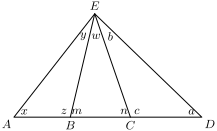
In a general triangle (as shown), lines and are drawn. Which of the following angle relations is true?
Pista pequeña:
Escribe la suma de ángulos del triángulo
Write the angle sum in triangle
Pista grande:
Escribe la suma de ángulos del triángulo y compara las ecuaciones
Write the angle sum in triangle , then compare the two equations
Solución:
El triángulo da El triángulo da Al igualar los lados izquierdos y cancelar , resulta
Por lo tanto, la respuesta correcta es E.
Triangle gives Triangle gives Equating the left sides and cancelling yields
Thus, the correct answer is E.
30.
Si y entonces es igual a:
If and then equals:
Pista pequeña:
Combina con denominador común
Combine using the common denominator
Pista grande:
Usa para hallar y luego suma
Use to find , then add
Solución:
Como de modo que Por lo tanto,
Por lo tanto, la respuesta correcta es C.
Since so Therefore
Therefore, the correct answer is C.
31.
La altura a la base de un triángulo isósceles mide y el perímetro es El área es:
The altitude drawn to the base of an isosceles triangle is and the perimeter is The area of the triangle is:
Pista pequeña:
Sea cada lado igual y la mitad de la base
Let each equal side be and half the base be
Pista grande:
Usa y
Use and
Solución:
Sea cada lado igual y la mitad de la base. El perímetro da La altura biseca la base, por lo que Así, y Entonces la base es y el área es
Por lo tanto, la respuesta correcta es B.
Let each equal side be and half the base be The perimeter gives The altitude bisects the base, so Thus giving Hence so the base is The area is
Therefore, the correct answer is B.
32.
Con , un ranchero va a comprar novillos a cada uno y vacas a cada una. Si el número de novillos y el número de vacas son ambos enteros positivos, entonces:
With a rancher is to buy steers at each and cows at each. If the number of steers and the number of cows are both positive integers, then:
este problema no tiene solución
this problem has no solution
hay dos soluciones con mayor que
there are two solutions with exceeding
hay dos soluciones con mayor que
there are two solutions with exceeding
hay una solución con mayor que
there is one solution with exceeding
hay una solución con mayor que
there is one solution with exceeding
Pista pequeña:
Escribe y reduce módulo
Write and reduce it modulo
Pista grande:
La congruencia y la positividad dejan un solo valor positivo posible de
The congruence and positivity leave only one possible positive value of
Solución:
La ecuación de compra es Al reducir módulo , Como es positivo y solo puede ser Entonces Hay una solución y
Por lo tanto, la respuesta correcta es E.
The purchase equation is Reducing modulo gives Since is positive and the only possibility is Then There is one solution, and
Thus, the correct answer is E.
33.
Para que una raíz de sea el doble de la otra, y deben satisfacer:
For one root of to be double the other, the coefficients must be related as follows:
Pista pequeña:
Representa las raíces como y
Represent the two roots as and
Pista grande:
Aplica las fórmulas de Vieta a su suma y producto y elimina
Apply Vieta’s formulas to their sum and product, then eliminate
Solución:
Sean las raíces y Las fórmulas de Vieta dan Al elevar al cuadrado la primera relación, Al dividirla entre la segunda, es decir,
Por lo tanto, la respuesta correcta es B.
Let the roots be and Vieta’s formulas give Squaring the first relation yields Dividing this by the second relation gives or
Therefore, the correct answer is B.
34.
El numerador de una fracción es el denominador es y puede tomar cualquier valor entre y ambos incluidos. Los valores de para los que el numerador supera al denominador son:
The numerator of a fraction is the denominator is and can have any value between and both included. The values of for which the numerator is greater than the denominator are:
Pista pequeña:
Compara numerador y denominador resolviendo
Compare the numerator and denominator directly by solving
Pista grande:
Interseca la desigualdad resultante con
Intersect the resulting inequality with the given interval
Solución:
La comparación da por lo que y Al intersecar con , se obtiene
Por lo tanto, la respuesta correcta es A.
The required comparison gives so and Intersecting this with gives
Thus, the correct answer is A.
35.
Se forma un triángulo uniendo tres puntos de coordenadas enteras. Si las unidades de y miden pulgada, su área en pulgadas cuadradas:
A triangle is formed by joining three points whose coordinates are integers. If the -unit and the -unit are each inch, then the area of the triangle, in square inches:
debe ser entera
must be an integer
puede ser irracional
may be irrational
debe ser irracional
must be irrational
debe ser racional
must be rational
será entera solo si el triángulo es equilátero
will be an integer only if the triangle is equilateral
Pista pequeña:
Traslada un vértice al origen y usa el determinante de coordenadas para el doble del área
Translate one vertex to the origin and use the coordinate determinant for twice the area
Pista grande:
El determinante de coordenadas enteras es entero
The determinant of integer coordinates is an integer
Solución:
Tras trasladar un vértice al origen, sean los otros dos y con coordenadas enteras. El área es Como es entero, el área es entera o semientera; en ambos casos es racional.
Por lo tanto, la respuesta correcta es D.
After translating one vertex to the origin, write the other two as and with all coordinates integers. The area is Since is an integer, the area is an integer or a half-integer, and in either case it is rational.
Therefore, the correct answer is D.
36.
Los lados de un triángulo miden y unidades. Una altura sobre el lado de longitud lo divide; el segmento mayor es:
The sides of a triangle are and units. If an altitude is dropped upon the side of length the larger segment cut off on this side is:
Pista pequeña:
Sea la división del lado de longitud en y
Let the altitude divide the side of length into and
Pista grande:
Iguala las dos expresiones para el cuadrado de la altura
Equate the two expressions for the square of the altitude
Solución:
Sea el segmento adyacente al lado de longitud Si la altura mide Al cancelar y resolver, El otro segmento es el mayor.
Por lo tanto, la respuesta correcta es D.
Let be the segment adjacent to the side of length If the altitude has length then Cancelling and solving gives The other segment is which is the larger one.
Thus, the correct answer is D.
37.
El primer término de una sucesión aritmética de enteros consecutivos es La suma de términos se expresa como:
The first term of an arithmetic series of consecutive integers is The sum of terms of this series may be expressed as:
Pista pequeña:
Halla el último término tras incrementos desde el primero
Find the last term after increases from the first term
Pista grande:
Usa el promedio del primer y último término
Use the arithmetic-series average of the first and last terms
Solución:
El último término es El promedio del primero y el último es Entonces la suma es
Por lo tanto, la respuesta correcta es A.
The last term is The average of the first and last terms is Therefore the sum is
Therefore, the correct answer is A.
38.
Sea la distancia del origen a un punto de coordenadas y Denotemos la razón por y la razón por Los valores de están:
Let be the distance from the origin to a point with coordinates and Designate the ratio by and the ratio by Then the values of are limited to the numbers:
por debajo de y por encima de sin
incluirlos
less than and greater than both excluded
por debajo de y por encima de incluyéndolos
less than and greater than both included
entre y sin incluirlos
between and both excluded
entre y incluyéndolos
between and both included
solo en y
and only
Pista pequeña:
Usa para relacionar
Use to relate
Pista grande:
Reescribe como
Rewrite as
Solución:
Como Así, Como la expresión recorre de a con ambos extremos incluidos.
Por lo tanto, la respuesta correcta es D.
Since Thus Because this expression ranges from through with both endpoints included.
Thus, the correct answer is D.
39.
Sobre las soluciones de , podemos decir que:
We may say concerning the solution of that:
hay una sola raíz
there is only one root
la suma de las raíces es
the sum of the roots is
la suma de las raíces es
the sum of the roots is
el producto de las raíces es
the product of the roots is
el producto de las raíces es
the product of the roots is
Pista pequeña:
Toma , de modo que
Set , so
Pista grande:
Factoriza la cuadrática en y vuelve a
Factor the resulting quadratic in , then translate the admissible value back to
Solución:
Sea Entonces La solución no negativa es así que y Su suma es
Por lo tanto, la respuesta correcta es C.
Let Then The nonnegative solution is so and Their sum is
Therefore, the correct answer is C.
40.
Dados y para es:
Given and the general relation for Then equals:
Pista pequeña:
Usa primero para hallar
Use the recurrence first with to find
Pista grande:
Luego usa para hallar
Then use it with to solve for
Solución:
Para así que Para de donde
Por lo tanto, la respuesta correcta es B.
For so For which gives
Thus, the correct answer is B.
41.
Las raíces de son y Para que las raíces de
sean y debe ser:
The roots of are and For the roots of
to be and must equal:
Pista pequeña:
En la nueva cuadrática mónica, es el opuesto de
For the new monic quadratic, is the negative of the sum
Pista grande:
Escribe y usa Vieta en la cuadrática original
Write and use Vieta’s formulas for the original quadratic
Solución:
Para la cuadrática original, Entonces El coeficiente es el opuesto de esta suma, así que
Por lo tanto, la respuesta correcta es C.
For the original quadratic, Hence The coefficient is the negative of this sum, so
Therefore, the correct answer is C.
42.
En un círculo de centro las cuerdas y son iguales. La cuerda corta en Si y entonces es:
In a circle with center chord equals chord Chord cuts in If and then equals:
Pista pequeña:
Compara los triángulos y
Compare triangles and
Pista grande:
Los ángulos y subtienden las cuerdas iguales y
Angles and subtend the equal chords and
Solución:
Como está en y los triángulos y comparten el ángulo Además, subtiende mientras subtiende Como estos ángulos son iguales. Por tanto, Los lados correspondientes dan Así, y
Por lo tanto, la respuesta correcta es E.
Because lies on and triangles and share angle Also subtends chord while subtends chord Since these angles are equal. Thus Corresponding sides give Therefore so
Thus, the correct answer is E.
43.
es la hipotenusa del triángulo rectángulo Las medianas son y La longitud de es:
is the hypotenuse of a right triangle Median and median The length of is:
Pista pequeña:
Sean y los cuadrados de los catetos opuestos a y
Let the legs opposite and have squared lengths and
Pista grande:
Usa las dos fórmulas de medianas y la relación pitagórica
Use the two median formulas together with the Pythagorean relation for the hypotenuse
Solución:
Sean y Como el ángulo recto está en Las fórmulas de medianas dan Al resolver, y Por tanto,
Por lo tanto, la respuesta correcta es D.
Let and Since the right angle is at The median formulas give Solving yields and Therefore
Thus, the correct answer is D.
44.
Dadas las afirmaciones verdaderas:
Si es mayor que entonces es mayor que
Si es menor que entonces es mayor que
Una conclusión válida es:
Given the true statements:
If is greater than then is greater than
If is less than then is greater than
A valid conclusion is:
Si es menor que entonces es mayor que
If is less than then is greater than
Si es mayor que entonces es menor que
If is greater than then is less than
Si es menor que entonces es mayor que
If is less than then is greater than
Si es mayor que entonces es menor que
If is greater than then is less than
ninguna de estas
none of these
Pista pequeña:
Representa las comparaciones como proposiciones y distingue cada implicación de su recíproca
Represent the comparisons as propositions and distinguish each implication from its converse
Pista grande:
La hipótesis de la segunda premisa es incompatible con la conclusión de la primera, pero eso no permite encadenar las implicaciones
The second premise’s hypothesis is incompatible with the first premise’s conclusion, but that alone does not chain the implications
Solución:
Sean la afirmación la afirmación la afirmación y la afirmación Las premisas son Las afirmaciones y son incompatibles. Las contrapositivas son y Ninguna de las cuatro implicaciones propuestas se deduce. Por ejemplo, da y, por tanto, pero no determina mientras que solo da no
Por lo tanto, la respuesta correcta es E.
Let mean mean mean and mean The premises are The statements and cannot both hold. The contrapositives are and None of the four proposed implications follows. For example, knowing gives and hence but says nothing about knowing gives not
Therefore, the correct answer is E.
45.
Un cheque se escribe por dólares y centavos, con y ambos de dos cifras. Por error se cobra por dólares y centavos, excediendo la cantidad correcta en Entonces:
A check is written for dollars and cents, and both two-digit numbers. In error it is cashed for dollars and cents, the incorrect amount exceeding the correct amount by Then:
no puede exceder
cannot exceed
puede ser igual a
can equal
la cantidad del cheque no puede ser múltiplo de
the amount of the check cannot be a multiple of
la cantidad incorrecta puede ser el doble de la correcta
the incorrect amount can equal twice the correct amount
la suma de los dígitos de la cantidad correcta es divisible por
the sum of the digits of the correct amount is divisible by
Pista pequeña:
Escribe las cantidades correcta e incorrecta en centavos
Write the correct and incorrect amounts in cents
Pista grande:
Su diferencia se simplifica a
Their difference simplifies to
Solución:
En centavos, la cantidad incorrecta menos la correcta es Como son centavos, así que Los valores de dos cifras satisfacen la relación y Por tanto, esa igualdad puede ocurrir.
Por lo tanto, la respuesta correcta es B.
In cents, the incorrect amount minus the correct amount is Since is cents, so The two-digit values satisfy this relation and have Thus that equality can occur.
Therefore, the correct answer is B.
46.
Para valores de menores que pero mayores que la expresión
tiene:
For values of less than but greater than the expression
has:
ningún máximo ni mínimo
no maximum or minimum value
mínimo
a minimum value of
máximo
a maximum value of
mínimo
a minimum value of
máximo
a maximum value of
Pista pequeña:
Toma que es negativo en el intervalo dado
Set which is negative on the given interval
Pista grande:
Reescribe como y usa la desigualdad para negativo
Rewrite the expression as and use the negative- form of AM-GM
Solución:
Sea Entonces y la expresión se vuelve Para con igualdad en Este valor corresponde a Así, la expresión es como máximo y su máximo es
Por lo tanto, la respuesta correcta es E.
Set Then and the expression becomes For with equality when That value is allowed and corresponds to Hence the expression is at most and its maximum is
Thus, the correct answer is E.
47.
es un rectángulo y es cualquier punto de Se tiene y Entonces es igual a:
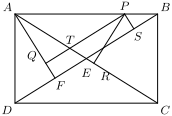
is a rectangle (see the accompanying diagram) with any point on and and Then is equal to:
Pista pequeña:
Como y identifica el pequeño paralelogramo junto a y
Because and identify the small parallelogram near and
Pista grande:
Usa para comparar los triángulos rectángulos y
Use the intersection to compare the right triangles and
Solución:
Como y Además, de modo que Así, es un rectángulo y Sea Las diagonales de un rectángulo forman ángulos iguales con por lo que y Los triángulos rectángulos y son semejantes por el ángulo en Como sus hipotenusas y son iguales, Por tanto,
Por lo tanto, la respuesta correcta es D.
Since and we have Also so Thus quadrilateral is a rectangle, and Let The diagonals of a rectangle make equal angles with side so giving The right triangles and are similar because they share the angle at Since their hypotenuses and are equal, Therefore
Thus, the correct answer is D.
48.
El diámetro de un círculo de centro mide unidades. está en a unidades de y está en a unidades de es cualquier punto del círculo. El camino quebrado de a y a
Diameter of a circle with center is units. is a point units from and on is a point units from and on is any point on the circle. Then the broken-line path from to to
tiene la misma longitud para toda posición de
has the same length for all positions of
supera unidades para toda posición de
exceeds units for all positions of
no puede superar unidades
cannot exceed units
es mínimo cuando es un triángulo rectángulo
is shortest when is a right triangle
es máximo cuando equidista de y
is longest when is equidistant from
and
Pista pequeña:
Coloca el centro en el origen y el diámetro en el eje , con y
Place the center at the origin and the diameter on the -axis, so and
Pista grande:
Para en el círculo, compara y
For on the circle, compare and
Solución:
Sean y , con Entonces Por lo tanto, Esto es máximo cuando exactamente cuando
Por lo tanto, la respuesta correcta es E.
Place and with Then Therefore This is largest when exactly when
Therefore, the correct answer is E.
49.
En la expansión de hay términos distintos. El número de términos distintos de es:
In the expansion of there are dissimilar terms. The number of dissimilar terms in the expansion of is:
Pista pequeña:
Cada término queda determinado por exponentes no negativos que suman
A term is determined by nonnegative exponents whose sum is
Pista grande:
Cuenta las soluciones de con estrellas y barras
Count the solutions of by stars and bars
Solución:
Cada término distinto es , con enteros no negativos que satisfacen Por estrellas y barras, el número de ternas es
Por lo tanto, la respuesta correcta es D.
Each distinct term is for nonnegative integers satisfying By stars and bars, the number of such triples is
Thus, the correct answer is D.
50.
El diagrama muestra un método para asociar recíprocamente los puntos de y Sea la distancia de un punto de a , y sea la distancia del punto asociado de a Si entonces es:
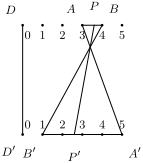
In this diagram a scheme is indicated for associating all the points of segment with those of segment and reciprocally. To describe this association scheme analytically, let be the distance from a point on to and let be the distance from the associated point of to Then for any pair of associated points, if equals:
Pista pequeña:
Las rectas del diagrama asocian con y con
The perspective lines in the diagram associate with and with
Pista grande:
Como los dos segmentos numerados son paralelos, la relación entre y es lineal
Because the two numbered segments are parallel, the induced relation between and is linear
Solución:
Los dos segmentos numerados son paralelos, así que la proyección da una relación lineal entre y Las asociaciones son y La pendiente es de modo que Si entonces
Por lo tanto, la respuesta correcta es C.
The two numbered segments are parallel, so projection through the fixed intersection point gives a linear relation between and The endpoint associations shown are and The slope is so If then
Therefore, the correct answer is C.