
Soluciones del 1983 AIME
Desplázate hacia abajo para ver las soluciones preparadas profesionalmente de LIVE by Po-Shen Loh, imprime las soluciones en PDF, consulta la clave de respuestas, o haz el examen cronometrado completo.
Todos los problemas se usan con el permiso legal oficial de la Mathematical Association of America (MAA).
1.
Sean y mayores que , y sea un número positivo tal que Halla
Let and all exceed and let be a positive number such that Find
Pista pequeña:
Reescribe cada logaritmo dado con base
Rewrite each given logarithm with base
Pista grande:
Expande como una suma de tres logaritmos
Expand as a sum of three logarithms
Solución:
Al tomar los recíprocos de los logaritmos dados se obtiene Por lo tanto, Al tomar el recíproco se obtiene
Taking reciprocals of the given logarithms gives Therefore Taking the reciprocal yields
2.
Sea donde Determina el valor mínimo que toma para en el intervalo
Let where Determine the minimum value taken by for in the interval
Pista pequeña:
Determina el signo de cada expresión dentro de un valor absoluto en el intervalo dado
Determine the sign of each expression inside an absolute value on the given interval
Pista grande:
En simplifica a una función lineal decreciente
On simplify to a decreasing linear function
Solución:
Como tenemos Por consiguiente, Esto se minimiza en el extremo derecho donde su valor es
Since we have Hence This is minimized at the right endpoint where its value is
3.
¿Cuál es el producto de las raíces reales de la ecuación
What is the product of the real roots of the equation
Pista pequeña:
La expresión fuera del radical es menor que el radicando
The expression outside the radical is less than the radicand
Pista grande:
Sea y resuelve
Set and solve
Solución:
Sea de modo que La ecuación se convierte en o Por tanto, y así que las raíces reales satisfacen Por las fórmulas de Vieta, su producto es
Set so The equation becomes or Thus and so the real roots satisfy By Vieta’s formulas, their product is
4.
Una herramienta de corte de un taller mecánico tiene la forma de un círculo con una muesca, como se muestra. El radio del círculo es cm, la longitud de es cm y la de es cm. El ángulo es recto. Halla el cuadrado de la distancia (en centímetros) de al centro del círculo.
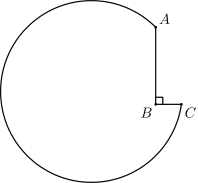
A machine-shop cutting tool has the shape of a notched circle, as shown. The radius of the circle is cm, the length of is cm, and that of is cm. The angle is a right angle. Find the square of the distance (in centimeters) from to the center of the circle.
Pista pequeña:
Coloca y
Put and
Pista grande:
El centro está en la mediatriz de , a una distancia de su punto medio
The center lies on the perpendicular bisector of at distance from its midpoint
Solución:
Coloca y El punto medio de es y Si es el centro, entonces Un vector perpendicular a es que ya tiene longitud Por tanto, los dos centros posibles son En el círculo con muesca de la figura, el centro está en el lado opuesto a la muesca, así que Por consiguiente,
Put and The midpoint of is and If is the center, then A vector perpendicular to is which already has length Thus the two possible centers are The pictured notched circle has its center on the side opposite the notch, so Therefore
5.
Supón que la suma de los cuadrados de dos números complejos y es , y la suma de sus cubos es ¿Cuál es el mayor valor real que puede tomar ?
Suppose that the sum of the squares of two complex numbers and is and the sum of the cubes is What is the largest real value that can have?
Pista pequeña:
Sea y
Let and
Pista grande:
Usa para eliminar de
Use to eliminate from
Solución:
Sean y De obtenemos Además, Por lo tanto, Cada raíz produce un posible par de raíces complejas de así que el mayor valor real posible de es
Let and From we get Also, Hence Each root gives a possible pair of complex roots of so the largest real possible value of is
6.
Sea Determina el residuo al dividir entre
Let Determine the remainder on dividing by
Pista pequeña:
Escribe y
Write and
Pista grande:
Módulo solo sobreviven los términos constante y lineal de cada expansión binomial
Modulo only the constant and linear terms of each binomial expansion survive
Solución:
Módulo se anula todo término binomial que contenga . Como es impar, y Su suma es congruente con
Modulo every binomial term containing vanishes. Since is odd, and Their sum is congruent to
7.
Veinticinco de los caballeros del rey Arturo están sentados en torno a su habitual mesa redonda. Se eligen tres de ellos, con todas las ternas igualmente probables, y se los envía a matar a un dragón que causaba problemas. Sea la probabilidad de que al menos dos de los tres ocuparan asientos contiguos. Si se escribe como una fracción irreducible, ¿cuál es la suma del numerador y el denominador?
Twenty-five of King Arthur’s knights are seated at their customary round table. Three of them are chosen, with all choices of three equally likely, and are sent off to slay a troublesome dragon. Let be the probability that at least two of the three had been sitting next to each other. If is written as a fraction in lowest terms, what is the sum of the numerator and denominator?
Pista pequeña:
Cuenta las selecciones complementarias en las que no hay dos caballeros elegidos adyacentes
Count the complementary selections in which no two chosen knights are adjacent
Pista grande:
Separa las selecciones que contienen a un caballero fijo de las que no lo contienen
Split into selections containing a fixed knight and selections not containing that knight
Solución:
Hay selecciones. Fija un asiento. Si no se elige, seleccionar tres asientos no adyacentes entre los restantes equivale a elegir tres posiciones no consecutivas de una fila de lo que da Si se elige el asiento fijo, sus dos vecinos quedan prohibidos y los otros dos asientos elegidos deben ser no consecutivos entre la fila restante de lo que da
Por tanto, el número de selecciones sin asientos elegidos adyacentes es Así, y la suma pedida es
There are selections. Fix one seat. If it is not selected, choosing three nonadjacent seats among the remaining seats is equivalent to choosing three nonconsecutive positions from a row of giving If the fixed seat is selected, its two neighbors are forbidden, and the other two selected seats must be nonconsecutive among the remaining row of giving
Thus the number with no adjacent selected seats is Therefore and the requested sum is
8.
¿Cuál es el mayor factor primo de cifras del entero ?
What is the largest -digit prime factor of the integer
Pista pequeña:
Para un primo compara el exponente de en con el doble de su exponente en
For a prime compare the exponent of in with twice its exponent in
Pista grande:
Los primos de a se cancelan; los primos de a no
Primes from through cancel; primes from through do not
Solución:
Para un primo tenemos de modo que Si esto es Si es Por tanto, ningún primo mayor que divide al coeficiente binomial, mientras que todo primo entre y sí lo divide. El mayor de ellos es
For a prime we have so If this is If it is Hence no prime greater than divides the binomial coefficient, while every prime between and does. The largest such prime is
9.
Halla el valor mínimo de para
Find the minimum value of for
Pista pequeña:
Sea que es positivo en el intervalo dado
Set which is positive on the given interval
Pista grande:
Aplica AM-GM a y comprueba que se puede alcanzar la igualdad
Apply AM-GM to and verify that equality is attainable
Solución:
Sea La expresión se convierte en con igualdad cuando o La función continua tiende a cuando tiende a , y vale en Por tanto, toma el valor en algún punto de de modo que se alcanza la cota inferior .
Let The expression becomes with equality when or The continuous function tends to as tends to and equals at Thus it takes the value somewhere in so the lower bound is attained.
10.
Los números y tienen algo en común: cada uno es un número de cuatro cifras que comienza con y tiene exactamente dos cifras idénticas. ¿Cuántos números de este tipo hay?
The numbers and have something in common: each is a four-digit number beginning with that has exactly two identical digits. How many such numbers are there?
Pista pequeña:
Separa el caso en que la cifra repetida es del caso en que no lo es
Separate the case where the repeated digit is from the case where it is not
Pista grande:
En cada caso, elige las posiciones de la cifra repetida antes de elegir la cifra distinta restante
In each case, choose the repeated digit’s positions before choosing the remaining distinct digit
Solución:
Si es la cifra repetida, exactamente una de las últimas tres posiciones contiene un Hay opciones para esa posición, opciones para la siguiente cifra y para la última, pues esas dos cifras deben diferir entre sí y de Esto da números.
Si se repite una cifra distinta de , hay opciones para esa cifra, maneras de elegir sus dos posiciones entre las últimas tres y opciones para la cifra restante. Esto da otros números. El total es
If is the repeated digit, exactly one of the last three positions contains There are choices for that position, choices for the next digit, and for the last digit, since those two digits must differ from each other and from This gives numbers.
If a digit other than is repeated, there are choices for that digit, ways to choose its two positions among the last three, and choices for the remaining digit. This gives another numbers. The total is
11.
El sólido mostrado tiene una base cuadrada de lado La arista superior es paralela a la base y tiene longitud Todas las demás aristas tienen longitud Dado que ¿cuál es el volumen del sólido?
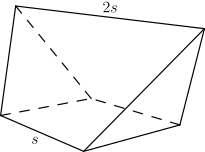
The solid shown has a square base of side length The upper edge is parallel to the base and has length All other edges have length Given that what is the volume of the solid?
Pista pequeña:
Halla la altura proyectando cualquiera de los extremos de la arista superior sobre la base
Find the height by projecting either endpoint of the upper edge onto the base
Pista grande:
A una fracción de la altura, la sección transversal es un rectángulo de lados y
At a fraction of the height, the cross-section is a rectangle with sides and
Solución:
Cada extremo de la arista superior está unido a los extremos de un lado de la base cuadrada. Por tanto, su distancia al punto medio de ese lado es La proyección de cada extremo superior queda más allá de ese punto medio, porque los dos extremos proyectados están separados por , mientras que los puntos medios de los dos lados opuestos están separados por . Así, la altura satisface de modo que
A una fracción de la altura sobre la base, la sección transversal es un rectángulo cuyas dimensiones son y Su área es Por el principio de Cavalieri, el volumen es el volumen de un prisma menos el volumen de una pirámide: Al sustituir , se obtiene
Each endpoint of the upper edge is joined to the endpoints of one side of the square base. Its distance to that side’s midpoint is therefore The projection of each upper endpoint lies beyond that midpoint, because the two projected endpoints are apart while the two opposite-side midpoints are apart. Thus the height satisfies so
At a fraction of the height above the base, the cross-section is a rectangle whose dimensions are and Its area is By Cavalieri’s principle, the volume is the volume of a prism minus the volume of a pyramid: Substituting gives
12.
El diámetro de un círculo tiene como longitud un entero de cifras (en base diez). Al invertir las cifras se obtiene la longitud de la cuerda perpendicular La distancia desde su punto de intersección hasta el centro es un número racional positivo. Determina la longitud de
Diameter of a circle has length a -digit integer (base ten). Reversing the digits gives the length of the perpendicular chord The distance from their intersection point to the center is a positive rational number. Determine the length of
Pista pequeña:
Escribe el diámetro como y la cuerda como
Write the diameter as and the chord as
Pista grande:
El cuadrado de la distancia del centro a la cuerda es la cuarta parte de la diferencia de sus cuadrados
The squared distance from the center to the chord is one fourth the difference of their squares
Solución:
Sean la longitud del diámetro y la de la cuerda. Como una perpendicular desde el centro biseca una cuerda, Para que sea racional, debe ser un cuadrado. Por tanto, es igual a de modo que Como y son cifras con el lado izquierdo es a lo sumo así que o Si los factores son y lo que da y Si los pares de factores de tienen distinta paridad o dan Por consiguiente, el diámetro es
Let the diameter be and the chord be Since a perpendicular from the center bisects a chord, For to be rational, must be a square. Thus it equals so Because and are digits with the left side is at most so or If the factors are and giving and If the factor pairs of either have different parity or give Hence the diameter is
13.
Para cada subconjunto no vacío de , se define una suma alternada única de la siguiente manera: ordena los números del subconjunto en orden decreciente y luego, empezando por el mayor, suma y resta alternativamente los números sucesivos. (Por ejemplo, la suma alternada de es , y para es simplemente ) Halla la suma de todas estas sumas alternadas para
For and each of its nonempty subsets a unique alternating sum is defined as follows: Arrange the numbers in the subset in decreasing order and then, beginning with the largest, alternately add and subtract successive numbers. (For example, the alternating sum for is and for it is simply ) Find the sum of all such alternating sums for
Pista pequeña:
Suma por separado la contribución de cada número sobre todos los subconjuntos
Add the contribution of each number separately over all subsets
Pista grande:
El signo de depende solo de si el subconjunto contiene un número par o impar de elementos mayores que
The sign of depends only on whether the subset contains an even or odd number of elements greater than
Solución:
Fija Una vez incluido los elementos menores se pueden elegir arbitrariamente, lo que aporta un factor de Si se eligen exactamente de los elementos mayores, el signo de es Por tanto, el coeficiente de en el total es Esto es para y para Por consiguiente, el total es
Fix Once is included, the smaller elements may be chosen arbitrarily, contributing a factor of If exactly of the larger elements are chosen, the sign of is Therefore the coefficient of in the total is This is for and for Hence the total is
14.
En la figura adjunta se trazan dos círculos de radios y , cuyos centros están separados por unidades. En uno de los puntos de intersección, se traza una recta de modo que las cuerdas y tengan la misma longitud. Halla el cuadrado de la longitud de
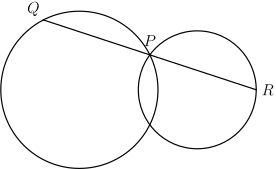
In the adjoining figure, two circles of radii and are drawn with their centers units apart. At one of the points of intersection, a line is drawn in such a way that the chords and have equal length. Find the square of the length of
Pista pequeña:
Coloca los centros en y y halla las coordenadas de
Put the centers at and and find the coordinates of
Pista grande:
Si y resta, en cada círculo, las ecuaciones de igual radio para el extremo correspondiente y el punto de intersección
If and subtract the two equal-radius equations
Solución:
Coloca el centro del círculo de radio en y el otro centro en Al restar las dos ecuaciones de los círculos se obtiene donde la coordenada positiva selecciona la intersección mostrada.
Sea la longitud común de las cuerdas y sea el vector unitario de hacia Entonces y Al comparar con en el primer círculo y con en el segundo, se obtiene Al sumar se ve que de modo que Al restar las dos ecuaciones de productos escalares se obtiene Por lo tanto,
Put the center of the radius- circle at and the other center at Subtracting the two circle equations gives where the positive -coordinate selects the pictured intersection.
Let the common chord length be and let be the unit vector from toward Then and Comparing with in the first circle and with in the second gives Adding shows that so Subtracting the two dot-product equations gives Therefore
15.
La figura adjunta muestra dos cuerdas que se cortan en un círculo, con en el arco menor Supón que el radio del círculo es que y que es bisecada por Supón además que es la única cuerda con extremo en que es bisecada por Se deduce que el seno del ángulo central subtendido por el arco menor es un número racional. Si este número se expresa como una fracción irreducible , ¿cuál es el producto ?
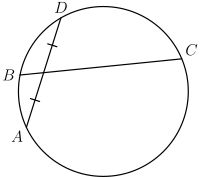
The adjoining figure shows two intersecting chords in a circle, with on minor arc Suppose that the radius of the circle is that and that is bisected by Suppose further that is the only chord starting at which is bisected by It follows that the sine of the minor arc is a rational number. If this fraction is expressed as a fraction in lowest terms, what is the product
Pista pequeña:
Los puntos medios de todas las cuerdas con extremo en están en el círculo cuyo diámetro une con el centro
The midpoints of all chords from lie on the circle with diameter joining to the center
Pista grande:
La unicidad hace que sea tangente a ese círculo de puntos medios en el punto medio de
Uniqueness makes tangent to that midpoint circle at the midpoint of
Solución:
Sea el punto medio de Coloca y sea el centro del círculo. Entonces Los puntos medios de todas las cuerdas con extremo en forman el círculo con centro y radio Como es la única cuerda de este tipo bisecada por la recta esa recta es tangente al círculo de puntos medios en
Por tanto, para se puede tomar como vector unitario de dirección, perpendicular a Escribe y donde Entonces y el teorema de las cuerdas que se cortan da Al sustituir la recta en el círculo original también se obtiene Por lo tanto, de modo que Sus raíces son y pero Así, y
Elige y para el extremo del arco menor Entonces El seno del ángulo central subtendido por el arco menor es el valor absoluto del determinante de estos vectores radiales dividido entre es decir, Por consiguiente,
Let be the midpoint of Put and let the circle’s center be Then The midpoints of all chords starting at form the circle with center and radius Because is the only such chord bisected by the line that line is tangent to the midpoint circle at
Hence a unit direction vector for may be taken as perpendicular to Write and where Then and intersecting chords give Substituting the line into the original circle also gives Therefore so Its roots are and but Thus and
Choose and for the endpoint on minor arc Then The sine of the central angle subtending minor arc is the absolute determinant of these radius vectors divided by namely Hence