
Soluciones del 2023 AMC 10A
Desplázate hacia abajo para ver las soluciones preparadas profesionalmente de LIVE by Po-Shen Loh, imprime las soluciones en PDF, consulta la clave de respuestas, o haz el examen cronometrado completo.
Todos los problemas se usan con el permiso legal oficial de la Mathematical Association of America (MAA).
1.
Las ciudades y están a millas de distancia. Alicia vive en y Beth vive en Alicia pedalea hacia a millas por hora. Beth sale al mismo tiempo y pedalea hacia a millas por hora. ¿A cuántas millas de la ciudad estarán cuando se encuentren?
Cities and are miles apart. Alicia lives in and Beth lives in Alicia bikes towards at miles per hour. Leaving at the same time, Beth bikes toward at miles per hour. How many miles from City will they be when they meet?
Pista pequeña:
Van una hacia la otra, así que sus velocidades se suman; halla el tiempo hasta que se encuentran
They ride toward each other, so their speeds add; find the time until they meet
Pista grande:
El tiempo de encuentro es horas; multiplica la velocidad de Alice por ese tiempo.
The meeting time is hours; multiply Alice’s speed by that time
Solución:
Van una hacia la otra, así que sus velocidades se suman. Eso reduce la separación de millas a mph, y se encuentran tras horas. Alice parte de así que para entonces ha recorrido millas. Por lo tanto, la respuesta correcta es E.
They ride toward each other, so their speeds add. That closes the -mile gap at mph, and they meet after hours. Alice starts at so by then she’s gone miles. Thus, E is the correct answer.
2.
El peso de de una pizza grande junto con tazas de rodajas de naranja es igual al peso de de una pizza grande junto con taza de rodajas de naranja. Una taza de rodajas de naranja pesa de libra. ¿Cuál es el peso, en libras, de una pizza grande?
The weight of of a large pizza together with cups of orange slices is the same as the weight of of a large pizza together with cup of orange slices. A cup of orange slices weighs of a pound. What is the weight, in pounds, of a large pizza?
Pista pequeña:
Sea el peso de la pizza y convierte las tazas de rodajas de naranja a libras usando de libra por taza
Let be the pizza’s weight and convert cups of orange slices to pounds using pound per cup
Pista grande:
Plantea y despeja .
Set and solve for
Solución:
Sea el peso de la pizza. Una taza de rodajas de naranja pesa de libra, así que los dos lados se equilibran como es decir Agrupa los términos de la pizza: Entonces Por lo tanto, la respuesta es A.
Let be the pizza’s weight. A cup of orange slices is pound, so the two sides balance as that is Collect the pizza terms: So Therefore, the answer is A.
3.
¿Cuántos cuadrados perfectos positivos menores que son divisibles entre ?
How many positive perfect squares less than are divisible by
Pista pequeña:
Un cuadrado perfecto divisible entre debe ser divisible entre
A perfect square divisible by must be divisible by
Pista grande:
Escribe el cuadrado como y cuenta los válidos.
Write the square as and count the valid
Solución:
Si un cuadrado perfecto es divisible entre es divisible entre así que tiene la forma Necesitamos es decir Eso permite lo que da cuadrados. Por lo tanto, la respuesta correcta es A.
If a perfect square is divisible by it’s divisible by so it looks like We need i.e. That allows which is squares. Thus, A is the correct answer.
4.
Un cuadrilátero tiene todos los lados de longitud entera, un perímetro de y un lado de longitud ¿Cuál es la mayor longitud posible de un lado de este cuadrilátero?
A quadrilateral has all integer side lengths, a perimeter of and one side of length What is the greatest possible length of one side of this quadrilateral?
Pista pequeña:
En cualquier cuadrilátero, cada lado es menor que la suma de los otros tres
In any quadrilateral, each side is less than the sum of the other three
Pista grande:
Si el lado más largo es los otros tres suman así que .
If the longest side is the other three sum to so
Solución:
En cualquier cuadrilátero cada lado es más corto que la suma de los otros tres. Sea el lado más largo Los demás suman así que lo que da y por tanto ¿Podemos alcanzar ? Los lados funcionan, ya que Así que la mayor longitud es Por lo tanto, la respuesta es D.
In any quadrilateral each side is shorter than the sum of the other three. Call the longest side The rest sum to so which gives and hence Can we hit The sides work, since So the greatest length is Therefore, the answer is D.
5.
¿Cuántos dígitos tiene la representación en base diez de ?
How many digits are in the base-ten representation of
Pista pequeña:
Factoriza cada base en primos: y .
Factor each base into primes: and
Pista grande:
Combínalos en que es seguido de ceros.
Combine into which is followed by zeros
Solución:
Factoriza todo en primos: Eso es seguido de ceros, así que tiene dígitos. Por lo tanto, la respuesta correcta es E.
Factor everything into primes. That’s followed by zeros, so it has digits. Thus, E is the correct answer.
6.
A cada vértice de un cubo se le asigna un entero. El valor de una arista se define como la suma de los valores de los dos vértices que toca, y el valor de una cara se define como la suma de los valores de las cuatro aristas que la rodean. El valor del cubo se define como la suma de los valores de sus seis caras. Supón que la suma de los enteros asignados a los vértices es ¿Cuál es el valor del cubo?
An integer is assigned to each vertex of a cube. The value of an edge is defined to be the sum of the values of the two vertices it touches, and the value of a face is defined to be the sum of the values of the four edges surrounding it. The value of the cube is defined as the sum of the values of its six faces. Suppose the sum of the integers assigned to the vertices is What is the value of the cube?
Pista pequeña:
Cada arista pertenece a caras, así que el valor total de las caras es veces el valor total de las aristas
Each edge belongs to faces, so the total face value is times the total edge value
Pista grande:
Cada vértice pertenece a aristas, así que el valor total de las aristas es veces el total de los vértices
Each vertex belongs to edges, so the total edge value is times the vertex total
Solución:
Cuenta por incidencias. Cada arista está en caras, así que los seis valores de las caras juntos son veces el total de todos los valores de las aristas. Cada vértice está en aristas, así que el valor total de las aristas es veces la suma de los vértices. Encadenando esto, el valor del cubo es Por lo tanto, la respuesta es D.
Count by incidences. Each edge lies on faces, so the six face values together are times the total of all edge values. Each vertex lies on edges, so the total edge value is times the vertex sum. Chaining these, the cube’s value is Therefore, the answer is D.
7.
Janet lanza un dado estándar de caras veces y mantiene un total acumulado de los números que saca. ¿Cuál es la probabilidad de que en algún momento su total acumulado sea igual a ?
Janet rolls a standard -sided die times and keeps a running total of the numbers she rolls. What is the probability that at some point her running total will equal
Pista pequeña:
El total acumulado llega a solo en los primeros lanzamientos; enumera las formas disjuntas de alcanzar exactamente
The running total reaches only through the first few rolls; list the disjoint ways to hit exactly
Pista grande:
Los casos son: primer lanzamiento lanzamientos lanzamientos lanzamientos suma sus probabilidades
The cases are first roll rolls rolls rolls add their probabilities
Solución:
El total solo puede llegar exactamente a mediante los primeros lanzamientos, y estas formas son disjuntas: solo (probabilidad ), luego y (cada una ), y (probabilidad ). Súmalas: Por lo tanto, la respuesta correcta es B.
The total can only reach exactly through the opening rolls, and these ways are disjoint: alone (probability ), then and (each ), and (probability ). Add them up: Thus, B is the correct answer.
8.
Barb la panadera crea un nuevo sistema de temperatura para hornear pan, el Breadus, que es lineal respecto a la escala Fahrenheit. El pan leva a lo que equivale a en la escala Breadus. El pan se hornea a lo que equivale a en la escala Breadus. El pan está listo cuando su temperatura interna es de ¿Cuánto es esta temperatura en la escala Breadus?
Barb the baker creates a new temperature system for baking bread, Breadus, which is linearly based on Fahrenheit. Bread rises at which is on the Breadus scale. Bread bakes at which is on the Breadus scale. Bread is done when its internal temperature is What is this temperature on the Breadus scale?
Pista pequeña:
La lectura Breadus es lineal en Fahrenheit y pasa por y .
The Breadus reading is linear in Fahrenheit through and
Pista grande:
La pendiente es aplícala a los grados por encima del punto .
The slope is apply it to the degrees above the point
Solución:
La lectura Breadus es lineal en Fahrenheit y pasa por y así que Sustituye Por lo tanto, la respuesta es D.
The Breadus reading is linear in Fahrenheit through and so Plug in Therefore, the answer is D.
9.
Una pantalla digital muestra la fecha actual como un entero de dígitos, formado por un año de dígitos, seguido de un mes de dígitos y luego un día de dígitos dentro del mes. Por ejemplo, el Día del Árbol de este año se muestra como ¿En cuántas fechas de aparecerá cada dígito un número par de veces en la pantalla de dígitos?
A digital display shows the current date as an -digit integer consisting of a -digit year, followed by a -digit month, followed by a -digit date within the month. For example, Arbor Day this year is displayed as For how many dates in will each digit appear an even number of times in the -digit display for that date?
Pista pequeña:
El año aporta dos (par), un y un .
The year contributes two s (even), one and one
Pista grande:
Los cuatro dígitos del mes y el día deben aportar un más y otro con los dos dígitos restantes iguales entre sí
The four month-and-day digits must supply one more and one more with the remaining two digits equal to each other
Solución:
El año ya da dos (par), un , y un . Así que, para que cada dígito aparezca un número par de veces, los cuatro dígitos de y deben aportar un más, un más, y dos dígitos iguales, manteniendo par la cantidad de . Al revisar las fechas válidas se obtiene , , , , , , , , y , exactamente fechas. Por lo tanto, la respuesta correcta es E.
The year already gives two s (even), one , and one . So to make every digit occur an even number of times, the four digits of and must supply one more , one more , and two equal digits, while keeping the number of s even. Checking the legal dates gives and exactly dates. Thus, E is the correct answer.
10.
Maureen lleva la cuenta del promedio de las calificaciones de sus pruebas de este semestre. Si Maureen saca un en su próxima prueba, su promedio subirá en Si saca un en cada una de las tres pruebas siguientes, su promedio aumentará en ¿Cuál es su promedio actual de las pruebas?
Maureen is keeping track of the mean of her quiz scores this semester. If Maureen scores an on the next quiz, her mean will increase by If she scores an on each of the next three quizzes, her mean will increase by What is the mean of her quiz scores currently?
Pista pequeña:
Sea el promedio actual sobre pruebas, así que el total actual es
Let the current mean be over tests, so the current total is
Pista grande:
Sumar un da promedio y sumar tres da promedio plantea dos ecuaciones.
Adding one gives mean and adding three s gives mean form two equations
Solución:
Sea el promedio actual sobre pruebas. Un más lleva el promedio a que se ordena en Tres más lo llevan a es decir Resuelve el par y Por lo tanto, la respuesta es D.
Let be the current mean over quizzes. One more makes the mean which tidies up to Three more s make it i.e. Solve the pair and Therefore, the answer is D.
11.
Un cuadrado de área está inscrito en un cuadrado de área lo que crea cuatro triángulos congruentes, como se muestra abajo. ¿Cuál es la razón entre el cateto menor y el cateto mayor en el triángulo rectángulo sombreado?

A square of area is inscribed in a square of area creating four congruent triangles, as shown below. What is the ratio of the shorter leg to the longer leg in the shaded right triangle?
Pista pequeña:
Cada triángulo de esquina tiene catetos con (un lado del cuadrado grande) y (un lado del cuadrado pequeño)
Each corner triangle has legs with (a side of the big square) and (a side of the small square)
Pista grande:
da entonces y son las raíces de
gives then and are the roots of
Solución:
Cada triángulo rectángulo de esquina tiene catetos y Un lado del cuadrado exterior da y un lado del cuadrado inscrito da Resta para hallar el producto: así que Entonces y son las raíces de es decir La razón entre el cateto menor y el mayor es Por lo tanto, la respuesta correcta es C.
Each corner right triangle has legs and A side of the outer square gives and a side of the inscribed square gives Subtract to find the product: so Then and are the roots of namely The ratio of the smaller leg to the larger is Thus, C is the correct answer.
12.
¿Cuántos enteros positivos de tres dígitos cumplen las dos propiedades siguientes?
• El número es divisible entre
• El número formado al invertir los dígitos de es divisible entre
How many three-digit positive integers satisfy the following properties?
• The number is divisible by
• The number formed by reversing the digits of is divisible by
Pista pequeña:
El número invertido termina en el primer dígito de y para ser divisible entre ese dígito debe ser o .
The reversed number ends in the first digit of and for divisibility by that digit must be or
Pista grande:
Como tiene tres dígitos, empieza con cuenta los múltiplos de desde hasta .
Since is three digits it starts with count the multiples of from to
Solución:
Al invertir su último dígito es el primer dígito de Para que el número invertido sea divisible entre ese dígito es o Un número de tres dígitos no puede empezar con así que empieza con es decir (y el número invertido termina en siempre válido). Ahora solo cuenta los múltiplos de aquí: desde hasta lo que da números. Por lo tanto, la respuesta es B.
When we reverse its last digit is the first digit of For the reversal to be divisible by that digit is or A three-digit number can’t start with so starts with meaning (and the reversal ends in always fine). Now just count multiples of here: from to that’s numbers. Therefore, the answer is B.
13.
Abdul y Chiang están de pie en un campo, separados pies. Bharat está de pie en el mismo campo lo más lejos posible de Abdul de modo que el ángulo formado por sus líneas de visión hacia Abdul y Chiang mida ¿Cuál es el cuadrado de la distancia (en pies) entre Abdul y Bharat?
Abdul and Chiang are standing feet apart in a field. Bharat is standing in the same field as far from Abdul as possible so that the angle formed by his lines of sight to Abdul and Chiang measures What is the square of the distance (in feet) between Abdul and Bharat?
Pista pequeña:
Los puntos que ven el segmento bajo un ángulo fijo de están en un arco de circunferencia que pasa por y
Points that see segment at a fixed lie on a circular arc through and
Pista grande:
El punto de este tipo más lejano de Abdul es un extremo de un diámetro; halla el diámetro de la circunferencia con la ley de los senos
The farthest such point from Abdul is a diameter endpoint; find the circle’s diameter with the law of sines
Solución:
Sea Abdul, Chiang con y Bharat con Todo punto que ve bajo está en un mismo arco de circunferencia, así que todos los válidos están en una circunferencia donde la cuerda subtiende La ley de los senos da su diámetro, Ahora es una cuerda, y una cuerda es más larga cuando es un diámetro. Así que y Por lo tanto, la respuesta correcta es C.
Let be Abdul, be Chiang with and be Bharat with Every point seeing at lies on one circular arc, so all valid sit on a circle where chord subtends The law of sines gives its diameter, Now is a chord, and a chord is longest when it’s a diameter. So and Thus, C is the correct answer.
14.
Se elige un número al azar entre los primeros enteros positivos, y luego se elige al azar un divisor entero positivo de ese número. ¿Cuál es la probabilidad de que el divisor elegido sea divisible entre ?
A number is chosen at random from among the first positive integers, and a positive integer divisor of that number is then chosen at random. What is the probability that the chosen divisor is divisible by
Pista pequeña:
Solo los múltiplos de hasta pueden tener un divisor divisible entre
Only multiples of up to can have a divisor divisible by
Pista grande:
Para con exactamente la mitad de los divisores de son múltiplos de ya que no es múltiplo de .
For with exactly half of ’s divisors are multiples of since is not a multiple of
Solución:
Un número solo puede tener un divisor divisible entre cuando es divisible entre así que Escribe con Aquí no es múltiplo de así que y los divisores que son múltiplos de son exactamente los números Eso hace que la probabilidad sea para cada uno de esos Promediando sobre los números iniciales, la probabilidad es Por lo tanto, la respuesta es B.
A number can only have a divisor divisible by when is divisible by so Write with Here is not a multiple of so and the divisors that are multiples of are exactly the numbers That makes the chance for each such Averaging over all starting numbers, the probability is Therefore, the answer is B.
15.
Un número par de circunferencias están anidadas, comenzando con radio y aumentando en cada vez, y todas comparten un punto común. Se sombrea la región entre una circunferencia y la siguiente sí y otra no, empezando con la región dentro de la circunferencia de radio pero fuera de la circunferencia de radio Abajo se muestra un ejemplo con circunferencias. ¿Cuál es el menor número de circunferencias necesario para que el área sombreada total sea al menos ?

An even number of circles are nested, starting with a radius of and increasing by each time, all sharing a common point. The region between every other circle is shaded, starting with the region inside the circle of radius but outside the circle of radius An example showing circles is displayed below. What is the least number of circles needed to make the total shaded area at least
Pista pequeña:
La región sombreada entre las circunferencias de radio y tiene área .
The shaded region between the circles of radius and has area
Pista grande:
Con circunferencias el área sombreada es resuelve .
With circles the shaded area is solve
Solución:
Una circunferencia de radio tiene área Así que el anillo sombreado entre radio y tiene área Con circunferencias el total sombreado es Queremos En es en es Así que lo que significa circunferencias. Por lo tanto, la respuesta correcta es E.
A circle of radius has area So the shaded ring between radius and has area With circles the shaded total is We want At it’s at it’s So which means circles. Thus, E is the correct answer.
16.
En un torneo de tenis de mesa, cada participante jugó contra cada uno de los demás exactamente una vez. Aunque había el doble de jugadores diestros que de jugadores zurdos, el número de partidos ganados por los zurdos fue un mayor que el número de partidos ganados por los diestros. (No hubo empates ni jugadores ambidiestros.) ¿Cuál es el número total de partidos jugados?
In a table tennis tournament every participant played every other participant exactly once. Although there were twice as many right-handed players as left-handed players, the number of games won by left-handed players was more than the number of games won by right-handed players. (There were no ties and no ambidextrous players.) What is the total number of games played?
Pista pequeña:
Con jugadores zurdos y diestros, el número de partidos es
With left-handed and right-handed players, the number of games is
Pista grande:
Cada partido tiene un ganador, y la razón de victorias zurdas a diestras es así que el total es múltiplo de .
Every game has one winner, and left wins to right wins is so the total is a multiple of
Solución:
Supongamos que hay zurdos y diestros, así que jugadores y partidos. Cada partido tiene un ganador, y las victorias zurdas son veces las diestras, así que las victorias se reparten y el total debe ser múltiplo de . Los zurdos pueden ganar a lo sumo todos los partidos en los que participa al menos un zurdo, es decir . Por lo tanto lo que da . Para y , el total no es divisible entre . Para , hay partidos. Esto es alcanzable si los zurdos ganan los partidos entre grupos y los partidos entre ellos, mientras que los diestros ganan sus partidos internos. Los totales de victorias son y , así que la respuesta es . Por lo tanto, la respuesta es B.
Say there are left-handers and right-handers, so players and games. Every game has one winner, and left wins are times right wins, so the wins split and the total must be a multiple of . Left-handers can win at most all games involving at least one left-hander, namely . Hence which gives . For and , the total is not divisible by . For , there are games. This is attainable if the left-handers win all cross-group games and all games among themselves, while the right-handers win their internal games. The win totals are and , so the answer is . Therefore, the answer is B.
17.
Sea un rectángulo con y Los puntos y están en y respectivamente, de modo que todos los lados de y tienen longitudes enteras. ¿Cuál es el perímetro de ?
Let be a rectangle with and Points and lie on and respectively so that all sides of and have integer lengths. What is the perimeter of
Pista pequeña:
Cada uno de los tres triángulos es rectángulo en una esquina, así que y deben ser cuadrados perfectos.
Each of the three triangles is right-angled at a corner, so and must be perfect squares
Pista grande:
Usa las ternas -- y -- entonces también resulta entero.
Use the triples -- and -- then comes out an integer too
Solución:
Pon , , , , con en y en . Los tres triángulos rectángulos dan , , y . Para , la ecuación da solo y , con y . De igual modo, poniendo , la ecuación con da o . Al probar estas cuatro combinaciones en la fórmula de , solo funciona , . Así , , y . El perímetro de es . Por lo tanto, la respuesta correcta es A.
Set , , , , with on and on . The three right triangles give , , and . For , the equation gives only and , with and . Similarly, setting , the equation with gives or . Testing these four combinations in the formula for , only , works. Thus , , and . The perimeter of is . Thus, A is the correct answer.
18.
Un dodecaedro rómbico es un sólido con caras rómbicas congruentes. En cada vértice se encuentran o aristas, según el vértice. ¿Cuántos vértices tienen exactamente aristas concurrentes?
A rhombic dodecahedron is a solid with congruent rhombus faces. At every vertex, or edges meet, depending on the vertex. How many vertices have exactly edges meeting?
Pista pequeña:
El sólido tiene caras y aristas; usa la fórmula de Euler para obtener el número de vértices
The solid has faces and edges; use Euler’s formula to get the number of vertices
Pista grande:
Si vértices tienen grado y el resto grado la suma de todos los grados es .
If vertices have degree and the rest degree the sum of all degrees is
Solución:
Cada rombo tiene aristas, y cada arista es compartida por caras, así que Con la fórmula de Euler da Supón que vértices tienen aristas y los otros tienen Los grados suman el doble del número de aristas: así que Por lo tanto, la respuesta es D.
Each rhombus has edges, and every edge is shared by faces, so With Euler’s formula gives Suppose vertices have edges and the other have The degrees sum to twice the edge count: so Therefore, the answer is D.
19.
El segmento formado por y se rota hasta el segmento formado por y alrededor del punto ¿Cuánto vale ?
The line segment formed by and is rotated to the line segment formed by and about the point What is
Pista pequeña:
El centro de rotación es equidistante de cada punto y su imagen, así que está en las mediatrices de y
The rotation center is equidistant from each point and its image, so it lies on the perpendicular bisectors of and
Pista grande:
Interseca la mediatriz de (una recta vertical) con la de
Intersect the perpendicular bisector of (a vertical line) with that of
Solución:
Una rotación mantiene su centro equidistante de cada punto y su imagen. Así que es equidistante de y y de y lo que lo sitúa en la intersección de dos mediatrices. La mediatriz de de a es La mediatriz de de a es Entonces así que y Por lo tanto, la respuesta correcta es E.
A rotation keeps its center equidistant from each point and its image. So is equidistant from and and from and which puts it at the intersection of two perpendicular bisectors. The bisector of from to is The bisector of from to is Then so and Thus, E is the correct answer.
20.
Cada casilla de una cuadrícula de casillas se colorea de rojo, blanco, azul o verde de modo que cada cuadrado de contenga una casilla de cada color. Abajo se muestra una de estas coloraciones (las letras indican los colores, con la casilla central blanca). ¿Cuántas coloraciones diferentes son posibles?
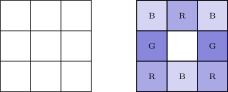
Each square in a grid of squares is colored red, white, blue, or green so that every square contains one square of each color. One such coloring is shown on the right below. How many different colorings are possible?
Pista pequeña:
Etiqueta las casillas las cuatro de arriba a la izquierda son una permutación de los cuatro colores.
Label the cells row by row as the top-left four are a permutation of all four colors
Pista grande:
Entonces y son cada uno los dos colores restantes en algún orden, y queda determinado, pero solo funciona cuando .
Then and are each the two remaining colors in some order, and is forced but works only when
Solución:
Etiqueta las casillas fila por fila El bloque superior izquierdo es una permutación de los cuatro colores, así que formas. El bloque también contiene los cuatro colores, y están fijos, así que son los dos restantes en algún orden: formas. Lo mismo para los dos colores aparte de otras formas. Eso deja obligado a ser el color que falte en y eso solo funciona cuando De las combinaciones de orden, exactamente una tiene así que sobreviven. El total es Por lo tanto, la respuesta es D.
Label the cells row by row as The top-left block is a permutation of the four colors, so ways. The block is also all four colors, and are fixed, so is the remaining two in some order: ways. Same story for the two colors apart from another ways. That leaves forced to whatever color is missing from and that only works when Of the order combinations, exactly one has so survive. The total is Therefore, the answer is D.
21.
Existe un único polinomio de menor grado con coeficiente principal que cumple todo lo siguiente:
es raíz de es raíz de es raíz de y es raíz de
Todas las raíces de excepto una son enteras. Si la única raíz no entera puede escribirse como donde y son enteros positivos primos entre sí, ¿cuánto vale ?
There is a unique polynomial of least degree with leading coefficient satisfying all of the following:
is a root of is a root of is a root of and is a root of
All the roots of except one are integers. If the one non-integer root can be written as where and are relatively prime positive integers, what is
Pista pequeña:
Traduce cada condición en un valor: .
Translate each condition into a value:
Pista grande:
Las raíces enteras obligan a usa para hallar .
The integer roots force use to find
Solución:
Traduce cada condición en un valor: y Así que son raíces. ¿Podría bastar un cúbico? Un cúbico mónico con esas raíces tiene así que no. El polinomio mónico de menor grado es de grado Ahora así que y Esa es la única raíz no entera, así que Por lo tanto, la respuesta correcta es D.
Translate each condition into a value: and So are roots. Could a cubic do it? A monic cubic with those roots has so no. The least-degree monic polynomial is degree Now so and That’s the lone non-integer root, so Thus, D is the correct answer.
22.
Las circunferencias y tienen radio y la distancia entre sus centros es La circunferencia es la mayor circunferencia tangente interiormente a y La circunferencia es tangente interiormente a y y tangente exteriormente a ¿Cuál es el radio de ?
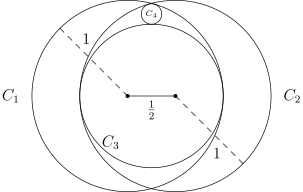
Circle and each have radius and the distance between their centers is Circle is the largest circle internally tangent to both and Circle is internally tangent to both and and externally tangent to What is the radius of
Pista pequeña:
Coloca los centros de en está centrada en el origen con radio dado por .
Put the centers of at is centered at the origin with radius from
Pista grande:
Sea centrada en con radio la tangencia interior a y la tangencia exterior a dan dos ecuaciones.
Let be centered at with radius internal tangency to and external tangency to give two equations
Solución:
Coloca los centros de en Por simetría, la mayor circunferencia dentro de ambas se sitúa en el origen con radio donde así que Sea centrada en con radio La tangencia interior a da y la tangencia exterior a da Sustituye la segunda en la primera: Esto se reduce a así que Por lo tanto, la respuesta es D.
Put the centers of at By symmetry the largest circle inside both sits at the origin with radius where so Let be centered at with radius Internal tangency to gives and external tangency to gives Substitute the second into the first: This collapses to so Therefore, the answer is D.
23.
Los divisores enteros positivos y de se llaman complementarios si Dado que tiene un par de divisores complementarios que difieren en y un par de divisores complementarios que difieren en halla la suma de los dígitos de
Positive integer divisors and of are called complementary if Given that has a pair of complementary divisors that differ by and a pair of complementary divisors that differ by find the sum of the digits of
Pista pequeña:
Los divisores complementarios con producto que difieren en son y así que .
Complementary divisors with product differing by are and so
Pista grande:
Entonces también es un cuadrado perfecto; combina ambos para obtener una diferencia de cuadrados igual a .
Then is also a perfect square; combine the two to get a difference of squares equal to
Solución:
Los divisores complementarios que difieren en son y con producto , así que y . Un par que difiere en da . Pon . Entonces , así que . El par de factores positivos da , y de ahí el valor inadmisible . El par da , , de donde . Comprobación: , y la suma de dígitos es . Por lo tanto, la respuesta correcta es C.
Complementary divisors differing by are and with product , so and . A pair differing by gives . Set . Then , so . The positive factor pair gives , hence the inadmissible value . The pair gives , , hence . Check it: , and the digit sum is . Thus, C is the correct answer.
24.
Seis bloques hexagonales regulares de lado unidad se disponen dentro de un marco hexagonal regular. Cada bloque se apoya a lo largo de una arista interior del marco y está alineado con otros dos bloques, como se muestra en la figura de abajo. La distancia desde cualquier esquina del marco hasta el vértice más cercano de un bloque es unidad. ¿Cuál es el área de la región dentro del marco no ocupada por los bloques?
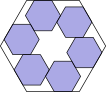
Six regular hexagonal blocks of side length unit are arranged inside a regular hexagonal frame. Each block lies along an inside edge of the frame and is aligned with two other blocks, as shown in the figure below. The distance from any corner of the frame to the nearest vertex of a block is unit. What is the area of the region inside the frame not occupied by the blocks?
Pista pequeña:
La región descubierta es el área del marco menos los seis hexágonos unitarios; un hexágono regular de lado tiene área
The uncovered region is the frame’s area minus the six unit hexagons; a regular hexagon of side has area
Pista grande:
Extiende los bordes de los bloques hasta el marco: un lado del marco se divide en longitudes y luego resta las áreas de los seis bloques
Extend the block edges to the frame: one frame side splits into lengths and then subtract the six block areas
Solución:
Sea Prolonguemos los lados inclinados de los bloques que llegan a un lado fijo del marco. Como todos los ángulos pertinentes miden las prolongaciones forman un triángulo equilátero de lado en un extremo y otro de lado en el otro. Por tanto, ese lado del marco queda dividido en segmentos de longitudes y y su longitud es Un hexágono regular de lado tiene área Así, el área descubierta es el área del marco de lado menos las áreas de los seis bloques unitarios: Por lo tanto, la respuesta es C.
Let Extend the slanted edges of the blocks that meet a fixed side of the frame. Because all the relevant angles are the extensions form an equilateral triangle of side at one end and an equilateral triangle of side at the other. Thus that frame side is partitioned into lengths and so its length is A regular hexagon of side has area Therefore the uncovered area is the area of the side- frame minus the areas of the six unit blocks: Therefore, the answer is C.
25.
Si y son vértices de un poliedro, define la distancia como el número mínimo de aristas del poliedro que hay que recorrer para conectar y Por ejemplo, si es una arista del poliedro, entonces pero si y son aristas y no es una arista, entonces Sean y tres vértices distintos elegidos al azar de un icosaedro regular (un poliedro regular formado por triángulos equiláteros). ¿Cuál es la probabilidad de que ?
If and are vertices of a polyhedron, define the distance to be the minimum number of edges of the polyhedron one must traverse in order to connect and For example, if is an edge of the polyhedron, then but if and are edges and is not an edge, then Let and be randomly chosen distinct vertices of a regular icosahedron (a regular polyhedron made up of equilateral triangles). What is the probability that
Pista pequeña:
Desde cualquier vértice de un icosaedro, vértices están a distancia a distancia y (el vértice opuesto) a distancia
From any vertex of an icosahedron, vertices are at distance at distance and (the opposite vertex) at distance
Pista grande:
Fija por simetría así que es igual a .
Fix by symmetry so it equals
Solución:
Fija De los otros vértices, están a distancia a distancia y (el vértice opuesto) a distancia Elige de forma ordenada distintos entre estos eso da pares. Los que cumplen son así que Por la simetría entre y los casos y reparten el resto por igual, así que Por lo tanto, la respuesta correcta es A.
Fix Of the other vertices, sit at distance at distance and (the opposite vertex) at distance Pick ordered distinct from these that’s pairs. The ones with number so By the symmetry between and the and cases split the rest evenly, so Thus, A is the correct answer.