1973 AMC 12 第 35 题

先试着解答 1973 AMC 12 第 35 题,然后核对你的答案与精心整理的解答,解答来自 LIVE by Po-Shen Loh。你也可以参加完整限时模拟考试、查看全部 1973 AMC 12 解答,或核对答案。

所有题目均经美国数学协会(MAA)官方合法授权使用。

35.

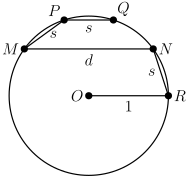
在图示单位圆中,弦 PQPQ 与 MNMN 都平行于以 OO 为圆心的圆的单位半径 OROR。弦 MPMP、PQPQ、NRNR 的长度均为 ss 个单位,弦 MNMN 的长度为 dd 个单位。
在三个等式 I.d−s=1,II.ds=1,III.d2−s2=5 \begin{array}{rl} \mathrm{I}.&d-s=1,\\ \mathrm{II}.&ds=1,\\ \mathrm{III}.&d^2-s^2=\sqrt5 \end{array} 中,必然成立的是
In the unit circle shown in the figure, chords PQPQ and MNMN are parallel to the unit radius OROR of the circle with center at O.O. Chords MP,MP, PQ,PQ, and NRNR are each ss units long and chord MNMN is dd units long.
Of the three equations I.d−s=1,II.ds=1,III.d2−s2=5 \begin{array}{rl} \mathrm{I}.&d-s=1,\\ \mathrm{II}.&ds=1,\\ \mathrm{III}.&d^2-s^2=\sqrt5 \end{array} those which are necessarily true are
仅 I\mathrm{I}
I\mathrm{I} only
仅 II\mathrm{II}
II\mathrm{II} only
仅 III\mathrm{III}
III\mathrm{III} only
仅 I\mathrm{I} 与 II\mathrm{II}
I\mathrm{I} and II\mathrm{II} only
I\mathrm{I}、II\mathrm{II} 与 III\mathrm{III}
I,\mathrm{I}, II,\mathrm{II}, and III\mathrm{III}
答案:E
知识点:弦圆三角恒等式代数变形
小提示:
利用关于竖直直径的对称性,看出上半圆被五条相等的弦分割
Use symmetry across the vertical diameter to see that the upper semicircle is divided into five equal chords
大提示:
写出 s=2sin⁡18∘s=2\sin18^\circ 与 d=2sin⁡54∘d=2\sin54^\circ,再将每个量与另一个量的平方联系起来
Write s=2sin⁡18∘s=2\sin18^\circ and d=2sin⁡54∘,d=2\sin54^\circ, then relate each to the square of the other
解答:
设 KK 为水平直径的左端点。关于竖直直径的反射表明 KM=NR=sKM=NR=s,且 QN=MP=sQN=MP=s。结合题目给出的相等弦,上半圆被分成五段相等的弧。每段弧在 OO 处所对的圆心角为 36∘36^\circ。因此 s=2sin⁡18∘,d=2sin⁡54∘=2cos⁡36∘。 \begin{aligned} s&=2\sin18^\circ,\\ d&=2\sin54^\circ\\ &=2\cos36^\circ \end{aligned}\text{。}
利用倍角恒等式, d=2(1−2sin⁡218∘)=2−s2,s=2cos⁡72∘=4cos⁡236∘−2=d2−2。 \begin{aligned} d&=2(1-2\sin^218^\circ)\\ &=2-s^2,\\ s&=2\cos72^\circ\\ &=4\cos^236^\circ-2\\ &=d^2-2 \end{aligned}\text{。}两式相加,得到 d+s=d2−s2=(d−s)(d+s)。 d+s=d^2-s^2=(d-s)(d+s)\text{。}因为 d+s>0d+s\gt0,所以 d−s=1d-s=1。将 d=s+1d=s+1 代入 d=2−s2d=2-s^2,得到 s2+s=1,s=5−12。 s^2+s=1, \qquad s=\frac{\sqrt5-1}{2}\text{。}因此 ds=s(s+1)=1 ds=s(s+1)=1 且 d2−s2=(d−s)(d+s)=2s+1=5。 \begin{aligned} d^2-s^2 &=(d-s)(d+s)\\ &=2s+1\\ &=\sqrt5 \end{aligned}\text{。}三个等式都必然成立。
所以正确答案是 E。
Let KK be the left endpoint of the horizontal diameter. Reflection across the vertical diameter shows that KM=NR=sKM=NR=s and QN=MP=s.QN=MP=s. Together with the given equal chords, the upper semicircle is split into five equal arcs. Each subtends 36∘36^\circ at O.O. Thus s=2sin⁡18∘,d=2sin⁡54∘=2cos⁡36∘. \begin{aligned} s&=2\sin18^\circ,\\ d&=2\sin54^\circ\\ &=2\cos36^\circ. \end{aligned}
Using the double-angle identities, d=2(1−2sin⁡218∘)=2−s2,s=2cos⁡72∘=4cos⁡236∘−2=d2−2. \begin{aligned} d&=2(1-2\sin^218^\circ)\\ &=2-s^2,\\ s&=2\cos72^\circ\\ &=4\cos^236^\circ-2\\ &=d^2-2. \end{aligned} Adding these equations gives d+s=d2−s2=(d−s)(d+s). d+s=d^2-s^2=(d-s)(d+s). Since d+s>0,d+s\gt0, it follows that d−s=1.d-s=1. Substituting d=s+1d=s+1 into d=2−s2d=2-s^2 yields s2+s=1,s=5−12. s^2+s=1, \qquad s=\frac{\sqrt5-1}{2}. Therefore ds=s(s+1)=1 ds=s(s+1)=1 and d2−s2=(d−s)(d+s)=2s+1=5. \begin{aligned} d^2-s^2 &=(d-s)(d+s)\\ &=2s+1\\ &=\sqrt5. \end{aligned} All three equations are necessarily true.
Therefore, the correct answer is E.
LIVE by Po-Shen Loh
LIVE项目

LIVE直播课程

Self-Paced录播课程

启明星Star计划

奖学金项目

关于我们

罗博深是谁?

邮件联系

订阅英文简报

加入我们

申请明星导师

For a more Thought Full world.

© 2026 Expii, Inc.