
Problemas del 1994 AMC 12
30 problemas · 75 minutos
¡Desplázate hacia abajo y presiona Iniciar para intentar el examen! O ve al PDF imprimible, la clave de respuestas, o las soluciones profesionales preparadas por LIVE by Po-Shen Loh.
O salta directamente a un solo problema con su solución: 1 · 2 · 3 · 4 · 5 · 6 · 7 · 8 · 9 · 10 · 11 · 12 · 13 · 14 · 15 · 16 · 17 · 18 · 19 · 20 · 21 · 22 · 23 · 24 · 25 · 26 · 27 · 28 · 29 · 30
Todos los problemas se usan con el permiso legal oficial de la Mathematical Association of America (MAA).
¿Quieres aprender de forma profesional con clases interactivas en video?
Aprende con LIVECon tiempo
1:15:00
1.
Respuesta: C
Pista pequeña:
Agrupa las potencias de y las potencias de
Group the powers of and the powers of
Pista grande:
Ambas bases tienen exponente total
Both bases have total exponent
Solución:
Al combinar las potencias de la misma base y luego emparejarlas, Por lo tanto, la respuesta correcta es C.
Combining like bases and then pairing them, Thus the correct answer is C.
2.
Un rectángulo grande está dividido en cuatro rectángulos mediante dos segmentos paralelos a sus lados. Se muestran las áreas de tres de los rectángulos resultantes. ¿Cuál es el área del cuarto rectángulo?
| ? |
A large rectangle is partitioned into four rectangles by two segments parallel to its sides. The areas of three of the resulting rectangles are shown. What is the area of the fourth rectangle?
| ? |
Respuesta: B
Pista pequeña:
Representa con variables los anchos de las dos columnas y las alturas de las dos filas
Represent the two column widths and two row heights by variables
Pista grande:
Los productos de las áreas diagonalmente opuestas son iguales
Products of diagonally opposite areas are equal
Solución:
Sean los anchos de las columnas y las alturas de las filas. Las áreas mostradas dan y Por lo tanto, el área que falta es Por lo tanto, la respuesta correcta es B.
Let the column widths be and the row heights be The displayed areas give and Therefore the missing area is Thus the correct answer is B.
3.
¿Cuántas de las siguientes expresiones son iguales a para todo ?
How many of the following are equal to for all
Respuesta: B
Pista pequeña:
Primero combina los dos términos idénticos
First combine the two identical terms
Pista grande:
Comprueba si cambiar la base o el exponente conserva para todo
Test whether changing the base or exponent preserves for every
Solución:
La suma dada es por lo que la expresión I siempre es igual a ella. La expresión II falla cuando pues su valor es en vez de La expresión III falla cuando pues su valor es en vez de La expresión IV falla cuando pues su valor es en vez de Por consiguiente, solo una expresión funciona. Por lo tanto, la respuesta correcta es B.
The given sum is so expression I is always equal to it. Expression II fails at where its value is instead of Expression III fails at where its value is instead of Expression IV fails at where its value is instead of Hence only one expression works. Thus the correct answer is B.
4.
En el plano , el segmento con extremos y es el diámetro de un círculo. Si el punto pertenece al círculo, entonces
In the -plane, the segment with endpoints and is the diameter of a circle. If the point is on the circle, then
Respuesta: A
Pista pequeña:
Halla el centro y el radio a partir de los extremos del diámetro
Find the center and radius from the diameter endpoints
Pista grande:
La distancia vertical del punto al centro ya es igual al radio
The point’s vertical distance from the center already equals the radius
Solución:
El centro es y el radio es Por consiguiente, así que Por lo tanto, la respuesta correcta es A.
The center is and the radius is Thus so Thus the correct answer is A.
5.
Pat quería multiplicar un número por , pero en su lugar lo dividió entre Luego quería sumar , pero en su lugar restó Tras estos errores, el resultado fue Si se hubieran usado las operaciones correctas, el valor obtenido habría sido
Pat intended to multiply a number by but instead divided by Pat then meant to add but instead subtracted After these mistakes, the result was If the correct operations had been used, the value produced would have been
menor que
less than
entre y
between and
entre y
between and
entre y
between and
mayor que
greater than
Respuesta: E
Pista pequeña:
Deshaz la resta y la división equivocadas para recuperar el número inicial
Undo the mistaken subtraction and division to recover the starting number
Pista grande:
Aplica a ese número inicial
Apply to that starting number
Solución:
Si el número inicial es el cálculo equivocado da de modo que El cálculo previsto produciría que es mayor que Por lo tanto, la respuesta correcta es E.
If the starting number is the mistaken calculation gives so The intended calculation would produce which is greater than Thus the correct answer is E.
6.
En la sucesión cada término es la suma de los dos términos situados a su izquierda. Halla
In the sequence each term is the sum of the two terms to its left. Find
Respuesta: A
Pista pequeña:
Trabaja hacia atrás restando el término anterior conocido
Work backward by subtracting the preceding known term
Pista grande:
Determina , en ese orden, antes de hallar
Determine in that order before finding
Solución:
Al trabajar hacia atrás, da luego da y da Finalmente, así que Por lo tanto, la respuesta correcta es A.
Working backward, gives then gives and gives Finally so Thus the correct answer is A.
7.
Los cuadrados y son congruentes, y es el centro del cuadrado El área de la región del plano cubierta por estos cuadrados es
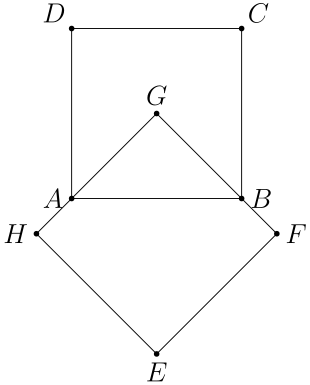
Squares and are congruent, and is the center of square The area of the region in the plane covered by these squares is
Respuesta: E
Pista pequeña:
La intersección es el triángulo
The overlap is triangle
Pista grande:
La distancia del centro al lado es
The distance from the center to side is
Solución:
Cada cuadrado tiene área Su intersección es cuya base es y cuya altura desde el centro hasta es Su área es Por lo tanto, la unión tiene área Por lo tanto, la respuesta correcta es E.
Each square has area Their overlap is whose base is and whose altitude from the center to is Its area is Hence the union has area Thus the correct answer is E.
8.
En el polígono mostrado, cada lado es perpendicular a sus lados adyacentes y los lados son congruentes. El perímetro del polígono es El área de la región delimitada por el polígono es

In the polygon shown, each side is perpendicular to its adjacent sides, and all of the sides are congruent. The perimeter of the polygon is The area of the region bounded by the polygon is
Respuesta: C
Pista pequeña:
Cada lado tiene longitud
Each side has length
Pista grande:
Tomando como unidad la longitud de un lado, divide la figura en franjas horizontales de anchos
In units of one side length, split the shape into horizontal strips of widths
Solución:
Cada lado tiene longitud Medidas en unidades de la longitud del lado, las siete franjas horizontales tienen anchos que suman cuadrados unitarios. Cada uno de esos cuadrados tiene área por lo que el área del polígono es Por lo tanto, la respuesta correcta es C.
Each side has length Measured in side-length units, the seven horizontal strips have widths totaling unit squares. Each such square has area so the polygon’s area is Thus the correct answer is C.
9.
Si es cuatro veces y el complemento de es cuatro veces el complemento de entonces
If is four times and the complement of is four times the complement of then
Respuesta: D
Pista pequeña:
Sea y escribe
Let and write
Pista grande:
Traduce la segunda condición como
Translate the second condition as
Solución:
Sea de modo que La condición sobre los complementos da Por tanto, y Por lo tanto, la respuesta correcta es D.
Let so The complement condition gives Hence and Thus the correct answer is D.
10.
Para números reales distintos y sea el mayor de y , y sea el menor de y Si entonces
For distinct real numbers and let be the larger of and and let be the smaller of and If then
Respuesta: B
Pista pequeña:
Evalúa primero las expresiones más internas
Evaluate the innermost expressions first
Pista grande:
Los dos argumentos de la exterior se reducen a y
The two arguments of the outermost reduce to and
Solución:
Por el orden dado, así que Además, por lo que Por tanto, la expresión exterior es Por lo tanto, la respuesta correcta es B.
From the ordering, so Also hence The outer expression is therefore Thus the correct answer is B.
11.
Tres cubos de volúmenes y se pegan por sus caras. La menor área superficial posible de la figura resultante es
Three cubes of volume and are glued together at their faces. The smallest possible surface area of the resulting configuration is
Respuesta: D
Pista pequeña:
Las longitudes de las aristas de los cubos son y
The cube side lengths are and
Pista grande:
Minimiza el área expuesta maximizando el área total de las porciones de caras pegadas
Minimize exposed area by maximizing the total areas of glued face portions
Solución:
Antes de pegar los cubos, el área superficial total es El cubo de arista puede compartir un área de con el cubo de arista , mientras que el cubo de arista se coloca en la arista común de los otros dos para compartir un área de con cada cubo mayor. Por tanto, el área total de contacto es Cada área pegada elimina dos copias expuestas, lo que da Ningún par puede compartir más que la cara del cubo menor, así que este contacto es máximo y el área superficial es mínima. Por lo tanto, la respuesta correcta es D.
Before gluing, the total surface area is The side- cube can share area with the side- cube, while the side- cube is placed at their common edge so that it shares area with each larger cube. Thus the total contact area is Each glued area removes two exposed copies, giving No pair can share more than the smaller face, so this is maximal contact and minimal surface area. Thus the correct answer is D.
12.
Si entonces
If then
Respuesta: D
Pista pequeña:
Usa
Use
Pista grande:
Después de simplificar el paréntesis, racionaliza
After simplifying the parentheses, rationalize
Solución:
Como Por lo tanto, la respuesta correcta es D.
Because Thus the correct answer is D.
13.
En el triángulo Si hay un punto estrictamente entre y tal que entonces
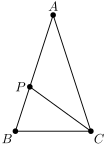
In triangle If there is a point strictly between and such that then
Respuesta: B
Pista pequeña:
Sea y usa en
Let and use in
Pista grande:
Usa para relacionar con un ángulo de la base de
Use to relate to a base angle of
Solución:
Sea Como el triángulo tiene Como cada ángulo de la base de es Además, de modo que los ángulos de la base de , en y , son iguales; el de es Por consiguiente, En lo cual da y Por lo tanto, la respuesta correcta es B.
Let Since triangle has Since each base angle of is Also so the base angles of at and are equal; the one at is Hence At giving and Thus the correct answer is B.
14.
Halla la suma de la serie aritmética
Find the sum of the arithmetic series
Respuesta: B
Pista pequeña:
La diferencia común es
The common difference is
Pista grande:
Halla el número de términos y luego multiplícalo por el promedio de los extremos
Find the number of terms, then multiply by the average of the endpoints
Solución:
El número de términos es Su promedio es así que la suma es Por lo tanto, la respuesta correcta es B.
The number of terms is Their average is so the sum is Thus the correct answer is B.
15.
¿Para cuántos valores de en es impar la cifra de las decenas de ?
For how many in is the tens digit of odd?
Respuesta: B
Pista pequeña:
La paridad de la cifra de las decenas de depende solo de la cifra de las unidades de
The parity of the tens digit of depends only on the units digit of
Pista grande:
Examina los cuadrados de las diez cifras posibles de las unidades
Check the squares of the ten possible units digits
Solución:
Escribe Módulo El término cambia la cifra de las decenas en una cantidad par, así que solo importa la cifra de las decenas de . Entre esta es impar únicamente para y Cada cifra de las unidades aparece veces de a lo que da Por lo tanto, la respuesta correcta es B.
Write Modulo The term changes the tens digit by an even amount, so only the tens digit of matters. Among it is odd only for and Each units digit occurs times from through giving Thus the correct answer is B.
16.
En una bolsa hay algunas canicas rojas y el resto son azules. Si se retira una canica roja, entonces una séptima parte de las canicas restantes son rojas. Si en vez de una roja se retiran dos canicas azules, entonces una quinta parte de las canicas restantes son rojas. ¿Cuántas canicas había originalmente en la bolsa?
Some marbles in a bag are red and the rest are blue. If one red marble is removed, then one-seventh of the remaining marbles are red. If two blue marbles are removed instead of one red, then one-fifth of the remaining marbles are red. How many marbles were in the bag originally?
Respuesta: B
Pista pequeña:
Sea el número de canicas rojas y el número total de canicas
Let be the red count and the total count
Pista grande:
Traduce los dos experimentos como y
Translate the two experiments into and
Solución:
Las dos condiciones dan y Por tanto, y De aquí, y Por lo tanto, la respuesta correcta es B.
The two conditions give and Thus and Hence and Thus the correct answer is B.
17.
Un rectángulo de por tiene el mismo centro que un círculo de radio El área de la región común al rectángulo y al círculo es
An by rectangle has the same center as a circle of radius The area of the region common to both the rectangle and the circle is
Respuesta: D
Pista pequeña:
El rectángulo elimina dos segmentos circulares congruentes del círculo
The rectangle removes two congruent caps from the circle
Pista grande:
La cuerda de cada segmento está a distancia del centro, por lo que la mitad de su ángulo central es
The cap chord is at distance from the center, so its half central angle is
Solución:
El rectángulo es más ancho que el círculo, así que la región común es el círculo sin los segmentos superior e inferior situados más allá de la distancia del centro. Uno de esos segmentos tiene área Por lo tanto, el área común es Por lo tanto, la respuesta correcta es D.
The rectangle is wider than the circle, so the common region is the circle with the top and bottom caps beyond distance from the center removed. One cap has area Therefore the common area is Thus the correct answer is D.
18.
El triángulo está inscrito en un círculo, y Si y son vértices adyacentes de un polígono regular de lados inscrito en este círculo, entonces
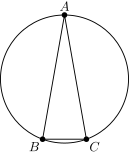
Triangle is inscribed in a circle, and If and are adjacent vertices of a regular polygon of sides inscribed in this circle, then
Respuesta: C
Pista pequeña:
Usa la suma de los ángulos del triángulo para hallar
Use the triangle angle sum to find
Pista grande:
El ángulo central que subtiende es el doble de
The central angle subtending is twice
Solución:
La suma de los ángulos da así que Por tanto, el ángulo central que subtiende la cuerda es Los vértices adyacentes de un -gono regular subtienden un ángulo de de modo que y Por lo tanto, la respuesta correcta es C.
The angle sum gives so The central angle subtending chord is therefore Adjacent vertices of a regular -gon subtend so and Thus the correct answer is C.
19.
Se rotula un disco con “”, dos discos con “”, tres discos con “”, y cincuenta discos con “”. Se colocan estos discos rotulados en una caja. Luego se extraen discos de la caja al azar y sin reemplazo. El número mínimo de discos que se deben extraer para garantizar que se obtengan al menos diez con el mismo rótulo es
Label one disk “,” two disks “,” three disks “,” fifty disks “.” Put these labeled disks in a box. Disks are then drawn from the box at random without replacement. The minimum number of disks that must be drawn to guarantee drawing at least ten disks with the same label is
Respuesta: C
Pista pequeña:
Cuenta el máximo número de discos que se puede extraer tomando como máximo nueve de cada rótulo
Count the most disks that can be drawn while taking at most nine of each label
Pista grande:
Se pueden extraer todos los discos rotulados del al , pero solo nueve de cada rótulo del al
All disks labeled through may be drawn, but only nine of each label through
Solución:
Para evitar diez rótulos iguales, se pueden extraer todos los discos con rótulos menores que y como máximo de cada uno de los rótulos del al Por tanto, se pueden extraer discos sin que necesariamente haya diez iguales, y la siguiente extracción los garantiza. El mínimo es Por lo tanto, la respuesta correcta es C.
To avoid ten equal labels, one may draw all disks with labels below and at most from each of the labels through Thus disks can be drawn without forcing ten alike, and the next draw guarantees them. The minimum is Thus the correct answer is C.
20.
Supón que forman una sucesión geométrica de razón común y que Si forman una sucesión aritmética, entonces es
Suppose is a geometric sequence with common ratio and If is an arithmetic sequence, then is
Respuesta: B
Pista pequeña:
Escribe y
Write and
Pista grande:
La condición de sucesión aritmética es
The arithmetic-sequence condition is
Solución:
Como y la condición de sucesión aritmética da Aquí así que lo cual produce o La condición excluye por lo que queda Por lo tanto, la respuesta correcta es B.
Because and the arithmetic-sequence condition gives Here so yielding or The condition excludes leaving Thus the correct answer is B.
21.
Halla el número de contraejemplos de la afirmación:
“Si es un entero positivo impar cuya suma de cifras es y ninguna de sus cifras es entonces es primo”.
Find the number of counterexamples to the statement:
“If is an odd positive integer the sum of whose digits is and none of whose digits is then is prime.”
Respuesta: C
Pista pequeña:
Un número que satisface las condiciones sobre sus cifras tiene como máximo cuatro cifras
A number satisfying the digit conditions has at most four digits
Pista grande:
Enumera las posibilidades impares componiendo como suma de cifras positivas
List the odd possibilities by composing into positive digits
Solución:
Las posibilidades impares son y Los números y son primos, mientras que y Por tanto, hay contraejemplos. Por lo tanto, la respuesta correcta es C.
The odd possibilities are and The numbers and are prime, while and Thus there are counterexamples. Thus the correct answer is C.
22.
Nueve sillas en fila serán ocupadas por seis estudiantes y los profesores Alfa, Beta y Gamma. Los tres profesores llegan antes que los seis estudiantes y deciden elegir sus sillas de modo que cada profesor quede entre dos estudiantes. ¿De cuántas maneras pueden elegir sus sillas los profesores Alfa, Beta y Gamma?
Nine chairs in a row are to be occupied by six students and Professors Alpha, Beta and Gamma. These three professors arrive before the six students and decide to choose their chairs so that each professor will be between two students. In how many ways can Professors Alpha, Beta and Gamma choose their chairs?
Respuesta: C
Pista pequeña:
Las sillas de los profesores no pueden estar en los extremos ni ser adyacentes
Professor chairs cannot be endpoints or adjacent to one another
Pista grande:
Primero elige tres posiciones no consecutivas entre las sillas a , y luego asigna los profesores
First choose three nonconsecutive positions from chairs through , then assign the professors
Solución:
Los profesores deben ocupar tres posiciones no consecutivas entre las sillas El número de tales subconjuntos de elementos entre posiciones consecutivas es Los tres profesores distintos se pueden asignar a las sillas elegidas de maneras, lo que da Por lo tanto, la respuesta correcta es C.
The professors must occupy three nonconsecutive positions among chairs The number of such -subsets of consecutive positions is The three distinct professors can be assigned to the selected chairs in ways, for Thus the correct answer is C.
23.
En el plano , considera la región en forma de L delimitada por segmentos horizontales y verticales, con vértices en y La pendiente de la recta que pasa por el origen y divide exactamente por la mitad el área de esta región es
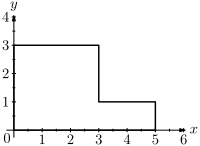
In the -plane, consider the L-shaped region bounded by horizontal and vertical segments with vertices at and The slope of the line through the origin that divides the area of this region exactly in half is
Respuesta: E
Pista pequeña:
La región en forma de L tiene área total
The L-shaped region has total area
Pista grande:
Para la pendiente buscada el área bajo la recta es la extensión de unidades más un triángulo de base
For the desired slope the area below the line is the -unit extension plus a triangle of base
Solución:
La región tiene área por lo que cada mitad tiene área Si la recta es la parte bajo ella consta de todo el rectángulo de unidades desde hasta junto con un triángulo de base y altura Por tanto, Esto da que efectivamente pertenece al intervalo supuesto. Por lo tanto, la respuesta correcta es E.
The region has area so each half has area If the line is the part below it consists of the entire -unit rectangle from to together with a triangle of base and height Therefore This gives which indeed lies in the assumed range. Thus the correct answer is E.
24.
Una muestra de cinco observaciones tiene media aritmética y mediana El menor valor que puede tomar el rango (observación mayor menos observación menor) de tal muestra es
A sample consisting of five observations has an arithmetic mean of and a median of The smallest value that the range (largest observation minus smallest) can assume for such a sample is
Respuesta: C
Pista pequeña:
Ordena las observaciones como
Order the observations as
Pista grande:
Usa la suma total y luego comprueba si es posible un rango menor que
Use the total sum , then test whether a range below is possible
Solución:
La muestra tiene suma mediana y rango así que el rango es posible. Supón que el rango fuera a lo sumo Si el valor mayor fuera a lo sumo los tres valores superiores serían dejando suma para los dos inferiores; sin embargo, cada uno sería al menos una contradicción. Si el valor mayor excediera el menor excedería y la suma sería mayor que Así, ningún rango menor funciona. La respuesta correcta es C.
The sample has sum median and range so range is possible. Suppose the range were at most If the largest value were at most then the top three values would all be leaving the bottom two with sum yet each would be at least a contradiction. If the largest value exceeded then the smallest would exceed making the total exceed Thus no smaller range works. The correct answer is C.
25.
Si y son números reales no nulos tales que
y
entonces el entero más cercano a es
If and are non-zero real numbers such that
and
then the integer nearest to is
Respuesta: A
Pista pequeña:
Considera por separado los signos de
Consider the signs of separately
Pista grande:
Para pon y combina con
For put and combine with
Solución:
Si la segunda ecuación da mientras que la primera da esto exigiría que no tiene raíces reales. Por tanto, Pon Entonces las ecuaciones se convierten en y de modo que Por consiguiente, que ya es un entero. Por lo tanto, la respuesta correcta es A.
If the second equation gives while the first gives these would require which has no real root. Hence Put Then the equations become and so Therefore already an integer. Thus the correct answer is A.
26.
Un polígono regular de lados está rodeado exactamente (sin superposiciones ni huecos) por polígonos regulares de lados cada uno. (Se muestra el caso ) Si ¿cuál es el valor de ?
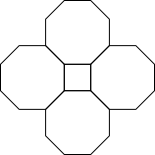
A regular polygon of sides is exactly enclosed (no overlaps, no gaps) by regular polygons of sides each. (Shown here for ) If what is the value of
Respuesta: A
Pista pequeña:
En cada vértice del polígono interior, un ángulo del -gono y dos ángulos de los -gonos suman
At each vertex of the inner polygon, one -gon angle and two -gon angles fill
Pista grande:
Usa para un -gono regular el ángulo interior
Use the regular -gon interior angle
Solución:
En un vértice del polígono interior, su ángulo interior y dos ángulos de los polígonos circundantes suman Por tanto, Esto se simplifica a Con se obtiene así que Por lo tanto, la respuesta correcta es A.
At a vertex of the inner polygon, its interior angle and two angles from the surrounding polygons total Thus This simplifies to With we get so Thus the correct answer is A.
27.
Una bolsa de maíz para palomitas contiene de granos blancos y de granos amarillos. Solo de los granos blancos reventarán, mientras que de los amarillos reventarán. Se elige un grano al azar de la bolsa y este revienta al ponerlo en la máquina. ¿Cuál es la probabilidad de que el grano elegido fuera blanco?
A bag of popping corn contains white kernels and yellow kernels. Only of the white kernels will pop, whereas of the yellow ones will pop. A kernel is selected at random from the bag, and pops when placed in the popper. What is the probability that the kernel selected was white?
Respuesta: D
Pista pequeña:
Calcula para cada color la probabilidad de elegir un grano y que reviente
Compute the probabilities of selecting-and-popping for each color
Pista grande:
Condiciona la probabilidad de elegir un grano blanco que revienta a la probabilidad total de que reviente
Condition the white-and-popped probability on the total probability of popping
Solución:
Las probabilidades de elegir un grano que revienta son Por consiguiente, y Por lo tanto, la respuesta correcta es D.
The probabilities of selecting a kernel that pops are Hence and Thus the correct answer is D.
28.
En el plano , ¿cuántas rectas cuyo intercepto con el eje es un número primo positivo y cuyo intercepto con el eje es un entero positivo pasan por el punto ?
In the -plane, how many lines whose -intercept is a positive prime number and whose -intercept is a positive integer pass through the point
Respuesta: C
Pista pequeña:
Sean y los interceptos, y usa
Let the intercepts be and , and use
Pista grande:
Despeja
Rearrange to
Solución:
Sea el intercepto con el eje el primo y el intercepto con el eje el entero positivo La forma de interceptos da Por tanto, es un divisor positivo de Al probar , se obtiene un primo solo para y Por consiguiente, hay rectas. Por lo tanto, la respuesta correcta es C.
Let the -intercept be the prime and the -intercept be the positive integer Intercept form gives Thus is a positive divisor of Testing gives prime only for and Therefore there are lines. Thus the correct answer is C.
29.
Los puntos y de un círculo de radio están situados de modo que y la longitud del arco menor es Si los ángulos se miden en radianes, entonces
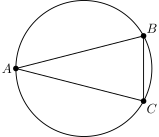
Points and on a circle of radius are situated so that and the length of minor arc is If angles are measured in radians, then
Respuesta: A
Pista pequeña:
El arco menor subtiende un ángulo central de radián
The minor arc subtends a central angle of radian
Pista grande:
Usa la fórmula de la cuerda tanto para como para
Use the chord formula for both and
Solución:
El ángulo central que subtiende el arco menor es así que Como y el punto es el punto medio del arco mayor El ángulo central menor de a es por lo que Por tanto, Por lo tanto, la respuesta correcta es A.
The central angle subtending minor arc is so Since and point is the midpoint of the major arc The minor central angle from to is so Therefore Thus the correct answer is A.
30.
Al lanzar dados estándar de caras, la probabilidad de obtener una suma de es mayor que cero e igual a la probabilidad de obtener una suma de El menor valor posible de es
When standard -sided dice are rolled, the probability of obtaining a sum of is greater than zero and is the same as the probability of obtaining a sum of The smallest possible value of is
Respuesta: C
Pista pequeña:
Una suma de solo es posible si
A sum of is possible only when
Pista grande:
Reemplazar el valor de cada dado por empareja las sumas y
Replacing every die value by pairs sums and
Solución:
El menor número factible de dados es Reemplazar cada resultado por es una biyección entre los resultados con suma y los resultados con suma Así, para la suma emparejada con es Los números de resultados para las sumas aumentan estrictamente desde la suma mínima hasta la media, por lo que para cualquier factible ninguna suma menor que puede tener el mismo número de resultados que Por tanto, el menor valor es y la respuesta correcta es C.
The smallest feasible number of dice is Replacing every die result by is a bijection between outcomes of sum and outcomes of sum Thus for the sum paired with is Dice-sum counts increase strictly from the minimum sum up to the mean, so for any feasible no sum below can match the count at Thus the smallest value is and the correct answer is C.