
Problemas del 1990 AMC 12
30 problemas · 75 minutos
¡Desplázate hacia abajo y presiona Iniciar para intentar el examen! O ve al PDF imprimible, la clave de respuestas, o las soluciones profesionales preparadas por LIVE by Po-Shen Loh.
O salta directamente a un solo problema con su solución: 1 · 2 · 3 · 4 · 5 · 6 · 7 · 8 · 9 · 10 · 11 · 12 · 13 · 14 · 15 · 16 · 17 · 18 · 19 · 20 · 21 · 22 · 23 · 24 · 25 · 26 · 27 · 28 · 29 · 30
Todos los problemas se usan con el permiso legal oficial de la Mathematical Association of America (MAA).
¿Quieres aprender de forma profesional con clases interactivas en video?
Aprende con LIVECon tiempo
1:15:00
1.
Si entonces
If then
Respuesta: E
Pista pequeña:
Simplifica primero ambas fracciones complejas
Simplify both complex fractions first
Pista grande:
Después de eliminar denominadores, resuelve la ecuación resultante en
After clearing denominators, solve the resulting equation in
Solución:
La ecuación se simplifica a Como al multiplicar por se obtiene así que
Por lo tanto, la respuesta correcta es E.
The equation simplifies to Since multiplying by gives so
Thus the correct answer is E.
2.
Respuesta: E
Pista pequeña:
Un exponente negativo indica que se toma el recíproco
A negative exponent takes the reciprocal
Pista grande:
Escribe como una potencia de
Rewrite as a power of
Solución:
Al tomar el recíproco se obtiene
Por lo tanto, la respuesta correcta es E.
Taking the reciprocal gives
Thus the correct answer is E.
3.
Los ángulos consecutivos de un trapecio forman una sucesión aritmética. Si el menor mide el mayor mide
The consecutive angles of a trapezoid form an arithmetic sequence. If the smallest angle is then the largest angle is
Respuesta: C
Pista pequeña:
Escribe los cuatro ángulos como
Write the four angles as
Pista grande:
Usa la suma de los ángulos de un cuadrilátero
Use the angle sum of a quadrilateral
Solución:
Los cuatro ángulos suman así que Por tanto, y el ángulo mayor es
Por lo tanto, la respuesta correcta es C.
The four angles sum to so Thus and the largest angle is
Thus the correct answer is C.
4.
Sea un paralelogramo con y Prolonga más allá de hasta , de modo que Si corta a en entonces es aproximadamente
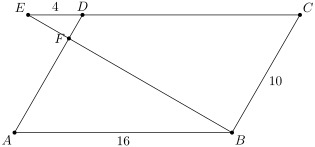
Let be a parallelogram with and Extend through to so that If intersects at then is closest to
Respuesta: B
Pista pequeña:
Usa que
Use that
Pista grande:
Los triángulos y son semejantes
Triangles and are similar
Solución:
Como los triángulos y son semejantes. Por tanto, Como se obtiene y por ello
Por lo tanto, la respuesta correcta es B.
Because triangles and are similar. Hence Since we get so
Thus the correct answer is B.
5.
¿Cuál de estos números es el mayor?
Which of these numbers is largest?
Respuesta: B
Pista pequeña:
Todas las opciones son positivas; eleva cada una a la sexta potencia
Every choice is positive, so raise each one to the sixth power
Pista grande:
Expresa cada sexta potencia como
Express each sixth power as
Solución:
Elevar las cinco opciones positivas a la sexta potencia conserva su orden y da, respectivamente, La segunda es la mayor.
Por lo tanto, la respuesta correcta es B.
Raising the five positive choices to the sixth power preserves their order and gives, respectively, The largest is the second.
Thus the correct answer is B.
6.
Los puntos y están separados unidades. ¿Cuántas rectas de un plano dado que contiene a y están a unidades de y a unidades de ?
Points and are units apart. How many lines in a given plane containing and are units from and units from
más de
more than
Respuesta: D
Pista pequeña:
Convierte las condiciones de distancia en tangencias a dos círculos
Replace the distance conditions by tangencies to two circles
Pista grande:
Los círculos tienen radios y y son tangentes exteriormente
The circles have radii and and are externally tangent
Solución:
Una recta que cumple las condiciones es una tangente común al círculo de centro y radio , y al círculo de centro y radio La distancia entre sus centros es igual a la suma de sus radios, por lo que son tangentes exteriormente. Tienen dos tangentes exteriores comunes y una tangente común en su punto de contacto, para un total de
Por lo tanto, la respuesta correcta es D.
A qualifying line is a common tangent to the circle centered at with radius and the circle centered at with radius Their center distance equals the sum of their radii, so they are externally tangent. They have two external common tangents and one common tangent at their point of contact, for a total of
Thus the correct answer is D.
7.
Un triángulo de lados enteros tiene perímetro Su área es
A triangle with integral sides has perimeter The area of the triangle is
Respuesta: A
Pista pequeña:
Enumera las ternas no ordenadas de enteros positivos que suman
List the unordered triples of positive integers summing to
Pista grande:
Solo una terna satisface la desigualdad triangular estricta
Only one triple satisfies the strict triangle inequality
Solución:
Los únicos lados enteros positivos no ordenados que suman y satisfacen la desigualdad triangular son El semiperímetro es así que la fórmula de Herón da
Por lo tanto, la respuesta correcta es A.
The only unordered positive integral side lengths summing to and satisfying the triangle inequality are Their semiperimeter is so Heron’s formula gives
Thus the correct answer is A.
8.
El número de soluciones reales de es
The number of real solutions of the equation is
más de
more than
Respuesta: E
Pista pequeña:
Interpreta los valores absolutos como distancias en la recta numérica
Interpret the two absolute values as distances on a number line
Pista grande:
Considera cada entre y
Consider every between and
Solución:
Para cada Así, todo el intervalo está formado por soluciones, por lo que hay más de
Por lo tanto, la respuesta correcta es E.
For every Thus the entire interval consists of solutions, so there are more than
Thus the correct answer is E.
9.
Cada arista de un cubo está pintada de rojo o de negro. Cada cara del cubo tiene al menos una arista negra. El menor número posible de aristas negras es
Each edge of a cube is colored either red or black. Every face of the cube has at least one black edge. The smallest possible number of black edges is
Respuesta: B
Pista pequeña:
Cada arista pertenece exactamente a dos caras
Each edge belongs to exactly two faces
Pista grande:
Para construir el caso que alcanza la cota, elige tres aristas que no sean adyacentes entre sí
For the matching upper bound, choose three mutually nonadjacent edges
Solución:
Cada arista negra puede cubrir solo sus dos caras incidentes, así que cubrir las caras requiere al menos aristas negras. Elige aristas que pertenezcan a los pares de caras superior/frontal, inferior/izquierda y posterior/derecha. Estas tres aristas cubren las seis caras, por lo que el mínimo es
Por lo tanto, la respuesta correcta es B.
Each black edge can cover only its two incident faces, so covering all faces requires at least black edges. Choose edges incident to the face-pairs top/front, bottom/left, and back/right. These three edges cover all six faces, so the minimum is
Thus the correct answer is B.
10.
Un cubo de madera de se forma pegando cubos unitarios. ¿Cuál es el mayor número de cubos unitarios que se pueden ver desde un solo punto?
An wooden cube is formed by gluing together unit cubes. What is the greatest number of unit cubes that can be seen from a single point?
Respuesta: D
Pista pequeña:
Desde un punto se pueden ver, como máximo, tres caras de un cubo
At most three faces of a cube are visible from one point
Pista grande:
Aplica inclusión-exclusión a tres caras adyacentes de
Use inclusion-exclusion on three mutually adjacent faces
Solución:
Desde un punto adecuado pueden verse tres caras mutuamente adyacentes. Contienen cubos unitarios distintos: se restan las tres aristas compartidas y se vuelve a añadir el cubo de la esquina.
Por lo tanto, la respuesta correcta es D.
From a suitable point one can see three mutually adjacent faces. They contain distinct unit cubes: subtract the three shared edges and restore the corner cube.
Thus the correct answer is D.
11.
¿Cuántos enteros positivos menores que tienen un número impar de divisores positivos?
How many positive integers less than have an odd number of positive integer divisors?
Respuesta: C
Pista pequeña:
Los divisores suelen emparejarse como y
Divisors normally pair as and
Pista grande:
Un divisor queda sin pareja exactamente cuando el número es un cuadrado perfecto
An unpaired divisor occurs exactly for a perfect square
Solución:
Un entero positivo tiene un número impar de divisores exactamente cuando es un cuadrado perfecto. Los cuadrados menores que son así que hay
Por lo tanto, la respuesta correcta es C.
A positive integer has an odd number of divisors exactly when it is a perfect square. The squares below are so there are
Thus the correct answer is C.
12.
Sea la función definida por para cierto positivo. Si entonces
Let be the function defined by for some positive If then
Respuesta: D
Pista pequeña:
Para positivo, ¿cuándo puede ser igual a ?
For positive when can equal
Pista grande:
Iguala a cero el valor interior
Set the inner value equal to zero
Solución:
Como la ecuación obliga a que Por tanto, de modo que
Por lo tanto, la respuesta correcta es D.
Because the equation forces Hence so
Thus the correct answer is D.
13.
Si una computadora ejecuta las siguientes instrucciones, ¿qué valor de se imprimirá debido a la instrucción ?
INICIAR EN Y EN
AUMENTAR EL VALOR DE EN
AUMENTAR EL VALOR DE EN EL VALOR DE
SI ES AL MENOS IR A LA INSTRUCCIÓN EN CASO CONTRARIO, IR A LA INSTRUCCIÓN Y CONTINUAR DESDE ALLÍ.
IMPRIMIR EL VALOR DE
DETENERSE.
If the following instructions are carried out by a computer, which value of will be printed because of instruction
START AT AND AT
INCREASE THE VALUE OF BY
INCREASE THE VALUE OF BY THE VALUE OF
IF IS AT LEAST THEN GO TO INSTRUCTION OTHERWISE, GO TO INSTRUCTION AND PROCEED FROM THERE.
PRINT THE VALUE OF
STOP.
Respuesta: E
Pista pequeña:
Después de pasadas por las instrucciones y halla y
After passes through instructions and find and
Pista grande:
Los valores añadidos a son enteros impares consecutivos a partir de
The values added to are consecutive odd numbers beginning with
Solución:
Después de pasadas, y Ahora, mientras que Por tanto, el ciclo termina en cuando
Por lo tanto, la respuesta correcta es E.
After passes, and Now while Thus the loop stops at when
Thus the correct answer is E.
14.
Un triángulo isósceles acutángulo está inscrito en un círculo. Por y se trazan tangentes al círculo que se cortan en Si y es la medida en radianes de entonces
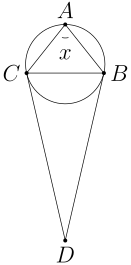
An acute isosceles triangle, is inscribed in a circle. Through and tangents to the circle are drawn, meeting at point If and is the radian measure of then
Respuesta: A
Pista pequeña:
Expresa cada ángulo de la base en función de
Express each base angle in terms of
Pista grande:
El ángulo entre las tangentes es
The angle between the tangents is
Solución:
Los dos ángulos de la base miden El arco menor tiene ángulo central así que el ángulo entre las tangentes es La relación dada produce Por tanto, o
Por lo tanto, la respuesta correcta es A.
The two base angles are each The minor arc has central angle so the angle between the tangents is The given relation yields Therefore or
Thus the correct answer is A.
15.
Cuatro números enteros no negativos, sumados de tres en tres, dan y ¿Cuál es el mayor de los cuatro números?
Four whole numbers, when added three at a time, give the sums and What is the largest of the four numbers?
no se puede determinar con la información dada
cannot be determined from the given information
Respuesta: C
Pista pequeña:
Suma las cuatro sumas dadas de tres números
Add the four given triple-sums
Pista grande:
Cada número original aparece exactamente en tres de esas sumas
Each original number appears in exactly three of those sums
Solución:
Sea la suma de los cuatro números. Al sumar las cuatro sumas triples se obtiene así que Los números omitidos son y y el mayor es
Por lo tanto, la respuesta correcta es C.
If is the sum of the four numbers, adding the four triple-sums gives so The omitted numbers are and whose largest is
Thus the correct answer is C.
16.
En una de las fiestas de George Washington, cada hombre estrechó la mano de todos excepto de su esposa, y no hubo apretones de manos entre mujeres. Si asistieron matrimonios, ¿cuántos apretones de manos hubo entre estas personas?
At one of George Washington’s parties, each man shook hands with everyone except his spouse, and no handshakes took place between women. If married couples attended, how many handshakes were there among these people?
Respuesta: C
Pista pequeña:
Comienza con todos los pares no ordenados de los invitados
Begin with all unordered pairs of the guests
Pista grande:
Elimina los matrimonios y los pares formados por dos mujeres
Remove spouse pairs and pairs consisting of two women
Solución:
Hay pares posibles. Excluimos los matrimonios y los pares de mujeres. El número de apretones de manos es
Por tanto, la respuesta correcta es C.
There are possible pairs. Exclude the married pairs and the pairs of women. The number of handshakes is
Thus the correct answer is C.
17.
¿Cuántos de los números tienen tres dígitos distintos en orden creciente o decreciente?
How many of the numbers have three different digits in increasing order or in decreasing order?
Respuesta: C
Pista pequeña:
Elegir tres dígitos distintos determina su orden creciente o decreciente
Choosing three distinct digits fixes their increasing or decreasing order
Pista grande:
Trata con cuidado el dígito en el caso creciente
Treat the digit carefully in the increasing case
Solución:
Un número creciente de tres dígitos no puede usar el así que hay números crecientes. Tres dígitos cualesquiera elegidos del al forman un número decreciente válido de tres dígitos, porque el mayor aparece primero; esto da El total es
Por tanto, la respuesta correcta es C.
An increasing three-digit number cannot use so there are increasing numbers. Any three digits chosen from through form a valid decreasing three-digit number, because the largest digit comes first; this gives The total is
Thus the correct answer is C.
18.
Primero se elige al azar del conjunto y luego se elige al azar del mismo conjunto. La probabilidad de que el entero tenga como dígito de las unidades el es
First is chosen at random from the set and then is chosen at random from the same set. The probability that the integer has units digit is
Respuesta: C
Pista pequeña:
Los dígitos de las unidades de ambas potencias se repiten con período
The units digits of both powers repeat with period
Pista grande:
Enumera los pares de residuos que producen un dígito de las unidades igual a
List the residue pairs that produce a units digit of
Solución:
Los dígitos de las unidades de para son mientras que los de son Una suma que termina en corresponde a los pares de residuos Cada residuo aparece veces entre así que la probabilidad es
Por tanto, la respuesta correcta es C.
The units digits of for are while those of are A sum ending in occurs for the residue pairs Each residue occurs times among so the probability is
Thus the correct answer is C.
19.
¿Para cuántos enteros entre y la fracción impropia no está en su mínima expresión?
For how many integers between and is the improper fraction not in lowest terms?
Respuesta: B
Pista pequeña:
Reduce módulo
Reduce modulo
Pista grande:
El único factor primo común posible es un divisor de
The only possible common prime factor is a divisor of
Solución:
Módulo tenemos de modo que Por tanto, la fracción es reducible exactamente cuando es divisible por o bien cuando Los valores son un total de
Por tanto, la respuesta correcta es B.
Modulo we have so Thus the fraction is reducible exactly when is divisible by or The values are a total of
Thus the correct answer is B.
20.
En la figura, es un cuadrilátero con ángulos rectos en y Los puntos y están sobre y y son perpendiculares a Si y entonces
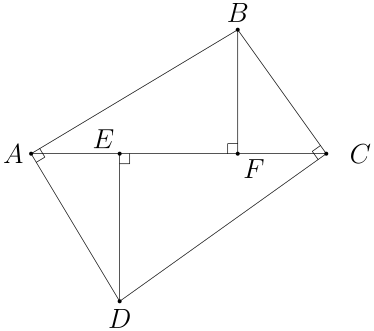
In the figure, is a quadrilateral with right angles at and Points and are on and and are perpendicular to If and then
Respuesta: C
Pista pequeña:
Coloca sobre el eje con
Place on the -axis with
Pista grande:
Usa productos escalares para los ángulos rectos en y
Use dot products for the right angles at and
Solución:
Toma y donde Como así que Como así que La sustitución da y
Por tanto, la respuesta correcta es C.
Set and where Since so Since so Substitution gives and
Thus the correct answer is C.
21.
Considera una pirámide cuya base es cuadrada y cuyo vértice equidista de y Si y entonces el volumen de la pirámide es
Consider a pyramid whose base is square and whose vertex is equidistant from and If and then the volume of the pyramid is
Respuesta: E
Pista pequeña:
En el triángulo isósceles expresa mediante la cuerda
In isosceles triangle express using the chord
Pista grande:
Relaciona con la altura de la pirámide y la distancia del centro del cuadrado a un vértice
Relate to the pyramid height and the center-to-vertex distance of the square
Solución:
Sea En el triángulo isósceles así que Si es la altura de la pirámide, la distancia horizontal del centro del cuadrado a es por lo que Por tanto, y el volumen es
Por tanto, la respuesta correcta es E.
Let In isosceles triangle so If is the pyramid height, the horizontal distance from the square’s center to is hence Thus and the volume is
Thus the correct answer is E.
22.
Si las seis soluciones de se escriben en la forma donde y son reales, entonces el producto de las soluciones con es
If the six solutions of are written in the form where and are real, then the product of those solutions with is
Respuesta: D
Pista pequeña:
Escribe en forma polar y enumera sus seis raíces sextas
Write in polar form and list its six sixth roots
Pista grande:
Las raíces con parte real positiva forman un par conjugado
The roots with positive real part form a conjugate pair
Solución:
Las raíces tienen módulo y argumentos Las raíces con parte real positiva tienen argumentos y Son conjugadas de módulo así que su producto es
Por tanto, la respuesta correcta es D.
The roots have modulus and arguments The roots with positive real part have arguments and They are conjugates of modulus so their product is
Thus the correct answer is D.
23.
Si y entonces
If and then
Respuesta: B
Pista pequeña:
Sea de modo que
Let so that
Pista grande:
Los valores resultantes de muestran que uno de es el cubo del otro
The resulting values of show that one of is the cube of the other
Solución:
Sea Entonces de modo que lo que da o Por tanto, uno de es el cubo del otro. Sea el menor. Entonces así que y Por consiguiente,
Por tanto, la respuesta correcta es B.
Let Then so giving or Thus one of is the cube of the other. Let the smaller be Then so and Therefore
Thus the correct answer is B.
24.
Todos los estudiantes de la Escuela Secundaria Adams y de la Escuela Secundaria Baker presentan cierto examen. La tabla muestra los promedios de los chicos, de las chicas y del grupo completo en las dos escuelas, así como el promedio combinado de los chicos de ambas escuelas. ¿Cuál es el promedio combinado de las chicas de las dos escuelas?
| Adams | Baker | Adams y Baker | |
|---|---|---|---|
| Chicos: | |||
| Chicas: | ¿? | ||
| Chicos y chicas: |
All students at Adams High School and at Baker High School take a certain exam. The average scores for boys, for girls, and for boys and girls combined, at Adams HS and Baker HS are shown in the table, as is the average for boys at the two schools combined. What is the average score for the girls at the two schools combined?
| Adams | Baker | Adams & Baker | |
|---|---|---|---|
| Boys: | |||
| Girls: | ? | ||
| Boys & Girls: |
Respuesta: D
Pista pequeña:
Usa el promedio combinado de cada escuela para hallar su razón de chicas a chicos
Use each school’s combined average to find its ratio of girls to boys
Pista grande:
Usa el promedio combinado de los chicos para relacionar las cantidades de chicos de las dos escuelas
Use the combined boys’ average to relate the numbers of boys at the two schools
Solución:
Supongamos que Adams tiene chicos y chicas. A partir de su promedio, así que Si Baker tiene chicos y chicas, su promedio da El promedio combinado de los chicos da así que y Por tanto, el promedio combinado de las chicas es
Por tanto, la respuesta correcta es D.
Let Adams have boys and girls. From its average, so If Baker has boys and girls, its average gives The combined boys’ average gives so and Hence the combined girls’ average is
Thus the correct answer is D.
25.
Nueve esferas congruentes se colocan dentro de un cubo unitario de modo que una tiene su centro en el centro del cubo y cada una de las demás es tangente a la esfera central y a tres caras del cubo. ¿Cuál es el radio de cada esfera?
Nine congruent spheres are packed inside a unit cube in such a way that one of them has its center at the center of the cube and each of the others is tangent to the center sphere and to three faces of the cube. What is the radius of each sphere?
Respuesta: B
Pista pequeña:
Coloca el centro de una esfera de esquina en
Place one corner sphere’s center at
Pista grande:
Su distancia a es igual a
Its distance from equals
Solución:
Si el radio es una esfera de esquina tiene centro y la esfera central tiene centro La tangencia da Al resolver y racionalizar,
Por tanto, la respuesta correcta es B.
If the radius is a corner sphere has center and the central sphere has center Tangency gives Solving and rationalizing,
Thus the correct answer is B.
26.
Diez personas forman un círculo. Cada una elige un número y se lo dice a sus dos vecinos inmediatos del círculo. Después, cada persona calcula y anuncia el promedio de los números de sus dos vecinos. La figura muestra el promedio anunciado por cada persona (no el número original que eligió). El número elegido por la persona que anunció el promedio fue
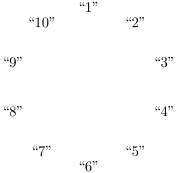
Ten people form a circle. Each picks a number and tells it to the two neighbors adjacent to him in the circle. Then each person computes and announces the average of the numbers of his two neighbors. The figure shows the average announced by each person (not the original number the person picked). The number picked by the person who announced the average was
no se puede determinar de manera única con la información
dada
not uniquely determined from the given information
Respuesta: A
Pista pequeña:
Si es un número elegido y el promedio mostrado, entonces
If is a picked number and the displayed average, then
Pista grande:
Comienza con dos números elegidos adyacentes desconocidos y continúa alrededor del círculo
Start with two unknown adjacent picked numbers and propagate around the circle
Solución:
Numera los promedios mostrados en sentido horario como y sea el número elegido correspondiente. Escribe A partir de los valores sucesivos son Las dos ecuaciones de cierre dan y Por tanto,
Por tanto, la respuesta correcta es A.
Index the displayed averages clockwise as and let be the corresponding picked numbers. Write From successive values are The two closing equations give and Hence
Thus the correct answer is A.
27.
¿Cuál de estas ternas no podría representar las longitudes de las tres alturas de un triángulo?
Which of these triples could not be the lengths of the three altitudes of a triangle?
Respuesta: C
Pista pequeña:
Para un área fija el lado correspondiente a una altura es igual a
For fixed area a side corresponding to altitude equals
Pista grande:
Comprueba la desigualdad triangular con los recíprocos de cada terna
Test the triangle inequality on the reciprocals of each triple
Solución:
Si las alturas son los lados correspondientes son proporcionales a Para por lo que los recíprocos no satisfacen la desigualdad triangular. Una comprobación directa muestra que los recíprocos de las demás ternas de la lista satisfacen todas las desigualdades triangulares estrictas.
Por tanto, la respuesta correcta es C.
If the altitudes are then the corresponding sides are proportional to For so the reciprocals fail the triangle inequality. Direct checking shows that the reciprocals of each other listed triple satisfy all strict triangle inequalities.
Thus the correct answer is C.
28.
Un cuadrilátero cuyos lados consecutivos tienen longitudes y está inscrito en un círculo y también tiene un círculo inscrito. El punto de tangencia del círculo inscrito con el lado de longitud divide ese lado en segmentos de longitudes y Halla
A quadrilateral that has consecutive sides of lengths and is inscribed in a circle and also has a circle inscribed in it. The point of tangency of the inscribed circle to the side of length divides that side into segments of lengths and Find
Respuesta: B
Pista pequeña:
Asigna una longitud tangente a cada vértice, de modo que cada par adyacente sume la longitud del lado correspondiente
Assign one tangent length to each vertex, so adjacent pairs sum to the four side lengths
Pista grande:
Para ángulos opuestos suplementarios, los productos de las longitudes tangentes en vértices opuestos son iguales
For supplementary opposite angles, the products of the tangent lengths at opposite vertices are equal
Solución:
Sean las longitudes tangentes desde los cuatro vértices consecutivos. Entonces Así, y Si el inradio es un vértice con ángulo tiene longitud tangente Los ángulos opuestos son suplementarios, por lo que En consecuencia, lo que da Por tanto, los dos segmentos del lado de longitud son y cuya diferencia es
Por tanto, la respuesta correcta es B.
Let the tangent lengths from the four consecutive vertices be Then Thus and If the inradius is a vertex with angle has tangent length Opposite angles are supplementary, so Therefore giving Hence the two segments of the -side are and whose difference is
Thus the correct answer is B.
29.
Un subconjunto de los enteros tiene la propiedad de que ninguno de sus elementos es veces otro. ¿Cuál es la mayor cantidad de elementos que puede tener ese subconjunto?
A subset of the integers has the property that none of its members is times another. What is the largest number of members such a subset can have?
Respuesta: D
Pista pequeña:
Agrupa los enteros en cadenas donde no es múltiplo de
Group integers into chains where is not a multiple of
Pista grande:
Dentro de cada cadena, elegir términos alternos produce una selección máxima permitida
Within each chain, alternating entries give a largest allowed selection
Solución:
Divide los enteros en cadenas donde no es múltiplo de En cada cadena no se pueden elegir dos términos adyacentes, de modo que una selección máxima toma términos alternos comenzando con De manera equivalente, elige los enteros cuyo exponente de es par. Hay El argumento de las cadenas también demuestra que no es posible una selección mayor.
Por tanto, la respuesta correcta es D.
Partition the integers into chains with not a multiple of In each chain, no two adjacent terms may both be selected, so a maximum selection takes alternating terms starting with Equivalently, select the integers whose exponent of is even. There are The chain argument also proves no larger selection is possible.
Thus the correct answer is D.
30.
Si donde y entonces es un entero. Su dígito de las unidades es
If where and then is an integer. Its units digit is
Respuesta: E
Pista pequeña:
Usa y para obtener una recurrencia para
Use and to obtain a recurrence for
Pista grande:
Calcula la recurrencia módulo y busca un período corto
Compute the recurrence modulo and look for a short period
Solución:
Como son raíces de Comenzando con los dígitos de las unidades son con período Como el dígito de las unidades es el mismo que el de es decir,
Por tanto, la respuesta correcta es E.
Because are roots of Starting with the units digits are with period Since the units digit is the same as that of namely
Thus the correct answer is E.