
Problemas del 1978 AMC 12
30 problemas · 75 minutos
¡Desplázate hacia abajo y presiona Iniciar para intentar el examen! O ve al PDF imprimible, la clave de respuestas, o las soluciones profesionales preparadas por LIVE by Po-Shen Loh.
O salta directamente a un solo problema con su solución: 1 · 2 · 3 · 4 · 5 · 6 · 7 · 8 · 9 · 10 · 11 · 12 · 13 · 14 · 15 · 16 · 17 · 18 · 19 · 20 · 21 · 22 · 23 · 24 · 25 · 26 · 27 · 28 · 29 · 30
Todos los problemas se usan con el permiso legal oficial de la Mathematical Association of America (MAA).
¿Quieres aprender de forma profesional con clases interactivas en video?
Aprende con LIVECon tiempo
1:15:00
1.
Si entonces es igual a
If then equals
o
or
o
or
Respuesta: B
Pista pequeña:
Sea
Let
Pista grande:
El trinomio resultante es un cuadrado perfecto
The resulting quadratic is a perfect square
Solución:
Con la ecuación se convierte en o bien Por lo tanto,
Por lo tanto, la respuesta correcta es B.
With the equation becomes or Therefore
Therefore, the correct answer is B.
2.
Si cuatro veces el recíproco de la circunferencia de un círculo es igual al diámetro del círculo, entonces el área del círculo es
If four times the reciprocal of the circumference of a circle equals the diameter of the circle, then the area of the circle is
Respuesta: C
Pista pequeña:
Expresa la circunferencia y el diámetro en términos del radio
Write the circumference and diameter in terms of the radius
Pista grande:
La condición determina directamente el producto
The condition directly determines the product
Solución:
La condición es Al multiplicar por se obtiene de modo que el área es igual a
Por lo tanto, la respuesta correcta es C.
The condition is Multiplying by gives so the area equals
Therefore, the correct answer is C.
3.
Para todos los números no nulos y tales que es igual a
For all nonzero numbers and such that equals
Respuesta: D
Pista pequeña:
Usa la relación de reciprocidad para sustituir y
Use the reciprocal relation to replace and
Pista grande:
Los dos factores se convierten en y
The two factors become and
Solución:
Como también se tiene Por lo tanto, el producto es
Por lo tanto, la respuesta correcta es D.
Since we also have Thus the product is
Therefore, the correct answer is D.
4.
Si y entonces es igual a
If and then is equal to
Respuesta: B
Pista pequeña:
Cuenta cuántas veces aparece cada variable con cada signo
Count how many times each variable appears with each sign
Pista grande:
La suma completa se simplifica al doble de
The entire sum simplifies to twice
Solución:
Cada variable aparece tres veces con signo positivo y una vez con signo negativo, por lo que la expresión es
Por lo tanto, la respuesta correcta es B.
Each variable appears positively three times and negatively once, so the expression is
Therefore, the correct answer is B.
5.
Cuatro muchachos compraron una embarcación por El primero pagó la mitad de la suma de las cantidades pagadas por los otros; el segundo pagó un tercio de la suma de las cantidades pagadas por los otros; y el tercero pagó un cuarto de la suma de las cantidades pagadas por los otros. ¿Cuánto pagó el cuarto muchacho?
Four boys bought a boat for The first boy paid one half of the sum of the amounts paid by the other boys; the second boy paid one third of the sum of the amounts paid by the other boys; and the third boy paid one fourth of the sum of the amounts paid by the other boys. How much did the fourth boy pay?
Respuesta: C
Pista pequeña:
Sustituye cada «suma pagada por los otros muchachos» por menos el pago de ese muchacho
Replace each “sum paid by the other boys” by minus that boy’s payment
Pista grande:
Calcula por separado los tres primeros pagos y luego resta su suma de
Solve separately for the first three payments, then subtract their sum from
Solución:
Los tres primeros pagos son y Entonces De aquí El cuarto pago es de dólares.
Por lo tanto, la respuesta correcta es C.
Let the first three payments be and Then Hence The fourth payment is dollars.
Therefore, the correct answer is C.
6.
El número de pares distintos de números reales que satisfacen ambas ecuaciones siguientes: es
The number of distinct pairs of real numbers satisfying both of the following equations: is
Respuesta: E
Pista pequeña:
Factoriza la segunda ecuación como
Factor the second equation as
Pista grande:
Considera y como casos separados
Handle and as separate cases
Solución:
Si la primera ecuación da por lo que o Si la segunda ecuación da La primera da entonces lo cual produce y Hay cuatro pares.
Por lo tanto, la respuesta correcta es E.
If the first equation gives so or If the second equation gives The first then gives producing and There are four pairs.
Therefore, the correct answer is E.
7.
Los lados opuestos de un hexágono regular están separados pulgadas. La longitud de cada lado, en pulgadas, es
Opposite sides of a regular hexagon are inches apart. The length of each side, in inches, is
Respuesta: E
Pista pequeña:
La distancia entre lados opuestos es el doble de la apotema
The distance between opposite sides is twice the apothem
Pista grande:
Un hexágono regular de lado tiene apotema
A regular hexagon of side has apothem
Solución:
La distancia entre lados opuestos es el doble de la apotema, es decir, Por lo tanto, así que
Por lo tanto, la respuesta correcta es E.
The distance between opposite sides is twice the apothem, hence Therefore so
Therefore, the correct answer is E.
8.
Si y las sucesiones y son progresiones aritméticas, entonces es igual a
If and the sequences and each are in arithmetic progression, then equals
Respuesta: D
Pista pequeña:
Cuenta los pasos iguales desde hasta en cada sucesión
Count the equal steps from to in each sequence
Pista grande:
Las dos diferencias comunes son y
The two common differences are and
Solución:
La primera diferencia común es y la segunda es Como su razón es
Por lo tanto, la respuesta correcta es D.
The first common difference is and the second is Since their ratio is
Therefore, the correct answer is D.
9.
Si entonces es igual a
If then equals
Respuesta: B
Pista pequeña:
Usa
Use
Pista grande:
Cuando determina los signos de y
When determine the signs of and
Solución:
Como Por lo tanto, pues
Por lo tanto, la respuesta correcta es B.
Because Therefore since
Therefore, the correct answer is B.
10.
Si es un punto del círculo con centro entonces el conjunto de todos los puntos del plano del círculo tales que la distancia entre y es menor o igual que la distancia entre y cualquier otro punto del círculo es
If is a point on circle with center then the set of all points in the plane of circle such that the distance between and is less than or equal to the distance between and any other point on circle is
el segmento de a
the line segment from to
la semirrecta que comienza en y pasa por
the ray beginning at and passing through
una semirrecta que comienza en
a ray beginning at
un círculo cuyo centro es
a circle whose center is
un círculo cuyo centro es
a circle whose center is
Respuesta: B
Pista pequeña:
Para el punto más cercano del círculo está en la semirrecta que parte de y pasa por
For the nearest point of the circle lies on the ray from through
Pista grande:
Exige que este punto radial más cercano sea el punto fijo
Require that this radial nearest point be the fixed point
Solución:
Para cualquier el punto del círculo más cercano a es la intersección del círculo con la semirrecta que parte de y pasa por Este punto es exactamente cuando pertenece a la semirrecta que parte de y pasa por El centro también cumple la condición porque todos los puntos del círculo están a la misma distancia de él. Por lo tanto, el lugar geométrico es esa semirrecta.
Por lo tanto, la respuesta correcta es B.
For any the closest point of the circle to is where the ray from through meets the circle. This point is exactly when lies on the ray from through The center also qualifies because every point on the circle is equally distant from it. Thus the locus is that ray.
Therefore, the correct answer is B.
11.
Si es positivo y la recta cuya ecuación es es tangente al círculo cuya ecuación es entonces es igual a
If is positive and the line whose equation is is tangent to the circle whose equation is then equals
Respuesta: C
Pista pequeña:
El círculo tiene centro en el origen y radio
The circle has center at the origin and radius
Pista grande:
Iguala la distancia del origen a la recta con el radio del círculo
Set the distance from the origin to the line equal to the circle’s radius
Solución:
La distancia del origen a es Para que haya tangencia, debe ser igual al radio de modo que Como al elevar al cuadrado y dividir por se obtiene
Por lo tanto, la respuesta correcta es C.
The distance from the origin to is Tangency requires this to equal the radius so Since squaring and dividing by gives
Therefore, the correct answer is C.
12.
En los puntos y están en los lados y respectivamente, y los puntos son distintos. Si las longitudes y son iguales, entonces la medida de es
In points and lie on sides and respectively, and points are distinct. If lengths and are all equal, then the measure of is
Respuesta: E
Pista pequeña:
Denomina y usa sucesivamente los triángulos isósceles
Name and use the successive isosceles triangles
Pista grande:
Expresa los otros ángulos de la base en términos de y luego usa la suma de ángulos de
Express the other base angles in terms of then use the angle sum in
Solución:
Sean y Al aplicar sucesivamente el teorema del ángulo exterior se obtiene Los ángulos de son y por lo que Por consiguiente,
Por lo tanto, la respuesta correcta es E.
Let and The exterior-angle theorem applied successively gives The angles of are and so Hence
Therefore, the correct answer is E.
13.
Si y son números no nulos tales que y son las raíces de y y son las raíces de entonces es igual a
If and are nonzero numbers such that and are the solutions of and and are the solutions of then equals
Respuesta: B
Pista pequeña:
Aplica las fórmulas de Vieta a ambas ecuaciones cuadráticas
Apply Vieta’s formulas to both quadratics
Pista grande:
Las dos ecuaciones de las sumas implican ; luego usa las ecuaciones de los productos y la condición de no nulidad
The two sum equations imply ; then use the product equations and nonzero condition
Solución:
Las fórmulas de Vieta dan Las dos ecuaciones de las sumas implican Como las ecuaciones de los productos dan Luego da y por lo tanto
Por lo tanto, la respuesta correcta es B.
Vieta’s formulas give The two sum equations imply Since the product equations give Then gives and therefore
Therefore, the correct answer is B.
14.
Si un entero mayor que es una raíz de la ecuación y la representación de en el sistema de numeración de base es entonces la representación de en base es
If an integer greater than is a solution of the equation and the representation of in the base numeration system is then the base representation of is
Respuesta: C
Pista pequeña:
Convierte el numeral en base en
Translate the base- numeral into
Pista grande:
Usa la suma y el producto de las dos raíces
Use the sum and product of the two roots
Solución:
En notación ordinaria, Como una raíz es la otra debe ser Su producto es cuya representación en base es
Por lo tanto, la respuesta correcta es C.
In ordinary notation, Since one root is the other root must be Their product is whose base- representation is
Therefore, the correct answer is C.
15.
Si y entonces es
If and then is
no está completamente determinada por la información dada
not completely determined by the given information
Respuesta: A
Pista pequeña:
Eleva al cuadrado la ecuación dada para determinar
Square the given equation to determine
Pista grande:
Considera y como raíces de una cuadrática y luego usa
Treat and as roots of a quadratic, then use
Solución:
Al elevar al cuadrado se obtiene de modo que Así, y son las raíces de es decir, y Como en el intervalo dado, y Por consiguiente,
Por lo tanto, la respuesta correcta es A.
Squaring gives so Thus and are the roots of namely and Because on the given interval, and Hence
Therefore, the correct answer is A.
16.
En una sala que contiene personas, con al menos una persona no ha estrechado la mano de todas las demás. ¿Cuál es el número máximo de personas de la sala que podrían haber estrechado la mano de todas las demás?
In a room containing people, at least one person has not shaken hands with everyone else in the room. What is the maximum number of people in the room that could have shaken hands with everyone else?
ninguna de las anteriores
none of these
Respuesta: E
Pista pequeña:
Un apretón de manos que no ocurrió siempre involucra a dos personas
A missed handshake always involves two people
Pista grande:
Halla una cota superior y luego alcánzala omitiendo un solo apretón de manos
Find an upper bound, then realize it by omitting just one handshake
Solución:
Si una persona no ha dado un apretón de manos, la otra persona de ese par tampoco ha estrechado la mano de todos. Por lo tanto, a lo sumo personas pueden haber estrechado la mano de todos. Esto se alcanza cuando exactamente dos personas no se dan la mano entre sí y ocurren todos los demás apretones. Como no aparece en la lista, la respuesta es «ninguna de las anteriores».
Por lo tanto, la respuesta correcta es E.
If one person has missed a handshake, the other person in that missed pair also has not shaken hands with everyone. Thus at most people can have shaken hands with everyone. This is attainable when exactly two people fail to shake hands with each other and every other handshake occurs. Since is not listed, the answer is “none of these.”
Therefore, the correct answer is E.
17.
Si es un número positivo y es una función tal que, para todo número positivo entonces, para todo número positivo es igual a
If is a positive number and is a function such that, for every positive number then, for every positive number is equal to
Respuesta: D
Pista pequeña:
Elige de modo que
Choose so that
Pista grande:
Después de hacer la sustitución, compara con
Compare with after making the substitution
Solución:
Sea que es positivo. Entonces Por lo tanto, la expresión pedida es
Por lo tanto, la respuesta correcta es D.
Set which is positive. Then Therefore the requested expression is
Therefore, the correct answer is D.
18.
¿Cuál es el menor entero positivo tal que ?
What is the smallest positive integer such that
No existe tal entero.
There is no such integer.
Respuesta: C
Pista pequeña:
Racionaliza
Rationalize
Pista grande:
Compara el denominador resultante con cerca de
Compare the resulting denominator with near
Solución:
Al racionalizar se obtiene Para el denominador es así que la diferencia es mayor que Para el denominador es así que la diferencia es menor que El denominador aumenta con por lo cual es el menor entero que cumple la condición.
Por lo tanto, la respuesta correcta es C.
Rationalizing gives For the denominator is so the difference exceeds For the denominator is so the difference is less than The denominator increases with making the least such integer.
Therefore, the correct answer is C.
19.
Se elige un entero positivo que no excede de tal manera que, si la probabilidad de elegir es y si la probabilidad de elegir es La probabilidad de elegir un cuadrado perfecto es
A positive integer not exceeding is chosen in such a way that if then the probability of choosing is and if then the probability of choosing is The probability that a perfect square is chosen is
Respuesta: C
Pista pequeña:
Primero usa la probabilidad total para determinar
First use the total probability to determine
Pista grande:
Cuenta por separado los cuadrados perfectos que no exceden y los que están entre y
Count the perfect squares at most and those from through separately
Solución:
La probabilidad total es por lo que Hay siete cuadrados perfectos que no exceden y otros tres, mayores que Por consiguiente, la probabilidad pedida es
Por lo tanto, la respuesta correcta es C.
The total probability is so There are seven perfect squares at most and three more, above Hence the desired probability is
Therefore, the correct answer is C.
20.
Si son números reales no nulos tales que y y entonces es igual a
If are nonzero real numbers such that and and then equals
Respuesta: A
Pista pequeña:
Iguala las tres fracciones a y compara por pares las ecuaciones resultantes
Set the three equal fractions to and compare pairs of the resulting equations
Pista grande:
La comparación obliga a que o ; usa el signo de
The comparison forces either or ; use the sign of
Solución:
Sea el valor común. Las dos primeras ecuaciones resultantes implican y las comparaciones cíclicas dan las relaciones análogas. Por lo tanto, o bien lo que da o bien En el segundo caso, y de modo que La condición selecciona este último valor.
Por lo tanto, la respuesta correcta es A.
Let the common value be The first two resulting equations imply and cyclic comparisons give the analogous relations. Thus either which gives or In the latter case and so The condition selects the latter value.
Therefore, the correct answer is A.
21.
Para todo número positivo distinto de es igual a
For all positive numbers distinct from equals
Respuesta: A
Pista pequeña:
Usa la identidad recíproca
Use the reciprocal identity
Pista grande:
Combina la suma resultante con la regla del producto de los logaritmos
Combine the resulting sum with the product rule for logarithms
Solución:
Sea la suma dada. Al cambiar de base y combinar logaritmos se obtiene
Por lo tanto, la respuesta correcta es A.
Let denote the given sum. Changing bases and combining logarithms gives
Therefore, the correct answer is A.
22.
En una tarjeta aparecen las siguientes cuatro afirmaciones, y solamente estas:
En esta tarjeta exactamente una afirmación es falsa.
En esta tarjeta exactamente dos afirmaciones son falsas.
En esta tarjeta exactamente tres afirmaciones son falsas.
En esta tarjeta exactamente cuatro afirmaciones son falsas.
En esta tarjeta exactamente dos afirmaciones son falsas.
En esta tarjeta exactamente tres afirmaciones son falsas.
En esta tarjeta exactamente cuatro afirmaciones son falsas.
(Supón que cada afirmación de la tarjeta es verdadera o falsa.) Entre ellas, el número de afirmaciones falsas es exactamente
The following four statements, and only these, are found on a card:
On this card exactly one statement is false.
On this card exactly two statements are false.
On this card exactly three statements are false.
On this card exactly four statements are false.
On this card exactly two statements are false.
On this card exactly three statements are false.
On this card exactly four statements are false.
(Assume each statement on the card is either true or false.) Among them the number of false statements is exactly
Respuesta: D
Pista pequeña:
Supón que en realidad hay afirmaciones falsas
Assume the actual number of false statements is
Pista grande:
Para cada valor posible de cuenta cuántas de las cuatro afirmaciones serían verdaderas
For each possible count how many of the four displayed statements would then be true
Solución:
Si el número de afirmaciones que son falsas en realidad es uno de exactamente una de las afirmaciones mostradas, la que menciona es verdadera. Por lo tanto, exactamente tres afirmaciones son falsas, lo que obliga a que Esto es coherente: la tercera afirmación es verdadera y las otras tres son falsas.
Por lo tanto, la respuesta correcta es D.
If the actual number of false statements is one of exactly one displayed statement—the one naming —is true. Therefore exactly three statements are false, forcing This is consistent: the third statement is true and the other three are false.
Therefore, the correct answer is D.
23.
El vértice del triángulo equilátero está en el interior del cuadrado y es el punto de intersección de la diagonal y el segmento Si la longitud es entonces el área de es
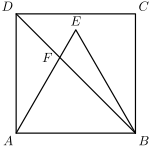
Vertex of equilateral triangle is in the interior of square and is the point of intersection of diagonal and line segment If length is then the area of is
Respuesta: C
Pista pequeña:
Ubica y donde
Place and where
Pista grande:
Halla la intersección de y
Find the intersection of and
Solución:
Sean y donde Las dos rectas que contienen a tienen ecuaciones Por lo tanto, la altura de sobre es Así,
Por lo tanto, la respuesta correcta es C.
Let and where The two lines containing have equations Hence the altitude of above is Therefore
Therefore, the correct answer is C.
24.
Si los números distintos y no nulos forman una progresión geométrica de razón común entonces satisface la ecuación
If the distinct nonzero numbers form a geometric progression with common ratio then satisfies the equation
Respuesta: A
Pista pequeña:
Suma las tres expresiones dadas
Add the three given expressions
Pista grande:
Escribe los tres términos no nulos como
Write the three nonzero terms as
Solución:
Las tres expresiones tienen suma Al escribir la progresión geométrica no nula como se obtiene Como
Por lo tanto, la respuesta correcta es A.
The three expressions have sum Writing the nonzero geometric progression as gives Since
Therefore, the correct answer is A.
25.
Sea un número positivo. Considera el conjunto de todos los puntos cuyas coordenadas rectangulares satisfacen todas las condiciones siguientes: La frontera del conjunto es un polígono con
Let be a positive number. Consider the set of all points whose rectangular coordinates satisfy all of the following conditions: The boundary of set is a polygon with
lados
sides
lados
sides
lados
sides
lados
sides
lados
sides
Respuesta: D
Pista pequeña:
Comienza con el cuadrado descrito por las condiciones y
Begin with the square described by conditions and
Pista grande:
Determina qué condición es redundante y cuáles dos recortan vértices opuestos
Determine which condition is redundant and which two cut off opposite corners
Solución:
Las dos primeras condiciones forman el cuadrado Dentro de este cuadrado, se cumple automáticamente. Las dos últimas condiciones equivalen a sus rectas frontera recortan los vértices y Al recortar dos vértices opuestos de un cuadrado se obtiene un hexágono, por lo que la frontera tiene seis lados.
Por lo tanto, la respuesta correcta es D.
The first two conditions form the square Within this square, is automatic. The last two conditions are equivalent to their boundary lines cut off the corners and Cutting two opposite corners from a square produces a hexagon, so the boundary has six sides.
Therefore, the correct answer is D.
26.
En y El círculo es el círculo de menor radio que pasa por y es tangente a Sean y los puntos de intersección distintos de del círculo con los lados y respectivamente. La longitud del segmento es
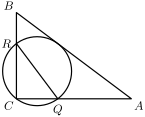
In and Circle is the circle with smallest radius which passes through and is tangent to Let and be the points of intersection, distinct from of circle with sides and respectively. The length of segment is
Respuesta: B
Pista pequeña:
El triángulo -- es rectángulo en ; sea el pie de la perpendicular desde hasta
The -- triangle is right at ; let be the foot from to
Pista grande:
El círculo más pequeño tiene como diámetro, y
The smallest circle has as a diameter, and
Solución:
Sea el pie de la altura desde hasta Entre los círculos que pasan por y son tangentes a el menor radio se obtiene cuando el punto de tangencia es por lo que es un diámetro. El área del triángulo rectángulo da Además, así que es un diámetro del círculo Por lo tanto,
Por lo tanto, la respuesta correcta es B.
Let be the foot of the altitude from to Among circles through tangent to the least radius occurs when the tangency point is so is a diameter. The area of the right triangle gives Also so is a diameter of circle Therefore
Therefore, the correct answer is B.
27.
Hay más de un entero mayor que que, al dividirse entre cualquier entero tal que deja residuo ¿Cuál es la diferencia entre los dos menores enteros de este tipo?
There is more than one integer greater than which, when divided by any integer such that has a remainder of What is the difference between the two smallest such integers?
ninguna de las anteriores
none of these
Respuesta: C
Pista pequeña:
Cada entero buscado es más que un múltiplo común de todos los enteros desde hasta
Each desired integer is more than a common multiple of every integer from through
Pista grande:
La diferencia entre dos enteros consecutivos de este tipo es el mínimo común múltiplo de esos divisores
The difference of consecutive such integers is the least common multiple of those divisors
Solución:
Un entero que cumple la condición es congruente con módulo cada entero desde hasta y por lo tanto módulo Los dos menores enteros mayores que que cumplen la condición son y cuya diferencia es
Por lo tanto, la respuesta correcta es C.
A qualifying integer is congruent to modulo every integer from through hence modulo The two smallest qualifying integers greater than are and whose difference is
Therefore, the correct answer is C.
28.
Si es equilátero y es el punto medio del segmento para todo entero positivo entonces la medida de es igual a
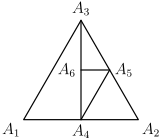
If is equilateral and is the midpoint of line segment for all positive integers then the measure of equals
Respuesta: E
Pista pequeña:
Sea y deriva una recurrencia para estos vectores
Let and derive a recurrence for these vectors
Pista grande:
Demuestra que reduciendo el ángulo pedido a uno formado por los primeros puntos
Show that reducing the requested angle to one among the first few points
Solución:
Sea La regla del punto medio da y también En consecuencia, Por lo tanto, y son, respectivamente, el mismo múltiplo escalar positivo de y de modo que Como y son los puntos medios de y Los ángulos del triángulo equilátero dan entonces
Por lo tanto, la respuesta correcta es E.
Let The midpoint rule gives and also Consequently, Thus and are the same positive scalar multiple of and respectively, so Since and are the midpoints of and The equilateral-triangle angles then give
Therefore, the correct answer is E.
29.
Los lados y respectivamente, del cuadrilátero convexo se prolongan más allá de y hasta los puntos y Además, y y el área de es El área de es
Sides and respectively, of convex quadrilateral are extended past and to points and Also, and and the area of is The area of is
Respuesta: D
Pista pequeña:
En notación vectorial, y análogamente para los otros dos vértices
In vector notation, and similarly for the other two vertices
Pista grande:
Sustituye estas expresiones en la fórmula del área de un polígono mediante productos vectoriales
Substitute these expressions into the cross-product area formula for a polygon
Solución:
Usando vectores de posición, las prolongaciones iguales dan Al sustituir en la suma orientada del área del polígono, los términos cruzados diagonales se cancelan: Por consiguiente, el área exterior es cinco veces el área original, es decir,
Por lo tanto, la respuesta correcta es D.
Using position vectors, the equal extensions give Substitution into the oriented polygon-area sum shows that the diagonal cross terms cancel: Hence the outer area is five times the original area, or
Therefore, the correct answer is D.
30.
En un torneo de tenis participan mujeres y hombres, y cada jugador disputa exactamente un partido contra cada uno de los demás. Si no hay empates y la razón entre el número de partidos ganados por mujeres y el número de partidos ganados por hombres es entonces es igual a
In a tennis tournament, women and men play, and each player plays exactly one match with every other player. If there are no ties and the ratio of the number of matches won by women to the number of matches won by men is then equals
ninguna de las anteriores
none of these
Respuesta: E
Pista pequeña:
Sea el número de partidos mixtos ganados por mujeres y cuenta todas las victorias de las mujeres
Let be the number of mixed matches won by women and count all wins by women
Pista grande:
Usa junto con la fracción requerida de todas las victorias
Use together with the required share of all match wins
Solución:
Hay partidos, por lo que las mujeres deben ganar partidos. Si las mujeres ganan de los partidos mixtos, entonces lo que da La cota obliga a que Para esta fórmula no da un entero, mientras que da lo cual es posible. Por lo tanto, que no aparece entre las opciones numéricas.
Por lo tanto, la respuesta correcta es E.
There are matches, so women must win matches. If women win of the mixed matches, then giving The bound forces For this formula is not an integer, while gives which is possible. Thus which is not among the listed numerical choices.
Therefore, the correct answer is E.