
Problemas del 1989 AMC 12
30 problemas · 75 minutos
¡Desplázate hacia abajo y presiona Iniciar para intentar el examen! O ve al PDF imprimible, la clave de respuestas, o las soluciones profesionales preparadas por LIVE by Po-Shen Loh.
O salta directamente a un solo problema con su solución: 1 · 2 · 3 · 4 · 5 · 6 · 7 · 8 · 9 · 10 · 11 · 12 · 13 · 14 · 15 · 16 · 17 · 18 · 19 · 20 · 21 · 22 · 23 · 24 · 25 · 26 · 27 · 28 · 29 · 30
Todos los problemas se usan con el permiso legal oficial de la Mathematical Association of America (MAA).
¿Quieres aprender de forma profesional con clases interactivas en video?
Aprende con LIVECon tiempo
1:15:00
1.
Respuesta: C
Pista pequeña:
Evalúa los exponentes de arriba hacia abajo
Evaluate the exponents from the top down
Pista grande:
La paridad del exponente de determina su signo
The parity of the exponent on determines its sign
Solución:
Como es impar, Además, así que la suma es
Por lo tanto, la respuesta correcta es C.
Because is odd, Also so the sum is
Thus the correct answer is C.
2.
Pista pequeña:
Suma las fracciones antes de sacar la raíz
Add the fractions before taking the square root
Pista grande:
Usa como denominador común
Use as a common denominator
Solución:
Tenemos Su raíz cuadrada positiva es
Por lo tanto, la respuesta correcta es D.
We have Its positive square root is
Thus the correct answer is D.
3.
Un cuadrado se corta en tres rectángulos mediante dos rectas paralelas a un lado, como se muestra. Si el perímetro de cada rectángulo es el área del cuadrado original es
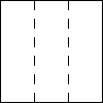
A square is cut into three rectangles along two lines parallel to a side, as shown. If the perimeter of each of the three rectangles is then the area of the original square is
Respuesta: D
Pista pequeña:
Los perímetros iguales obligan a que los anchos de los tres rectángulos sean iguales
Equal perimeters force the three rectangle widths to be equal
Pista grande:
Expresa el perímetro de un rectángulo con el lado del cuadrado
Express one rectangle’s perimeter using the square’s side length
Solución:
Sea el lado del cuadrado. Cada rectángulo tiene longitud y el mismo perímetro, así que sus anchos son iguales a Entonces por lo que y el área es
Por lo tanto, la respuesta correcta es D.
Let the square have side Since every rectangle has length and the same perimeter, their three widths are equal and are each Thus so and the square’s area is
Thus the correct answer is D.
4.
En la figura, es un trapecio isósceles con y El punto está en , y es el punto medio de la hipotenusa del triángulo rectángulo Entonces
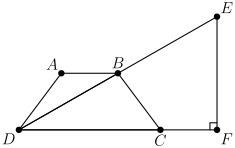
In the figure, is an isosceles trapezoid with side lengths and The point is on and is the midpoint of hypotenuse in the right triangle Then
Respuesta: D
Pista pequeña:
Traza perpendiculares desde y hasta
Drop perpendiculars from and to
Pista grande:
El segmento por el punto medio , paralelo a , llega al punto medio de
The segment through midpoint parallel to reaches the midpoint of
Solución:
Traza y perpendiculares a En el trapecio, y Como es punto medio de y el teorema del punto medio hace que sea punto medio de Así, y
Por lo tanto, la respuesta correcta es D.
Drop perpendiculars and to In the isosceles trapezoid, and Since is the midpoint of and the midpoint theorem makes the midpoint of Hence so and
Thus the correct answer is D.
5.
Se usan palillos iguales para construir la cuadrícula mostrada. Si mide palillos de alto y de ancho, el número de palillos usados es
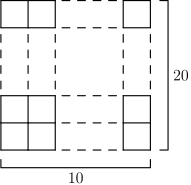
Toothpicks of equal length are used to build a rectangular grid as shown. If the grid is toothpicks high and toothpicks wide, then the number of toothpicks used is
Respuesta: E
Pista pequeña:
Cuenta por separado los palillos horizontales y verticales
Count horizontal and vertical toothpicks separately
Pista grande:
Una cuadrícula de palillos de ancho tiene líneas verticales
A grid toothpicks wide has vertical grid lines
Solución:
Hay líneas verticales con palillos cada una y líneas horizontales con cada una. El total es
Por lo tanto, la respuesta correcta es E.
There are vertical grid lines with toothpicks each, and horizontal grid lines with toothpicks each. The total is
Thus the correct answer is E.
6.
Si y el triángulo del primer cuadrante limitado por los ejes y la gráfica de tiene área entonces
If and the triangle in the first quadrant bounded by the coordinate axes and the graph of has area then
Respuesta: A
Pista pequeña:
Halla las intersecciones de la recta con los ejes
Find the intercepts of the line on the two axes
Pista grande:
Usa las intersecciones como base y altura
Use those intercepts as the base and height of the triangle
Solución:
Las intersecciones son y Así, el área es de donde
Por lo tanto, la respuesta correcta es A.
The intercepts are and Therefore the triangle’s area is which gives
Thus the correct answer is A.
7.
En es una altura y una mediana. Entonces
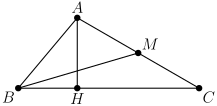
In is an altitude, and is a median. Then
Respuesta: C
Pista pequeña:
Compara los cambios horizontal y vertical de al punto medio
Compare the horizontal and vertical changes from to midpoint
Pista grande:
Ambos son la mitad de los catetos correspondientes del triángulo rectángulo
Both changes are half the corresponding legs of right triangle
Solución:
Como es punto medio de los cambios de a son, en sentido horizontal, y, en sentido vertical, Por tanto, Así,
Por lo tanto, la respuesta correcta es C.
Because is the midpoint of the horizontal change from to is while the vertical change is Thus Hence
Thus the correct answer is C.
8.
¿Para cuántos enteros entre y se factoriza como producto de dos factores lineales con coeficientes enteros?
For how many integers between and does factor into the product of two linear factors with integer coefficients?
Respuesta: D
Pista pequeña:
Escribe los factores como con enteros positivos
Write the factors as with positive integers
Pista grande:
El coeficiente de obliga a que los parámetros difieran en
The coefficient of forces the two integer parameters to differ by
Solución:
La factorización debe ser para algún entero positivo Al desarrollar se obtiene así que Los valores dan mientras que Hay valores.
Por lo tanto, la respuesta correcta es D.
An integer factorization must have the form for some positive integer Expanding gives so The values give while There are values.
Thus the correct answer is D.
9.
El señor y la señora Zeta quieren ponerle nombre a su bebé de modo que su monograma (las iniciales del nombre, el segundo nombre y el apellido) quede en orden alfabético y sin letras repetidas. ¿Cuántos monogramas de este tipo son posibles?
Mr. and Mrs. Zeta want to name their baby Zeta so that its monogram (first, middle, and last initials) will be in alphabetical order with no letters repeated. How many such monograms are possible?
Respuesta: B
Pista pequeña:
La inicial del apellido ya es
The last initial is already fixed as
Pista grande:
Elegir las otras dos letras distintas determina su orden
Choosing the other two distinct letters determines their alphabetical order
Solución:
Las dos primeras iniciales son dos letras distintas elegidas de a Elegidas las letras, el orden queda fijado. Por tanto, el número de monogramas es
Por lo tanto, la respuesta correcta es B.
The first two initials must be two distinct letters chosen from through Once chosen, their order is forced. Therefore the number of monograms is
Thus the correct answer is B.
10.
Considera la sucesión definida por (cualquier número positivo) y ¿Para cuál valor de debe cumplirse ?
Consider the sequence defined recursively by (any positive number), and For which of the following values of must
Respuesta: C
Pista pequeña:
Calcula simbólicamente y
Compute and symbolically
Pista grande:
Busca el período de
Look for the period of the transformation
Solución:
La sustitución directa da La sucesión se repite cada términos, así que cuando Entre las opciones, solo tiene esa forma.
Por lo tanto, la respuesta correcta es C.
Direct substitution gives The sequence therefore repeats every terms, so whenever Among the choices, only has that form.
Thus the correct answer is C.
11.
Sean y enteros con y Si el mayor valor posible de es
Let and be integers with and If the largest possible value for is
Respuesta: A
Pista pequeña:
Maximiza los enteros desde hacia
Maximize the integers from backward to
Pista grande:
Cada desigualdad estricta reduce en el mayor entero permitido
Each strict inequality lowers the greatest allowable integer by
Solución:
Los mayores valores posibles son y finalmente Todos satisfacen las desigualdades, así que el máximo se alcanza.
Por lo tanto, la respuesta correcta es A.
The largest possible values are and finally Each value satisfies its strict inequality, so this maximum is attainable.
Thus the correct answer is A.
12.
En cierta carretera este-oeste, el tránsito va a millas por hora en ambas direcciones. Un conductor hacia el este pasa vehículos hacia el oeste en cinco minutos. Si están igualmente espaciados, ¿qué opción se aproxima al número de vehículos hacia el oeste en un tramo de millas?
The traffic on a certain east-west highway moves at a constant speed of miles per hour in both directions. An eastbound driver passes westbound vehicles in a five-minute interval. Assume vehicles in the westbound lane are equally spaced. Which of the following is closest to the number of westbound vehicles present in a -mile section of highway?
Respuesta: C
Pista pequeña:
La rapidez relativa es la suma de las velocidades
The cars approach one another at the sum of their speeds
Pista grande:
Usa la distancia recorrida a rapidez relativa para hallar el espaciamiento
Use the distance covered at relative speed to find the spacing between westbound vehicles
Solución:
La rapidez relativa es millas por hora, así que en cinco minutos se recorren millas relativas. Pasar vehículos implica espaciamiento milla. Un tramo de millas contiene aproximadamente vehículos.
Por lo tanto, la respuesta correcta es C.
The relative speed is miles per hour, so in five minutes the driver covers relative miles. Passing equally spaced vehicles in that distance means the spacing is about mile. Thus a -mile section contains about vehicles.
Thus the correct answer is C.
13.
Dos franjas de ancho se superponen formando un ángulo . El área de la región sombreada es
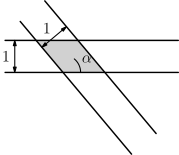
Two strips of width overlap at an angle of as shown. The area of the overlap (shown shaded) is
Respuesta: B
Pista pequeña:
La región es un paralelogramo de altura
The overlap is a parallelogram with altitude
Pista grande:
Si su lado inclinado mide entonces
If its slanted side has length then
Solución:
La región es un paralelogramo. Con el lado inclinado como base, la altura es el ancho de la franja inclinada. Si la base mide su componente vertical da Así, y el área es
Por lo tanto, la respuesta correcta es B.
The overlap is a parallelogram. Taking a slanted side as its base, the perpendicular height is the width of the slanted strip. If that base has length its vertical component is the width of the horizontal strip, so Hence and the area is
Thus the correct answer is B.
14.
Respuesta: B
Pista pequeña:
Reescribe ambos términos con seno y coseno
Rewrite both terms using sine and cosine
Pista grande:
Usa y
Use and
Solución:
Usando El numerador común es Como este numerador es y la expresión es
Por lo tanto, la respuesta correcta es B.
Using Combining the fractions gives numerator Since this numerator is and the expression is
Thus the correct answer is B.
15.
En y está en con Halla
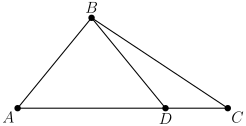
In and is on with Find the ratio
Respuesta: E
Pista pequeña:
Sea y
Let and
Pista grande:
Aplica el teorema de Stewart a la ceviana
Apply Stewart’s Theorem to cevian
Solución:
Sea y Stewart da Al simplificar, así que Entonces y
Por lo tanto, la respuesta correcta es E.
Let and Stewart’s Theorem gives Simplifying yields so Then and
Thus the correct answer is E.
16.
Un punto reticular es un punto del plano cuyas coordenadas son enteras. ¿Cuántos puntos reticulares hay en el segmento cuyos extremos son y ? (Incluye ambos extremos del segmento en el conteo.)
A lattice point is a point in the plane with integer coordinates. How many lattice points are on the line segment whose endpoints are and (Include both endpoints of the segment in your count.)
Respuesta: B
Pista pequeña:
Calcula las diferencias entre las coordenadas horizontales y verticales
Compute the horizontal and vertical coordinate differences
Pista grande:
Un segmento con diferencias contiene puntos reticulares
A segment with differences contains lattice points
Solución:
Las diferencias entre las coordenadas son y cuyo máximo común divisor es Por tanto, el número de puntos reticulares, incluidos ambos extremos, es
Por tanto, la respuesta correcta es B.
The coordinate differences are and whose greatest common divisor is The number of lattice points, including both endpoints, is therefore
Thus the correct answer is B.
17.
El perímetro de un triángulo equilátero supera en cm el perímetro de un cuadrado. La longitud de cada lado del triángulo supera en cm la longitud de cada lado del cuadrado. El perímetro del cuadrado es mayor que ¿Cuántos enteros positivos no son valores posibles de ?
The perimeter of an equilateral triangle exceeds the perimeter of a square by cm. The length of each side of the triangle exceeds the length of each side of the square by cm. The square has perimeter greater than How many positive integers are not possible values for
infinitos
infinitely many
Respuesta: D
Pista pequeña:
Sea la longitud del lado del cuadrado
Let the square’s side length be
Pista grande:
Traduce la condición de perímetro positivo en una desigualdad estricta para
Translate the positive-perimeter condition into a strict inequality for
Solución:
Si el cuadrado tiene lado el triángulo tiene lado La condición sobre los perímetros da por lo que La condición equivale a Por tanto, los enteros positivos del al son precisamente los valores imposibles.
Por tanto, la respuesta correcta es D.
If the square has side the triangle has side The perimeter condition gives so The condition is equivalent to Thus the positive integers through are precisely the impossible values.
Thus the correct answer is D.
18.
El conjunto de todos los números reales para los que es un número racional es el conjunto de todos los
The set of all real numbers for which is a rational number is the set of all
enteros
integers
racionales
rational
reales
real
para los cuales es racional
for which is rational
para los cuales es racional
for which is rational
Respuesta: B
Pista pequeña:
Racionaliza el término recíproco
Rationalize the reciprocal term
Pista grande:
El conjugado es el recíproco del denominador
The conjugate is the reciprocal of the denominator
Solución:
Al racionalizar se obtiene Por tanto, la expresión completa es Es racional exactamente cuando es racional.
Por tanto, la respuesta correcta es B.
Rationalizing gives The entire expression is therefore It is rational exactly when is rational.
Thus the correct answer is B.
19.
Un triángulo está inscrito en un círculo. Los vértices del triángulo dividen el círculo en tres arcos de longitudes y ¿Cuál es el área del triángulo?
A triangle is inscribed in a circle. The vertices of the triangle divide the circle into three arcs of lengths and What is the area of the triangle?
Respuesta: E
Pista pequeña:
La circunferencia mide así que primero halla el radio y los tres ángulos centrales
The circumference is so first find the radius and the three central angles
Pista grande:
Divide el triángulo en tres triángulos que tengan el centro del círculo como vértice común
Split the triangle into three triangles having the circle’s center as a common vertex
Solución:
El radio es Las longitudes de arco dan los ángulos centrales La suma de sus senos es Al dividir el triángulo desde el centro, su área es
Por tanto, la respuesta correcta es E.
The radius is The arc lengths give central angles Their sines sum to Splitting the triangle at the center, its area is
Thus the correct answer is E.
20.
Sea un número real elegido uniformemente al azar entre y Si halla la probabilidad de que ( es el mayor entero menor o igual que )
Let be a real number selected uniformly at random between and If find the probability that ( means the greatest integer less than or equal to )
Respuesta: B
Pista pequeña:
Convierte cada condición de parte entera en un intervalo para
Convert each floor condition into an interval for
Pista grande:
La probabilidad condicional es la razón entre las longitudes de los dos intervalos pertinentes
The conditional probability is the ratio of the two relevant interval lengths
Solución:
La condición dada es un intervalo de longitud La condición deseada es o Su longitud es por lo que la probabilidad condicional es
Por tanto, la respuesta correcta es B.
The given condition is an interval of length The desired condition is or Its length is so the conditional probability is
Thus the correct answer is B.
21.
Una bandera cuadrada tiene, sobre un fondo blanco, una cruz roja de anchura uniforme con un cuadrado azul en el centro, como se muestra. (La cruz es simétrica respecto de cada diagonal del cuadrado.) Si la cruz completa (tanto los brazos rojos como el centro azul) ocupa el del área de la bandera, ¿qué porcentaje del área de la bandera es azul?
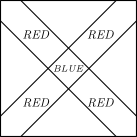
A square flag has a red cross of uniform width with a blue square in the center on a white background as shown. (The cross is symmetric with respect to each of the diagonals of the square.) If the entire cross (both the red arms and the blue center) takes up of the area of the flag, what percent of the area of the flag is blue?
Respuesta: C
Pista pequeña:
Sea la mitad de una diagonal del cuadrado azul central después de escalar el lado de la bandera a
Let be half a diagonal of the central blue square after scaling the flag side to
Pista grande:
Los cuatro triángulos blancos de las esquinas tienen área total
The four white corner triangles together have area
Solución:
Escala la bandera a un cuadrado unitario y sea la distancia horizontal desde su centro hasta un vértice del cuadrado azul. Los cuatro triángulos blancos congruentes de las esquinas tienen área total Como la cruz ocupa Con esto da El cuadrado azul tiene diagonales perpendiculares de longitudes y por lo que su área es es decir, el del área de la bandera.
Por tanto, la respuesta correcta es C.
Scale the flag to a unit square, and let be the horizontal distance from its center to a vertex of the blue square. The four congruent white corner triangles have total area Since the cross occupies With this gives The blue square has perpendicular diagonals and so its area is or of the flag.
Thus the correct answer is C.
22.
Un niño tiene un conjunto de bloques distintos. Cada bloque es de uno de materiales (plástico, madera), uno de tamaños (pequeño, mediano, grande), uno de colores (azul, verde, rojo, amarillo) y una de formas (círculo, hexágono, cuadrado, triángulo). ¿Cuántos bloques del conjunto difieren del «círculo rojo mediano de plástico» exactamente en dos aspectos? (El «cuadrado rojo mediano de madera» es uno de ellos.)
A child has a set of distinct blocks. Each block is one of materials (plastic, wood), sizes (small, medium, large), colors (blue, green, red, yellow), and shapes (circle, hexagon, square, triangle). How many blocks in the set are different from the “plastic medium red circle” in exactly two ways? (The “wood medium red square” is such a block.)
Respuesta: A
Pista pequeña:
Para cada atributo, cuenta las alternativas distintas de las del bloque especificado
For each attribute, count the alternatives different from the specified block
Pista grande:
Elige un par de atributos para cambiar y multiplica sus cantidades de alternativas
Choose a pair of attributes to change, then multiply their alternative counts
Solución:
Las cantidades de alternativas para el material, el tamaño, el color y la forma son Al cambiar exactamente dos atributos se obtiene
Por tanto, la respuesta correcta es A.
The numbers of alternatives for material, size, color, and shape are Changing exactly two attributes gives
Thus the correct answer is A.
23.
Una partícula se mueve por el primer cuadrante de la siguiente manera. Durante el primer minuto se desplaza desde el origen hasta Después sigue las direcciones indicadas en la figura, yendo de un lado a otro entre los semiejes positivos e , y en cada minuto recorre una unidad de distancia paralela a un eje. ¿En qué punto estará la partícula después de exactamente minutos?
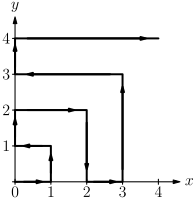
A particle moves through the first quadrant as follows. During the first minute it moves from the origin to Thereafter, it continues to follow the directions indicated in the figure, going back and forth between the positive and axes, moving one unit of distance parallel to an axis in each minute. At which point will the particle be after exactly minutes?
Respuesta: D
Pista pequeña:
Anota la posición de la partícula en los tiempos
Record the particle’s location at times
Pista grande:
Compara con los cuadrados consecutivos y
Compare with the consecutive squares and
Solución:
En el tiempo la partícula está en si es impar y en si es par. Por tanto, en el tiempo está en Luego se mueve unidades hacia la derecha, llega a en el tiempo y se desplaza hacia abajo durante los siguientes minutos. Por consiguiente, en el tiempo está en
Por tanto, la respuesta correcta es D.
At time the particle is at for odd and at for even Thus at time it is at It then moves units right, reaching at time and moves downward for the next minutes. At time it is therefore at
Thus the correct answer is D.
24.
Cinco personas están sentadas alrededor de una mesa redonda. Sea el número de personas sentadas junto a por lo menos una mujer y sea el número de personas sentadas junto a por lo menos un hombre. El número de pares ordenados posibles es
Five people are sitting at a round table. Let be the number of people sitting next to at least one female and be the number of people sitting next to at least one male. The number of possible ordered pairs is
Respuesta: B
Pista pequeña:
Clasifica las distribuciones según el número de mujeres
Classify arrangements by the number of females
Pista grande:
Con dos mujeres, separa los casos en que están juntas y en que no son adyacentes; obtén los casos con tres mujeres por simetría
With two females, separate the adjacent and nonadjacent cases; obtain three-female cases by symmetry
Solución:
Para mujeres, los pares posibles son, respectivamente, donde los dos casos con dos mujeres distinguen si están juntas o no son adyacentes. Al intercambiar los sexos se obtiene Estos son pares ordenados distintos.
Por tanto, la respuesta correcta es B.
For females, the possible pairs are respectively where the two-female cases distinguish adjacent from nonadjacent females. Swapping the sexes gives These are distinct ordered pairs.
Thus the correct answer is B.
25.
En cierta competencia de campo traviesa entre dos equipos de cinco corredores cada uno, quien termina en la posición aporta puntos a su equipo. Gana el equipo con la puntuación más baja. Si no hay empates entre los corredores, ¿cuántas puntuaciones ganadoras distintas son posibles?
In a certain cross-country meet between two teams of five runners each, a runner who finishes in the th position contributes to his team’s score. The team with the lower score wins. If there are no ties among the runners, how many different winning scores are possible?
Respuesta: B
Pista pequeña:
Las puntuaciones de los dos equipos suman
The two team scores add to
Pista grande:
Determina la puntuación ganadora mínima y verifica que se puede obtener cada entero menor que la mitad del total
Determine the minimum winning score and verify that every integer below half the total is attainable
Solución:
Las dos puntuaciones suman así que la puntuación ganadora es a lo sumo Su mínimo es Cada puntuación del al se obtiene con para Las puntuaciones del al se obtienen con para y las puntuaciones se obtienen con y Por tanto, son posibles los enteros del al
Por tanto, la respuesta correcta es B.
The two scores sum to so the winning score is at most Its minimum is Every score from through is obtained by for Scores through use for and use and Thus all integers from through are possible.
Thus the correct answer is B.
26.
Se forma un octaedro regular uniendo los centros de las caras adyacentes de un cubo. La razón entre el volumen del octaedro y el volumen del cubo es
A regular octahedron is formed by joining the centers of adjoining faces of a cube. The ratio of the volume of the octahedron to the volume of the cube is
Respuesta: C
Pista pequeña:
Escala el cubo para que tenga arista y sitúa su centro en el origen
Scale the cube to side length and place its center at the origin
Pista grande:
El octaedro tiene vértices
The octahedron has vertices
Solución:
Toma un cubo de arista cuyo volumen es Los centros de las caras son En cada octante, el octaedro recorta un tetraedro con tres aristas unitarias perpendiculares y volumen Así, su volumen es y la razón es
Por tanto, la respuesta correcta es C.
Take a cube of side so its volume is The face centers are In each octant, the octahedron cuts out a tetrahedron with three perpendicular unit edges and volume Thus its volume is and the ratio is
Thus the correct answer is C.
27.
Sea un entero positivo. Si la ecuación tiene soluciones en enteros positivos y entonces debe ser
Let be a positive integer. If the equation has solutions in positive integers and then must be either
o
or
o
or
o
or
o
or
o
or
Respuesta: D
Pista pequeña:
Agrupa las soluciones según
Group solutions according to
Pista grande:
Para un fijo, cuenta los pares ordenados positivos y exige que
For fixed count the positive ordered pairs and require
Solución:
Para hay pares ordenados positivos y es positivo cuando Si escribimos el número de soluciones es Al igualarlo a se obtiene Por tanto, así que o
Por tanto, la respuesta correcta es D.
For there are positive ordered pairs and is positive when Writing the number of solutions is Setting this equal to gives Hence so or
Thus the correct answer is D.
28.
Halla la suma de las raíces de que están entre y radianes.
Find the sum of the roots of that are between and radians.
Respuesta: D
Pista pequeña:
En , sean y las dos raíces positivas
Let the two positive roots in be and
Pista grande:
Usa para relacionar y luego incluye el período de la tangente
Use to relate then include the period of tangent
Solución:
Las dos raíces de son positivas y satisfacen Por tanto, la suma de sus arcotangentes agudas es Cada valor de la tangente aparece dos veces entre y con la segunda aparición desplazada en La suma de las cuatro raíces es
Por tanto, la respuesta correcta es D.
The two roots of are positive and satisfy Therefore their acute arctangents add to Each tangent value occurs twice between and with the second occurrence shifted by The sum of all four roots is
Thus the correct answer is D.
29.
Halla donde
Find where
Respuesta: B
Pista pequeña:
Reconoce como
Recognize as
Pista grande:
Toma la parte real del desarrollo binomial de
Take the real part of the binomial expansion of
Solución:
La suma es la parte real de Como su parte real es
Por tanto, la respuesta correcta es B.
The sum is the real part of Since its real part is
Thus the correct answer is B.
30.
Supongamos que niños y niñas se forman en una fila. Sea el número de lugares de la fila en los que un niño y una niña están uno al lado del otro. Por ejemplo, para la fila tenemos El valor promedio de (si se consideran todos los órdenes posibles de estas personas) es más cercano a
Suppose that boys and girls line up in a row. Let be the number of places in the row where a boy and a girl are standing next to each other. For example, for the row we have The average value of (if all possible orders of these people are considered) is closest to
Respuesta: A
Pista pequeña:
Usa un indicador para cada uno de los pares de posiciones adyacentes
Use an indicator for each of the adjacent pairs
Pista grande:
Para un par de posiciones adyacentes fijo, calcula la probabilidad de obtener o
For a fixed adjacent pair, compute the probability of seeing or
Solución:
Para cada uno de los pares de posiciones adyacentes, la probabilidad de que los sexos sean distintos es Por la linealidad de la esperanza, que es más cercano a
Por tanto, la respuesta correcta es A.
For each of the adjacent position pairs, the probability of mixed sexes is By linearity of expectation, which is closest to
Thus the correct answer is A.