
1981 AMC 12 Problema 20
Intenta el Problema 20 del 1981 AMC 12 a continuación y luego compara tu respuesta con la solución preparada profesionalmente de LIVE by Po-Shen Loh. También puedes intentar el examen cronometrado completo, ver todas las soluciones del 1981 AMC 12, o revisar la clave de respuestas.
Todos los problemas se usan con el permiso legal oficial de la Mathematical Association of America (MAA).
20.
Un rayo de luz parte del punto y viaja en un plano, reflejándose veces entre las rectas y antes de incidir perpendicularmente en un punto (que puede estar en o ) y volver sobre su trayectoria hasta (En cada punto de reflexión, el rayo forma dos ángulos iguales, como se indica en la figura adjunta. La figura muestra la trayectoria para ) Si ¿cuál es el mayor valor que puede tener ?
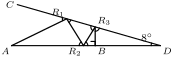
A ray of light originates from point and travels in a plane, being reflected times between lines and before striking a point (which may be on or ) perpendicularly and retracing its path to (At each point of reflection the light makes two equal angles as indicated in the adjoining figure. The figure shows the light path for ) If what is the largest value can have?
No existe un valor máximo.
There is no largest value.
Respuesta: B
Pista pequeña:
Sigue el ángulo agudo entre el rayo y cada recta reflectora sucesiva
Track the acute angle between the ray and each successive reflecting line
Pista grande:
Cada reflexión aumenta ese ángulo en el ángulo de la cuña,
Each reflection advances that angle by the wedge angle
Solución:
Sea el ángulo agudo inicial entre el rayo y Las relaciones sucesivas entre ángulos exteriores aumentan el ángulo agudo correspondiente en con cada reflexión. En la incidencia perpendicular final, Así, por lo que El mayor entero posible es alcanzado cuando
Por lo tanto, la respuesta correcta es B.
Let be the initial acute angle between the ray and Successive exterior-angle relations increase the corresponding acute angle by at each reflection. At the final perpendicular strike, Thus so The greatest integer possible is attained when
Therefore, the correct answer is B.
El Problema 20 en otros años
- 1950 AMC 12
- 1951 AMC 12
- 1952 AMC 12
- 1953 AMC 12
- 1954 AMC 12
- 1955 AMC 12
- 1956 AMC 12
- 1957 AMC 12
- 1958 AMC 12
- 1959 AMC 12
- 1960 AMC 12
- 1961 AMC 12
- 1962 AMC 12
- 1963 AMC 12
- 1964 AMC 12
- 1965 AMC 12
- 1966 AMC 12
- 1967 AMC 12
- 1968 AMC 12
- 1969 AMC 12
- 1970 AMC 12
- 1971 AMC 12
- 1972 AMC 12
- 1973 AMC 12
- 1974 AMC 12
- 1975 AMC 12
- 1976 AMC 12
- 1977 AMC 12
- 1978 AMC 12
- 1979 AMC 12
- 1980 AMC 12
- 1982 AMC 12
- 1983 AMC 12
- 1984 AMC 12
- 1985 AMC 12
- 1986 AMC 12
- 1987 AMC 12
- 1988 AMC 12
- 1989 AMC 12
- 1990 AMC 12
- 1991 AMC 12
- 1992 AMC 12
- 1993 AMC 12
- 1994 AMC 12
- 1995 AMC 12
- 1996 AMC 12
- 1997 AMC 12
- 1998 AMC 12
- 1999 AMC 12
- 2000 AMC 12
- 2001 AMC 12
- 2002 AMC 12A
- 2002 AMC 12B
- 2003 AMC 12A
- 2003 AMC 12B
- 2004 AMC 12A
- 2004 AMC 12B
- 2005 AMC 12A
- 2005 AMC 12B
- 2006 AMC 12A
- 2006 AMC 12B
- 2007 AMC 12A
- 2007 AMC 12B
- 2008 AMC 12A
- 2008 AMC 12B
- 2009 AMC 12A
- 2009 AMC 12B
- 2010 AMC 12A
- 2010 AMC 12B
- 2011 AMC 12A
- 2011 AMC 12B
- 2012 AMC 12A
- 2012 AMC 12B
- 2013 AMC 12A
- 2013 AMC 12B
- 2014 AMC 12A
- 2014 AMC 12B
- 2015 AMC 12A
- 2015 AMC 12B
- 2016 AMC 12A
- 2016 AMC 12B
- 2017 AMC 12A
- 2017 AMC 12B
- 2018 AMC 12A
- 2018 AMC 12B
- 2019 AMC 12A
- 2019 AMC 12B
- 2020 AMC 12A
- 2020 AMC 12B
- 2021 AMC 12A Spring
- 2021 AMC 12B Spring
- 2021 AMC 12A Fall
- 2021 AMC 12B Fall
- 2022 AMC 12A
- 2022 AMC 12B
- 2023 AMC 12A
- 2023 AMC 12B
- 2024 AMC 12A
- 2024 AMC 12B
- 2025 AMC 12A
- 2025 AMC 12B