
1970 AMC 12 Problema 30
Intenta el Problema 30 del 1970 AMC 12 a continuación y luego compara tu respuesta con la solución preparada profesionalmente de LIVE by Po-Shen Loh. También puedes intentar el examen cronometrado completo, ver todas las soluciones del 1970 AMC 12, o revisar la clave de respuestas.
Todos los problemas se usan con el permiso legal oficial de la Mathematical Association of America (MAA).
30.
En la figura adjunta, los segmentos y son paralelos, la medida del ángulo es el doble de la del ángulo y las longitudes de los segmentos y son y respectivamente. Entonces la longitud de es igual a:
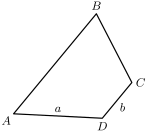
In the accompanying figure, segments and are parallel, the measure of angle is twice that of angle and the measures of segments and are and respectively. Then the measure of is equal to:
Respuesta: E
Pista pequeña:
Biseca el ángulo y haz que la bisectriz corte a en
Bisect angle and let the bisector meet at
Pista grande:
La persecución de ángulos muestra que es isósceles, mientras que es un paralelogramo
Angle chasing makes isosceles, while is a parallelogram
Solución:
Sea el punto donde la bisectriz de corta a Como cada mitad tiene medida Puesto que el ángulo interior alterno también es igual a Así, el triángulo es isósceles y Además, y por lo que es un paralelogramo. Entonces Por lo tanto,
Por lo tanto, la respuesta correcta es E.
Let the bisector of meet at Because each half has measure Since the alternate interior angle also equals Thus triangle is isosceles and Also and so is a parallelogram. Hence Therefore
Therefore, the correct answer is E.
El Problema 30 en otros años
- 1950 AMC 12
- 1951 AMC 12
- 1952 AMC 12
- 1953 AMC 12
- 1954 AMC 12
- 1955 AMC 12
- 1956 AMC 12
- 1957 AMC 12
- 1958 AMC 12
- 1959 AMC 12
- 1960 AMC 12
- 1961 AMC 12
- 1962 AMC 12
- 1963 AMC 12
- 1964 AMC 12
- 1965 AMC 12
- 1966 AMC 12
- 1967 AMC 12
- 1968 AMC 12
- 1969 AMC 12
- 1971 AMC 12
- 1972 AMC 12
- 1973 AMC 12
- 1974 AMC 12
- 1975 AMC 12
- 1976 AMC 12
- 1977 AMC 12
- 1978 AMC 12
- 1979 AMC 12
- 1980 AMC 12
- 1981 AMC 12
- 1982 AMC 12
- 1983 AMC 12
- 1984 AMC 12
- 1985 AMC 12
- 1986 AMC 12
- 1987 AMC 12
- 1988 AMC 12
- 1989 AMC 12
- 1990 AMC 12
- 1991 AMC 12
- 1992 AMC 12
- 1993 AMC 12
- 1994 AMC 12
- 1995 AMC 12
- 1996 AMC 12
- 1997 AMC 12
- 1998 AMC 12
- 1999 AMC 12